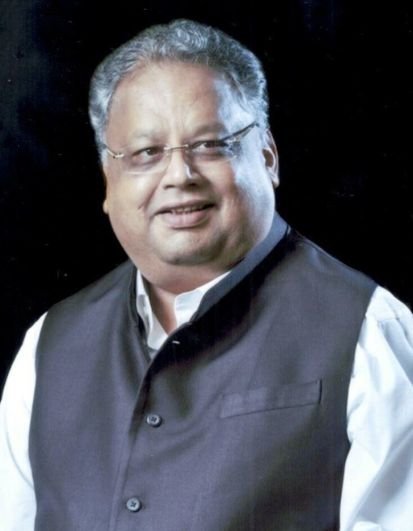
By PIB Mumbai – Photo, GODL-India, Source, Wikimedia Commons
Rakesh Jhunjhunwala was born on July 5, 1960, in Hyderabad, India, into a middle-class Rajasthani family. His father worked as an Income Tax Officer, which meant that financial discussions were common in their household. Unlike most Indian families of the time, where conversations largely revolved around careers in medicine, engineering, or government jobs, the Jhunjhunwala household frequently touched upon topics such as tax policies, the state of the Indian economy, and stock market trends. These early conversations sowed the seeds of curiosity in young Rakesh’s mind.
Growing up in a modest home during the economically challenging decades of the 1960s and 1970s, he developed a keen sense of value for money and an appreciation of financial discipline. India, during his childhood, was navigating a path of socialist policies and the License Raj, where growth was restricted and opportunities were limited. For a young boy with entrepreneurial instincts, the environment appeared restrictive, yet it fueled his imagination about what could be possible in the future of Indian business and markets.
Rakesh’s father often read newspapers that carried updates on the Bombay Stock Exchange (BSE), and this caught his attention. Curious about the mysterious fluctuations of share prices, Rakesh asked his father why stock prices moved up and down. His father’s simple reply—“Look at the news, look at the economy, and you will understand”—was enough to ignite a spark that would never fade. By the time he was in his teenage years, he had already developed an unusual fascination with the financial world, often spending hours listening to stories of market movements and company news.
Jhunjhunwala pursued a Bachelor’s degree in Commerce from Sydenham College, Mumbai, one of India’s most respected commerce institutions. This was a crucial stage of his intellectual formation. At Sydenham, he not only built a solid foundation in accounting, economics, and finance but also had the opportunity to be in Mumbai—the financial capital of India and home to the Bombay Stock Exchange.
Being in Mumbai exposed him to the buzz of Dalal Street. While his peers focused on preparing for stable careers in banking, auditing, or government service, Rakesh spent much of his free time learning about stock markets, following companies, and engaging in discussions with brokers and investors. His ambitions were far from conventional—he wanted to create wealth through investing rather than settle for a fixed-income job.
After Sydenham College, Rakesh enrolled in the Institute of Chartered Accountants of India (ICAI) and became a Chartered Accountant in 1985. The rigorous CA program honed his ability to analyze balance sheets, cash flows, and business models. He gained an appreciation for the importance of corporate governance, financial discipline, and compliance—all of which would later influence his investment style.
While completing his CA, Rakesh also tracked the market more actively. He closely followed the BSE Sensex, which was then still a relatively small index. He developed a belief that the Indian economy, despite its structural inefficiencies, would eventually unleash massive growth potential. This conviction gave him the courage to start investing right after qualifying as a CA instead of pursuing a conventional accounting career.
Unlike many wealthy investors who started with family money, Rakesh’s journey was humble. He began his investment career in 1985 with just ₹5,000, borrowed from his elder brother. He promised to return the money with higher returns than a fixed deposit—a bold promise, given that the stock market was widely considered a gamble by most Indians at the time.
The Bombay Stock Exchange then was very different from the electronic systems of today. Trades were carried out manually, and information was scarce. Investing required not only courage but also a network of trustworthy contacts. With his strong interest and financial acumen, Rakesh quickly built connections among brokers and traders, immersing himself in the world of equities.
It is important to understand the India of the 1980s to appreciate Jhunjhunwala’s risk-taking. The Indian economy was still heavily regulated under the License Raj. The stock market was small, illiquid, and dominated by a handful of influential players. For an ordinary middle-class individual to step into such a world with just ₹5,000 required not only ambition but also extraordinary conviction.
Most of his peers and relatives considered his choice unconventional, even reckless. Government jobs and steady corporate roles were seen as the only safe paths to a respectable life. But Rakesh was not deterred. He was driven by a vision that India’s economy would one day open up, and those who participated early in its financial markets would be the biggest beneficiaries.
His first major profit came in 1986 when he bought 5,000 shares of Tata Tea at ₹43 per share and sold them at ₹143 within just a few months. The trade netted him over ₹3 lakh—a massive sum compared to his modest beginnings. This early win gave him not only financial confidence but also credibility in the market. It proved that his ideas and instincts were sound, and it encouraged him to pursue investing full-time.
By the time he completed his Chartered Accountancy, he had already realized that his future lay not in auditing or consulting but in the thrill and challenge of the stock market. His early successes planted the foundation for what would later become a legendary career, making him one of India’s most celebrated investors.
By the mid-1980s, Rakesh Jhunjhunwala had transformed from a curious child in Hyderabad to a budding investor in Mumbai. Armed with a Chartered Accountant’s analytical skills, the confidence of early successes, and an unshakable belief in India’s future, he stood ready to begin his journey toward becoming the ‘Big Bull of Dalal Street.’
After his initial success with Tata Tea in 1986, Rakesh Jhunjhunwala quickly developed a reputation as a daring yet insightful trader on Dalal Street. He was not afraid to take bold bets, provided his research and conviction supported them. In those days, the Bombay Stock Exchange (BSE) was a place of open outcry, where information was often scarce and controlled by brokers and market operators. Navigating this environment required not only financial acumen but also people skills, networking, and courage. Jhunjhunwala excelled in all three.
His next major profit came from buying Sesa Goa, an iron ore mining company. In the late 1980s, the stock was trading at around ₹20–₹25 per share. With demand for commodities rising, Jhunjhunwala saw potential others overlooked. Within a few years, Sesa Goa’s share price multiplied, bringing him substantial gains. By the early 1990s, he had already built a reputation as a young investor with an uncanny ability to spot undervalued opportunities.
The late 1980s and early 1990s were turbulent times for Indian markets. The Harshad Mehta scam of 1992 created massive volatility, wiping out fortunes overnight. While many traders were ruined, Jhunjhunwala’s cautious optimism and contrarian approach helped him weather the storm. He diversified his investments and avoided reckless leverage. When others panicked, he selectively bought into strong companies whose fundamentals remained intact.
This resilience during one of India’s most notorious financial scandals cemented his reputation as not just a lucky speculator but a disciplined investor with nerves of steel. He often remarked later in his career: “The market rewards those who endure pain and stay the course.”
In the early 1990s, Rakesh Jhunjhunwala formalized his investment journey by setting up RARE Enterprises, named after the initials of himself (RA) and his wife Rekha (RE). Unlike hedge funds or mutual funds, RARE Enterprises was a privately held asset management firm that managed Jhunjhunwala’s personal wealth. It became the vehicle through which he made most of his legendary investments.
Through RARE Enterprises, he diversified his portfolio across multiple sectors—consumer goods, pharmaceuticals, banking, infrastructure, and technology. His philosophy was simple: identify businesses with scalable models, trustworthy management, and the potential to grow in India’s expanding economy. RARE soon became one of the most closely watched investment firms in the country, with every move by Jhunjhunwala sparking media coverage and retail investor curiosity.
Among his closest allies in the market was Radhakishan Damani, the founder of D-Mart (Avenue Supermarts). Their friendship was built on mutual respect, complementary styles, and shared convictions. While Damani was known for his cautious, long-term approach, Jhunjhunwala had a more aggressive, risk-taking personality. Together, they formed one of the most respected duos in Indian investing.
During the Harshad Mehta era, both Damani and Jhunjhunwala were among the few investors who spotted the irrational exuberance and stayed cautious. Their ability to remain calm and focused during chaos distinguished them from the herd. Later, they would continue to exchange ideas and support each other’s ventures. Jhunjhunwala often credited Damani as one of his biggest mentors and inspirations.
While equities remained his first love, Jhunjhunwala gradually expanded his interests beyond the stock market. He invested in real estate, private equity, and startups. His philosophy was that India’s growth story extended beyond listed companies, and he wanted to be a part of it all. This diversification also helped balance his portfolio and gave him access to emerging opportunities before they reached the public markets.
Unlike many investment firms that kept a low profile, RARE Enterprises was known for its transparency and active engagement with the media. Jhunjhunwala frequently gave interviews, openly sharing his market views, predictions, and even his mistakes. This honesty made him a beloved figure among retail investors, who saw him as approachable and relatable. He was not just an investor; he was a storyteller, a motivator, and a mentor for millions.
Jhunjhunwala’s career coincided with several bull markets in India: the IT boom of the late 1990s, the infrastructure wave of the mid-2000s, and the post-2008 recovery fueled by global liquidity. In each cycle, he demonstrated an uncanny ability to spot themes early and position himself accordingly. Unlike many traders who chased momentum, he combined trading for liquidity with long-term bets on businesses he believed in.
His bullishness on India was unwavering. He often declared: “The mother of all bull markets is still ahead of India.” This optimism inspired confidence in countless investors who looked to him for guidance during volatile times.
No career in the markets is without setbacks, and Jhunjhunwala was no exception. He faced losses during bear phases, such as the 2008 global financial crisis, but his resilience always brought him back stronger. He believed losses were part of the game and often said: “I may lose money, but I will never lose conviction.” His ability to learn from mistakes and move on made him one of the most respected figures in finance.
By the early 2000s, Rakesh Jhunjhunwala had evolved from a small-time investor with ₹5,000 into the undisputed ‘Big Bull of Dalal Street.’ His journey was defined not only by financial success but also by resilience, mentorship, and an unshakable belief in India’s future.
Rakesh Jhunjhunwala often credited Warren Buffett as an inspiration but was quick to clarify: “I am not a clone of Buffett. I like to take more risks. I enjoy the excitement of the market.” While Buffett avoided trading and speculative moves, Jhunjhunwala thrived on them, balancing short-term liquidity with long-term conviction. His philosophy was not about imitating Western investors but about adapting global wisdom to the unique context of Indian markets, which were often more volatile, less mature, and more sentiment-driven than developed economies.
Jhunjhunwala’s philosophy came alive through his legendary investments. Titan, CRISIL, Lupin, and NCC became household examples of multi-baggers. In Titan’s case, he held on despite skepticism from others, because he believed India’s rising middle class would spend more on jewelry and watches. CRISIL demonstrated his foresight in understanding the financial infrastructure India needed as its economy liberalized. Lupin reflected his vision for the pharmaceutical sector’s global expansion. Each investment carried his hallmark—bold conviction backed by deep analysis.
One of his most famous traits was his contrarian streak. He often said: “Always go against tide. Buy when others are selling and sell when others are buying.” During the 2001 market crash after the Ketan Parekh scam, while most investors were fleeing equities, Jhunjhunwala was buying aggressively. This courage paid off when the market rebounded, turning him into a legend.
Similarly, during the 2008 global financial crisis, when panic gripped Dalal Street, he kept faith in India’s long-term growth and bought selectively. His ability to withstand short-term fear and focus on long-term opportunity distinguished him from the herd.
Unlike Buffett or Peter Lynch, Jhunjhunwala openly embraced trading as part of his arsenal. He viewed trading not as speculation but as a way to generate liquidity. He once said: “Trading is my bread and butter, investing is my passion.” This dual strategy gave him flexibility: profits from short-term trades funded his long-term bets, ensuring he could stay invested without worrying about cash flow.
This approach also reflected his pragmatic understanding of Indian markets. He knew volatility could be exploited for quick gains without compromising long-term positions. It was this combination of trading and investing that made him unique among global investing legends.
Jhunjhunwala earned the nickname “The Big Bull of Dalal Street” because of his unwavering optimism about India. He consistently predicted that India was on the cusp of becoming an economic superpower, and that equities would be the best vehicle to ride this growth. His bullishness was not blind—it was grounded in analysis of demographics, consumption trends, and policy reforms. He often said, “The mother of all bull runs is yet to come in India,” a phrase that became synonymous with his brand of optimism.
Despite his optimism, he was not reckless. He acknowledged that risk was part of the game but believed it could be managed. His famous line was: “In investing, you don’t need to be a genius. What you need is patience and discipline.” He accepted losses gracefully, treating them as tuition fees paid to the market. He openly discussed his failed bets—such as DHFL—proving that even the best investors make mistakes. What mattered was not avoiding losses entirely but ensuring that winners outpaced losers.
Beyond his personal wealth, Jhunjhunwala’s greatest contribution was cultural. In the 1980s and 1990s, investing in India was viewed with suspicion. Many considered it equivalent to gambling. Jhunjhunwala helped change that perception. Through his media appearances, interviews, and seminars, he became the face of disciplined investing. His success stories inspired millions of middle-class Indians to look at equities not as speculation but as a legitimate path to wealth creation.
He also mentored numerous young investors and traders, generously sharing his knowledge. For many, simply listening to his interviews or reading about his trades became an education. He helped democratize market wisdom in a country where financial literacy was low.
Over time, Jhunjhunwala’s voice carried influence beyond markets. Policymakers respected his insights on India’s economy and growth prospects. He often advocated for reforms, transparency, and investor-friendly policies. His bullish stance on India was not just rhetoric; it aligned with his broader vision of India as a hub of global capital.
Through his philosophy, Rakesh Jhunjhunwala not only built a multi-billion-dollar fortune but also transformed India’s investment culture. He proved that conviction, patience, and courage—when combined with research and discipline—could create extraordinary wealth in one of the world’s most volatile markets.
One of the most remarkable aspects of Rakesh Jhunjhunwala’s life is the sheer scale of wealth creation. Beginning in 1985 with just ₹5,000, borrowed from his brother, he went on to build a fortune worth over $5.8 billion (₹40,000+ crore) by the time of his death in 2022. This meteoric rise from modest beginnings to becoming one of India’s richest men is not only inspirational but also a testament to the power of conviction and compounding.
His journey embodied the classic Indian dream: a middle-class boy with education, ambition, and courage who turned into a national icon through sheer belief in himself and in India’s future. Every bull market, every contrarian trade, and every long-term bet added another chapter to his story of transformation.
Jhunjhunwala’s portfolio through RARE Enterprises included stakes in some of India’s most valuable companies. By the 2010s, his holdings were closely watched by investors, with quarterly updates on his shareholding patterns making headlines. Some of his most notable holdings included:
Each of these investments was not just a stock pick but a story of foresight, conviction, and resilience. Titan, for instance, was mocked by many as a risky bet on consumer luxury. But Jhunjhunwala believed in India’s growing middle class and their aspiration for branded products. His patience turned that bet into a fortune worth billions.
Beyond the stock market, Jhunjhunwala took on one of his boldest ventures in 2021—launching Akasa Air, a low-cost airline. While many questioned the timing, given the pandemic’s devastation of the aviation industry, Jhunjhunwala’s conviction never wavered. He invested over $50 million into the airline, despite being in poor health at the time. His vision was simple: India’s middle class would increasingly travel by air, and a cost-efficient airline could capture enormous demand.
Akasa Air began operations in August 2022, just weeks before his death. It was the final testament to his risk-taking spirit—launching a new venture in one of the toughest industries, despite skepticism. “I see a lot of people traveling by air in the next decade. I want to be part of that journey,” he said shortly before the airline’s debut.
By the 2010s, Jhunjhunwala was widely recognized as the “Warren Buffett of India.” This comparison stemmed from his wealth, long-term investments, and inspirational role in popularizing equity culture. However, he always distinguished himself from Buffett, pointing out that he had a higher appetite for risk and a stronger inclination toward trading. Nevertheless, the nickname reflected the respect he commanded globally, with publications like Forbes, Bloomberg, and The Economist covering his story.
Jhunjhunwala was more than an investor; he was also an educator. He regularly appeared in television interviews, investor conferences, and public forums, where he explained his outlook on India and global markets. Unlike many wealthy investors who maintained secrecy, he openly shared his mistakes and learning process. This transparency endeared him to retail investors, who saw him not as an unreachable billionaire but as a relatable guide.
Through his visibility, he normalized equity investing in India. Millions who once considered stock trading as “gambling” began to view it as a legitimate wealth-building tool. His bullish commentary on India’s future gave confidence to a generation of first-time investors.
Even as his wealth grew, Jhunjhunwala remained committed to giving back. He donated extensively to causes such as education, healthcare, and social welfare. Reports suggest that he pledged at least 25% of his wealth to charity. Through the Jhunjhunwala Foundation, he funded hospitals, schools, and initiatives for the underprivileged. He supported institutions such as St. Jude India ChildCare Centres and the Agastya International Foundation.
His philanthropy reflected his philosophy of practical impact rather than symbolic gestures. He believed wealth was meaningful only if it improved the lives of others. Much like his investments, his giving was guided by conviction and long-term thinking.
Jhunjhunwala never shied away from acknowledging his failures. Investments in companies like DHFL and Kingfisher Airlines turned sour, costing him crores. But instead of hiding them, he used them as teaching moments. “Losses are part of the game. The key is to keep your winners riding and cut your losers early,” he would say. This honesty distinguished him from many who only highlighted their successes.
His fame extended beyond India. Global media covered him as a case study in emerging market investing. His philosophy was seen as a bridge between Western value investing principles and the realities of fast-growing economies. International investors admired his courage, optimism, and storytelling ability, which made him one of the few Indian investors known worldwide.
By the late 2010s, Rakesh Jhunjhunwala was no longer just an investor—he was an institution. His achievements extended far beyond wealth. He built credibility for Indian markets, inspired millions of investors, diversified into entrepreneurship with Akasa Air, and gave back generously to society. His milestones defined not just his career, but also an era of Indian capitalism.
Rakesh Jhunjhunwala passed away on August 14, 2022, in Mumbai, at the age of 62. His death came as a shock to millions of Indians who had come to see him not just as a market wizard but as a symbol of India’s rising economic confidence. Tributes poured in from across the spectrum—from the Prime Minister of India to global investors, from business leaders to ordinary retail investors whose journeys began with his inspiration. His passing left a void on Dalal Street, but his influence continued to live on in the portfolios, philosophies, and dreams of those he inspired.
Perhaps Jhunjhunwala’s greatest contribution was cultural. In the 1980s and 1990s, investing in equities in India was widely seen as gambling. Families discouraged their children from participating in stock markets, preferring the safety of fixed deposits, gold, or real estate. By living out his philosophy openly, speaking candidly about markets, and demonstrating through his wealth creation that equities could generate long-term prosperity, Jhunjhunwala helped normalize investing in India.
His journey from ₹5,000 to billions was the ultimate proof that India’s markets could reward discipline, conviction, and courage. Millions of new retail investors who entered during the 2000s and 2010s cited his story as their inspiration. His media appearances gave investing a relatable face—someone who was witty, blunt, passionate, and very much Indian in his approach.
Jhunjhunwala took pride in mentoring younger investors and traders. He frequently shared his market views on television, at conferences, and in interviews, not shying away from difficult questions. He also offered personal guidance to several upcoming investors, some of whom went on to build successful careers of their own. His generosity with knowledge earned him the reputation of being the “people’s investor.”
In many ways, he democratized stock market wisdom in India. While earlier generations had little access to the thinking of big investors, Jhunjhunwala made himself available. He enjoyed debating, teaching, and sometimes even scolding younger investors for reckless decisions. His legacy as a mentor was as important as his legacy as an investor.
Jhunjhunwala had a knack for memorable one-liners that captured complex ideas with wit and simplicity. Some of his most quoted lines include:
These quotes became part of Dalal Street folklore, repeated by traders and investors during every market cycle. They captured his philosophy of optimism tempered with caution, passion balanced by discipline.
Jhunjhunwala’s career was filled with legendary stories of daring trades. One of the most famous came during the 2001 market crash after the Ketan Parekh scam. When panic gripped Dalal Street, most investors fled. But Jhunjhunwala doubled down, buying aggressively into fundamentally strong companies. As the market recovered, his portfolio soared, cementing his reputation as India’s Big Bull.
Another remarkable phase was during the early 2000s, when he invested in PSU banks and pharma companies. His contrarian instincts and ability to spot long-term cycles gave him massive returns when others stayed cautious. These stories became lessons in courage for the investing community.
Importantly, he was open about his failures too. He lost heavily in companies like DHFL, but he admitted mistakes openly. His view was that losses were inevitable, but learning from them was optional. By discussing his failures as candidly as his successes, he humanized investing, showing that even legends were fallible.
One of his most remarkable legacies was Akasa Air, the airline he founded in 2021. Despite severe health issues and skepticism from peers, he went ahead with the venture, investing around $50 million. For Jhunjhunwala, Akasa was not just a business—it was a symbol of India’s growing middle class and their aspirations. He believed air travel would explode in the coming decades, and he wanted to participate in that journey.
Akasa Air launched operations in August 2022, just weeks before his death. The sight of the airline’s first flight, carrying the vision of India’s Big Bull into the skies, became a fitting metaphor for his life: bold, risk-taking, and forward-looking until the very end.
Jhunjhunwala also left behind a strong philanthropic legacy. Through his foundation, he donated to healthcare, education, and welfare causes. He supported organizations such as St. Jude India ChildCare Centres for children with cancer, the Arpan initiative to combat child abuse, and the Agastya International Foundation to promote hands-on science education. He pledged to donate at least 25% of his wealth to charity.
Much like his investments, his philanthropy was practical and long-term oriented. He believed in supporting institutions that could multiply impact over time. His donations to hospitals and schools were designed to create opportunities for generations to come.
Rakesh Jhunjhunwala’s greatest legacy lies in the way he changed the DNA of Indian investing. He made stock markets mainstream in a country where they were once dismissed as speculation. He proved that equities could build generational wealth, and he inspired millions of ordinary Indians to invest with discipline and courage.
His story also embodied the rise of India itself. From a closed economy in the 1980s to a liberalized powerhouse in the 2000s and 2010s, Jhunjhunwala’s career mirrored India’s growth story. His bullishness on India became a rallying cry for a nation increasingly confident in its economic future.
Rakesh Jhunjhunwala’s life was more than just numbers and profits. It was a story of conviction, optimism, resilience, and an unshakable belief in India’s future. He began with ₹5,000 and turned it into billions, but his true wealth lay in the millions of lives he inspired. His story taught Indians that investing was not a gamble but a disciplined path to prosperity. His quotes and trades became lessons. His philanthropy became hope for the underprivileged. And his life became a symbol of what was possible when courage met conviction.
Even after his death, his legacy continues through the portfolios he built, the businesses he supported, the airline he founded, and the millions of investors he mentored from afar. In every sense, Rakesh Jhunjhunwala will remain India’s Big Bull—an enduring symbol of the nation’s entrepreneurial spirit and its belief in a brighter tomorrow.
