
Bear Call Spread Options Strategy: Defined-Risk Bearish Trade

The Bear Call Spread is a moderately bearish options strategy where you sell a Call at a lower strike and buy another Call at a higher strike. It generates limited income if the market stays below the short strike, while risk is capped by the higher strike Call.
Bear Call Spread Options Strategy: Defined-Risk Income in a Sideways or Bearish Market
The Bear Call Spread is a defined-risk, credit-based options strategy employed when a trader holds a neutral to moderately bearish outlook on the underlying asset. It is constructed by selling one Call option at a specific strike price and simultaneously buying another Call option at a higher strike price, both with the same expiration date. The sale of the closer-to-the-money call generates immediate premium income, while the purchase of the further out-of-the-money call acts as a hedge, capping the trader's maximum potential loss. This structure transforms a potentially unlimited risk short call position into a disciplined, capital-efficient trade.
- Max Profit: Limited to the net premium received when entering the trade. This maximum gain is realized if the underlying asset closes at or below the strike price of the short call at expiration.
- Max Loss: Strictly limited and predefined. It is calculated as the difference between the two strike prices, minus the net premium received.
- Market View: Neutral to moderately bearish. The ideal scenario is for the underlying to stagnate or decline gently, allowing both options to expire worthless so the trader keeps the entire credit.
When to Use a Bear Call Spread
- When you believe the underlying asset will face resistance at a certain level and will trade flat or move lower until expiration.
- When Implied Volatility (IV) is high, making option premiums rich. You can sell expensive premium and expect it to decay (aided by Theta and potentially falling IV).
- When you want to express a bearish opinion but are unwilling to accept the uncapped risk associated with naked short calls. This is a crucial risk-management tool.
- When the risk-to-reward ratio of the spread is favorable and aligns with your capital allocation goals.
Setup Checklist: Building the Spread
- Underlying Selection: Choose liquid underlyings with active options chains to minimize slippage. NIFTY, BankNIFTY, and liquid large-cap stocks are prime candidates.
- Strike Selection:
- Short Call: Sell an At-The-Money (ATM) or slightly Out-of-The-Money (OTM) call option. This strike should align with a key technical resistance level you believe the price will not surpass.
- Long Call (Hedge): Buy a further OTM call option. The distance between the short and long strikes defines your risk zone. A wider spread reduces the net credit but also increases the maximum loss amount. A narrower spread increases the net credit but provides less protection.
- Expiry Selection: Typically 2-6 weeks to expiration. This provides enough time for Theta (time decay) to work in your favor while avoiding the accelerated gamma risk of the final week.
- Net Credit: The trade must be entered for a net credit. The premium received for the short call must be greater than the premium paid for the long call.
Entry Rules: Executing the Two-Legged Trade
- Sell the Lower Strike Call: Sell to Open (STO) one call option at your chosen resistance level (e.g., 20,200 CE).
- Buy the Higher Strike Call: Buy to Open (BTO) one call option at a strike above the short call (e.g., 20,400 CE). This is your protective hedge.
- Ensure Net Credit: The trade is valid only if the credit from the sale is greater than the debit from the purchase.
- Record Trade Details: Note the net credit received, the short and long strike prices, expiration date, maximum profit, maximum loss, and breakeven point.
Detailed Example: NIFTY Bear Call Spread
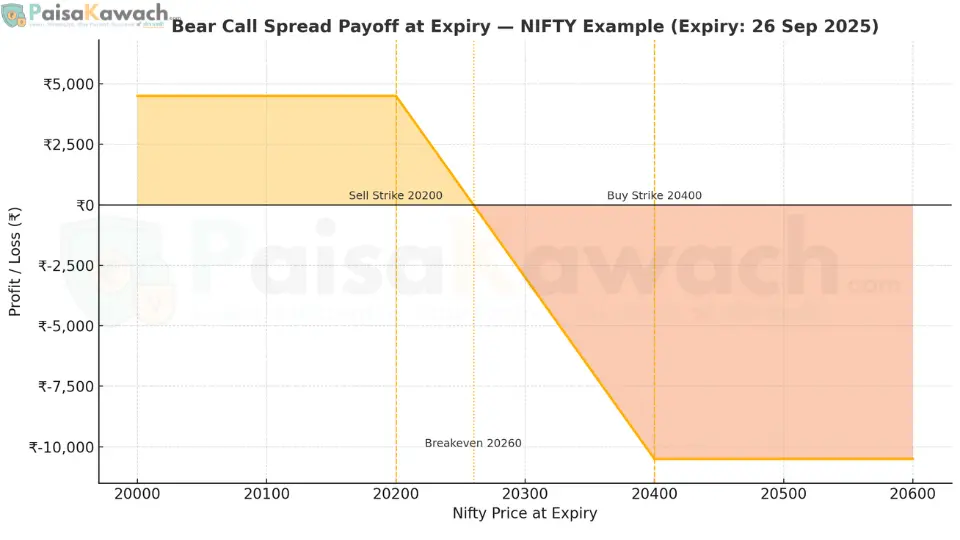
Assume NIFTY is trading at 20,000. You identify 20,200 as a strong resistance level and initiate a spread for the September 26th, 2025 expiry. The standard lot size is 75.
- Sell 20,200 CE @ ₹120
- Buy 20,400 CE @ ₹60
Net Credit Received: ₹120 - ₹60 = ₹60 per share.
Total Max Profit: ₹60 * 75 = ₹4,500.
Max Loss Calculation:
The difference between the strike prices is 200 points (20,400 - 20,200).
Max Loss per share: (Strike Difference - Net Credit) = (200 - 60) = ₹140.
Total Max Loss: ₹140 * 75 = ₹10,500.
This maximum loss occurs if NIFTY closes at or above the long call strike (20,400) at expiration.
Breakeven Point Calculation:
This is the point where the trade transitions from profit to loss at expiration.
Breakeven: Short Strike + Net Credit = 20,200 + 60 = 20,260.
The trade is profitable at expiration if NIFTY closes below 20,260.
Payoff Scenarios at Expiry:
- Scenario 1: Ideal Outcome (NIFTY ≤ 20,200)
Both calls expire worthless.
Net Profit = ₹4,500 (Max Profit) - Scenario 2: At Breakeven (NIFTY = 20,260)
The short call is ITM by ₹60. This loss exactly equals the net credit received.
Net Profit/Loss = ₹0 - Scenario 3: Worst-Case Outcome (NIFTY ≥ 20,400)
Loss on short call: -₹200 (intrinsic value).
Gain on long call: +₹200 (intrinsic value).
The intrinsic values cancel each other out. The net loss is the initial credit received minus the cost of the hedge, which is the predefined max loss.
Net Loss = ₹10,500 (Max Loss)
Risk & Management: The Greeks
- Max Loss & Profit: Both are predefined, making risk management mechanical.
- Theta (Time Decay): Positive. The strategy benefits from the passage of time. As expiration approaches, the value of the spread (if OTM) will decay toward zero, allowing the trader to buy it back for less or keep the full credit.
- Vega (Volatility Risk): Negative. The strategy is a net seller of volatility. An increase in Implied Volatility will hurt the position's value, while a decrease in IV will benefit it.
- Delta (Directional Risk): Initially slightly negative (bearish). The delta becomes more negative if the price rises toward the short strike, and approaches zero if the price rallies past the long strike (as the spread reaches its max loss).
Exit Rules: Active Management for Optimal Outcomes
- Profit Target: Close the spread early by buying it back once a significant portion (e.g., 50-75%) of the max profit has been realized. This locks in gains and avoids gamma risk near expiration.
- Stop-Loss (Price): If the underlying price breaks decisively above your short strike and approaches the breakeven point, consider closing the trade to avoid further losses. Holding to max loss is a conscious choice, but often cutting losses early is prudent.
- Stop-Loss (Volatility): Exit the trade if Implied Volatility spikes significantly higher, as this will increase the value of the spread against you.
- Rolling: If the outlook remains neutral/bearish but the price has moved against you, you can "roll" the spread up and out (to a higher strike and a later expiration) for a new credit. This adjusts your position and defers the problem.
Advantages
- Defined Risk: Maximum possible loss is known and capped at initiation.
- Lower Margin Requirement: Requires significantly less capital than a naked short call.
- Positive Theta: Benefits from time decay, the option seller's best friend.
- Strategic Flexibility: Can be used in neutral or bearish markets to generate income.
Disadvantages
- Capped Profit Potential: Gains are limited to the initial credit received, no matter how far the market falls.
- Favorable Risk/Reward Challenge: Often, the maximum loss is a multiple of the maximum gain (e.g., in our example, risking ₹10,500 to make ₹4,500). This requires a high probability of success.
- Opportunity Cost: If the underlying crashes, the profit is still limited to the credit, whereas a outright bearish position (like long puts) would have yielded much larger gains.
Comparison: Bear Call Spread vs. Naked Short Call
| Factor | Bear Call Spread | Naked Short Call |
|---|---|---|
| Risk Profile | Defined and Limited | Unlimited |
| Max Profit | Net Credit Received | Net Premium Received |
| Margin Requirement | Lower (Defined Risk) | Very High (Unlimited Risk) |
| Psychological Impact | Lower stress, known worst-case | Extremely high stress, uncapped losses |
| Ideal For | Risk-averse traders, defined-risk accounts | Highly experienced, well-capitalized professionals |
The Bear Call Spread is a foundational strategy for the disciplined options trader. It offers a methodical way to generate income from a neutral or bearish bias without venturing into the dangerous territory of unlimited risk. Its defined nature allows for precise position sizing and calm, strategic decision-making, making it a superior choice over naked short calls for the vast majority of retail traders.