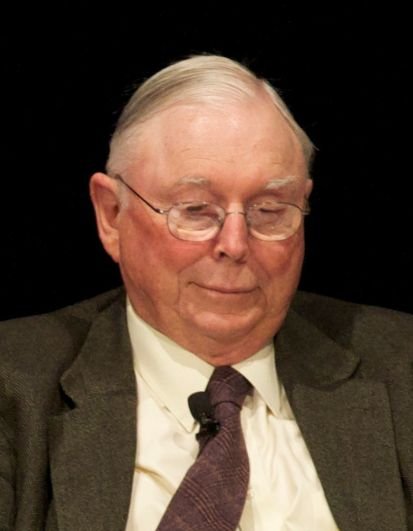
By Nick Webb – Photo, CC BY 2.0, Wikimedia Commons
Charles Thomas Munger was born on January 1, 1924, in Omaha, Nebraska, a modest Midwestern city that would later become synonymous with investment wisdom due to its association with both Charlie Munger and Warren Buffett. Born during the interwar years and raised through the harsh realities of the Great Depression, Munger’s upbringing was shaped by scarcity, frugality, and resilience. These early experiences deeply influenced his later philosophy, where prudence, rationality, and practical judgment became hallmarks of his worldview.
Charlie’s father, Alfred Case Munger, was a respected lawyer who practiced real estate and corporate law. His mother, Florence Munger, came from a family with strong civic values. The family’s household emphasized education, intellectual curiosity, and integrity. However, the Great Depression created challenges that left lasting impressions on young Charlie. He witnessed the volatility of economic cycles and how external forces could devastate families, businesses, and communities. This early encounter with economic hardship taught him the value of resilience, thrift, and adaptability—principles that would later guide his investment strategies.
From a young age, Munger exhibited signs of exceptional intelligence and curiosity. He developed a love for reading, a trait that never left him. By adolescence, he had already cultivated a voracious appetite for books across subjects ranging from history and science to philosophy and mathematics. His intellectual curiosity was wide-ranging, which later became the foundation of his famous idea of building a “latticework of mental models.”
Unlike many of his peers, who pursued singular career tracks, Charlie valued multidisciplinary learning. He believed that problems could not be solved in isolation by one field of study. This mindset, seeded during his teenage years, later grew into one of his most important contributions to investment thinking: the idea that worldly wisdom comes from combining insights across disciplines.
Charlie attended Central High School in Omaha, where his sharp intellect and mathematical prowess quickly earned him a reputation among both teachers and classmates. He excelled at analytical subjects, particularly mathematics, which would later prove critical in his ability to think probabilistically about investments. Central High was also the school attended by Warren Buffett, though their paths did not cross at that time—Buffett was younger by six years. This coincidence underscored Omaha’s role as the unlikely birthplace of two of the greatest investment thinkers of the 20th century.
In 1941, Munger enrolled at the University of Michigan, initially focusing on mathematics. His time at Michigan was cut short when the United States entered World War II. Like many young men of his generation, Munger answered the call to service and joined the U.S. Army Air Corps. Assigned to study meteorology, he was trained to analyze complex weather data that directly influenced military operations. This role honed his skills in probability, data interpretation, and logical reasoning—skills that later translated seamlessly into his approach to investing and problem-solving.
Despite not completing an undergraduate degree at Michigan, his intellectual abilities were so strong that the military sent him for advanced training at the California Institute of Technology (Caltech). There, he studied advanced meteorology, combining his mathematical foundation with real-world applications. This experience introduced him to scientific thinking and probabilistic models, which became cornerstones of his analytical framework.
Serving in the military during one of history’s most turbulent times instilled in Munger a sense of discipline, structure, and resilience. The combination of mathematics, meteorology, and military precision reinforced his belief in logical analysis and rational decision-making. He later remarked that the ability to think in terms of probability distributions and likely outcomes was among the most valuable skills he gained during this time.
After his military service, Munger used the GI Bill to pursue higher education. Despite never completing an undergraduate degree, his exceptional capabilities earned him admission to Harvard Law School, an almost unprecedented achievement. At Harvard, Munger thrived. He graduated magna cum laude in 1948, among the top of his class, earning his Juris Doctor degree. His success at Harvard reflected not only his intellectual brilliance but also his relentless work ethic and discipline, both of which would define his professional life.
After graduation, Munger moved to California and began practicing real estate law at Wright & Garrett (later Musick, Peeler & Garrett), a prominent law firm. He quickly developed a reputation as a sharp, capable attorney who excelled in complex real estate and corporate transactions. His legal background gave him a unique edge in later investment analysis—contracts, regulatory frameworks, and corporate structures became tools he could dissect with ease.
However, even as a successful lawyer, Munger realized his true passion lay not in legal practice but in business and investing. He found the practice of law limiting, a profession where compensation was tied to billable hours rather than scalable value creation. In contrast, investing offered leverage: good ideas and disciplined execution could generate exponential returns. This realization marked the beginning of his transition from law into the world of finance and business.
During the 1950s, alongside his legal practice, Munger began experimenting with real estate development and small business investments in California. These ventures taught him practical lessons in business management, capital allocation, and risk assessment. His early entrepreneurial activities demonstrated a natural flair for spotting value and thinking several steps ahead, qualities that would later define his partnership with Warren Buffett.
By the late 1950s, Charlie Munger had evolved from a brilliant law graduate into a budding investor and businessman. His unique blend of legal expertise, military discipline, scientific training, and entrepreneurial experimentation positioned him to eventually join forces with Warren Buffett, creating one of the most iconic partnerships in financial history.
The story of Charlie Munger and Warren Buffett’s partnership begins in 1959, when mutual friends in Omaha arranged a dinner between the two men. Though Munger was living in California at the time, he frequently returned to his hometown. Buffett, six years younger, had already started making a name for himself as a talented money manager influenced heavily by Benjamin Graham. The moment they sat down together, sparks flew. Their conversation lasted for hours, as both discovered a shared worldview built on rationality, curiosity, humor, and a deep respect for common sense.
That first dinner was more than a social encounter—it was the beginning of a lifelong intellectual partnership. Despite their differences in background—Buffett with his quantitative “cigar butt” approach and Munger with his legal, multidisciplinary perspective—they immediately recognized each other’s brilliance. Over time, they would shape each other’s thinking, creating an investment philosophy that blended the best of value investing with an appreciation for quality, patience, and long-term compounding.
Though Munger did not formally join Berkshire Hathaway until 1978, his influence on Buffett began in the early 1960s. Munger was already running a successful investment partnership in California, generating strong returns for his investors. Meanwhile, Buffett was practicing Graham-style investing, buying deeply undervalued but mediocre businesses—the so-called “cigar butts” that offered one last puff of value. Munger challenged Buffett to think differently, arguing that it was far better to pay a fair price for a wonderful business than a wonderful price for a fair business.
This shift in philosophy became known as the “Munger influence.” Buffett himself later admitted, “Charlie shoved me in the direction of buying better businesses and not just buying bargains.” The proof of this transformation can be seen in Berkshire’s investments from the 1970s onward, which included iconic companies like See’s Candies, Coca-Cola, and American Express—all businesses with strong brands, durable competitive advantages, and long-term growth prospects.
What made the Buffett-Munger partnership so enduring and effective was the way their strengths complemented each other. Buffett was the master of capital allocation, gifted with a near photographic memory for numbers and an uncanny ability to analyze financial statements. Munger, meanwhile, brought a multidisciplinary lens to decision-making. He studied psychology, history, physics, and biology, applying insights from these fields to business analysis. Together, they created a holistic approach that was greater than the sum of its parts.
Their relationship was not built on constant agreement. In fact, they often debated vigorously. But their debates were grounded in intellectual honesty and mutual respect. This dynamic reinforced Munger’s famous principle: “The best thing a human being can do is to help another human being know more.” Buffett and Munger embodied this idea for over six decades.
Munger formally joined Berkshire Hathaway as Vice Chairman in 1978, but by then, his influence on the company was already profound. Before Munger, Buffett had focused on undervalued companies, often buying businesses that were cheap but not necessarily high quality. With Munger’s urging, Berkshire shifted its strategy toward quality businesses with durable moats. This pivot transformed Berkshire from a modest textile company into a global conglomerate and investment powerhouse.
Through such decisions, Munger helped Buffett move from a quantitative bargain-hunter to a qualitative investor in world-class companies. This shift not only improved Berkshire’s performance but also reshaped modern value investing.
One of the most famous aspects of the Buffett-Munger partnership is their annual Berkshire Hathaway shareholder meeting, held in Omaha. What began as a small gathering of investors grew into a legendary event attracting over 40,000 people from around the world each year. Nicknamed “Woodstock for Capitalists,” the meetings became a platform where Buffett and Munger shared their wisdom in a candid, humorous, and brutally honest style.
Munger’s role at these meetings was distinctive. While Buffett often gave detailed explanations of Berkshire’s performance, Munger delivered concise, often razor-sharp insights. His famous phrase, “I have nothing to add,” became legendary, reflecting both his humility and his insistence on brevity when he believed Buffett had already nailed the point. But when he did speak at length, his words carried enormous weight, often distilling complex ideas into memorable aphorisms.
One of Munger’s most important contributions to the partnership was his advocacy of inversion—solving problems backward. Instead of asking, “What will make us successful?” Munger often asked, “What would make us fail?” By identifying pitfalls and avoiding stupidity, Berkshire was able to reduce risk and make more rational decisions. This approach aligned perfectly with Buffett’s obsession with avoiding permanent loss of capital.
For example, when evaluating potential acquisitions, Munger would ask: “How could this go wrong? What risks could destroy value here?” By starting with failure scenarios, they filtered out bad deals and focused only on opportunities with high probability of long-term success.
Munger was also known for his sharp wit and no-nonsense style. While Buffett charmed with folksy Midwestern humor, Munger delivered blunt truths with surgical precision. He often skewered bad ideas, called out irrational behavior, and used humor to cut through complexity. This dynamic created a balance—Buffett reassured investors with optimism, while Munger grounded them with tough-minded rationality.
The Buffett-Munger partnership did not just reshape Berkshire; it reshaped the entire world of investing. By moving away from cigar-butt investing and embracing high-quality businesses, they set a new standard for value investing. Investors around the world began looking not just at balance sheets but at intangible qualities like brand strength, management quality, and competitive moats. Munger’s influence ensured that Berkshire became not just a company, but a philosophy studied in business schools and boardrooms globally.
By the late 20th century, the Buffett-Munger partnership had become the gold standard of rational investing. Their shared wisdom created not only vast wealth for shareholders but also a philosophy that continues to guide investors worldwide. Munger was not just Buffett’s partner—he was his equal, his challenger, and the philosophical architect behind Berkshire’s transformation into a global icon.
Charlie Munger’s investment philosophy was built on the concept of “worldly wisdom.” Unlike many investors who specialized narrowly in finance or accounting, Munger believed that the most successful decision-makers drew upon knowledge from multiple disciplines. He famously said, “You must know the big ideas in the big disciplines and use them routinely—all of them, not just a few.” This meant that psychology, physics, biology, history, economics, and mathematics all had a place in analyzing investments.
Munger described this as creating a “latticework of mental models.” By building a framework of key principles from different fields, he believed an investor could avoid common errors, see patterns others missed, and make decisions with greater clarity. For example, understanding psychology helped him recognize investor biases like fear and greed, while insights from engineering and mathematics taught him the value of redundancy and probability in assessing risk.
Munger frequently cited specific mental models he found particularly valuable. Among them:
By weaving together dozens of such models, Munger created a mental toolkit far more powerful than traditional financial formulas alone. His multidisciplinary approach distinguished him as one of the most original thinkers in investing history.
One of Munger’s most famous contributions to investing was his shift from the traditional Graham-style “cigar butt” approach to prioritizing quality businesses. He often said: “It’s far better to buy a wonderful company at a fair price than a fair company at a wonderful price.”
This insight radically changed Warren Buffett’s investing style as well. Before Munger, Buffett focused on deeply discounted, mediocre businesses. With Munger’s influence, Berkshire began buying world-class franchises like See’s Candies and Coca-Cola. The results validated the philosophy—quality companies with durable competitive advantages could compound wealth at extraordinary rates for decades, while cheap, struggling companies often stagnated or declined.
Munger placed enormous emphasis on patience. He often remarked that one of the greatest traits of a successful investor was the ability to “sit on your ass” and do nothing until the right opportunity appeared. Unlike traders who sought constant action, Munger argued that true wealth was built by waiting for rare, high-probability bets and holding them for the long term.
He tied patience directly to rationality. Emotional decisions—driven by fear, greed, or envy—were the enemies of rational investing. Munger advised investors to cultivate equanimity, avoid reacting to market noise, and always ground their decisions in logic. “A lot of people with high IQs are terrible investors because they’ve got terrible temperaments,” he observed. For Munger, temperament mattered more than intellect.
Munger also championed the idea of the circle of competence. He believed investors should clearly define the areas they understood well and stay within those boundaries. Venturing into industries or businesses they did not understand was a recipe for mistakes. Importantly, he stressed that it was not necessary to know everything; it was only necessary to know your circle of competence and operate confidently within it.
He famously quipped: “Knowing what you don’t know is more useful than being brilliant.” This humility, combined with discipline, allowed him and Buffett to avoid speculative fads and dangerous sectors that ensnared less cautious investors.
Another cornerstone of Munger’s thinking was inversion. He urged investors to approach problems by asking the opposite question: “Instead of asking how to succeed, ask how to avoid failure.” He often borrowed the phrase “Invert, always invert” from mathematician Carl Jacobi. By focusing on avoiding stupidity rather than seeking brilliance, investors could eliminate many risks upfront.
For example, when analyzing a potential acquisition, Munger would ask: “What factors could destroy this business?” By identifying vulnerabilities first—such as poor management, weak competitive positioning, or unsustainable debt—they avoided bad decisions. Inversion turned investing into a process of systematically reducing errors rather than chasing perfect foresight.
In line with his multidisciplinary philosophy, Munger advocated for checklists. Just as pilots use pre-flight checklists to prevent catastrophic mistakes, investors, he argued, should use structured lists to ensure they didn’t overlook crucial factors. These checklists included questions about incentives, competition, customer loyalty, balance sheet strength, and potential psychological biases affecting judgment.
Munger repeatedly warned about the dangers of cognitive biases. He believed psychology was one of the most underappreciated fields in investing and gave lectures on the subject, famously cataloging dozens of human misjudgments. Among them were confirmation bias, overconfidence, social proof, and commitment bias. By identifying these traps, Munger built guardrails around his own thinking and encouraged others to do the same.
He once observed: “If you can get rid of envy, resentment, and self-pity, you can have a pretty good life.” This wasn’t just life advice—it was investing advice too. Emotional reactions distort rational judgment, leading to costly mistakes.
Central to Munger’s philosophy was the idea of compounding. He believed compounding was the single most powerful force in wealth creation. But compounding only worked if investors allowed time to do its magic. Selling too quickly, chasing short-term fads, or reacting to market volatility interrupted the compounding process. He urged investors to hold onto great companies for decades, letting their intrinsic value grow.
Munger’s philosophy diverged from conventional Benjamin Graham-style value investing in important ways:
Munger was a master of distilling complex ideas into pithy, unforgettable phrases. Some of his most famous principles include:
Through his philosophy, Charlie Munger elevated investing from a narrow financial discipline into a broad intellectual pursuit. His emphasis on rationality, patience, and multidisciplinary thinking created a timeless framework that continues to guide investors, business leaders, and thinkers around the world.
Charlie Munger’s most visible role in business history was as Vice Chairman of Berkshire Hathaway, a position he held from 1978 until his passing in 2023. During this time, Berkshire transformed from a struggling textile manufacturer into one of the most valuable companies in the world. Under the joint stewardship of Munger and Warren Buffett, Berkshire’s per-share book value grew from $19 to over $300,000, representing one of the most extraordinary wealth creation stories in corporate history.
Munger’s contributions at Berkshire cannot be overstated. While Buffett executed capital allocation with unmatched precision, Munger provided the philosophical and strategic backbone that reshaped Berkshire’s approach. His insistence on focusing on quality businesses with durable competitive advantages forever altered the company’s trajectory. Instead of buying companies simply because they were cheap, Berkshire began acquiring firms with strong brands, great management, and long-term growth prospects. This “Munger influence” helped Berkshire build a portfolio that included iconic holdings like Coca-Cola, American Express, and Apple.
Perhaps the best example of Munger’s influence was Berkshire’s acquisition of See’s Candies in 1972. At the time, Buffett was hesitant to pay more than $25 million for a company that produced $4 million in annual earnings. Munger argued that See’s brand, customer loyalty, and pricing power made it worth the premium. He told Buffett: “If you buy See’s, you’ll learn how to buy quality companies.”
The investment turned out to be one of the most important in Berkshire’s history. See’s has since generated billions in profits and provided Buffett and Munger with a template for recognizing the power of moats—sustainable competitive advantages that allow businesses to fend off competitors. See’s was more than just a financial win; it became a philosophical cornerstone for how Berkshire invested going forward.
Munger also played a crucial role in Berkshire’s $1 billion investment in Coca-Cola in 1988. At a time when many investors saw the company as a slow-growth beverage giant, Munger recognized its extraordinary brand power and global dominance. The investment has since become one of Berkshire’s most iconic, producing massive dividends and long-term appreciation. For Munger, Coca-Cola embodied his philosophy that it was better to buy a great business at a fair price than a mediocre business at a cheap price.
Beyond Berkshire, Munger also served as Chairman of the Daily Journal Corporation, a small publishing company based in Los Angeles. Originally focused on legal newspapers, the company faced existential challenges as print media declined. Under Munger’s leadership, Daily Journal pivoted into software, developing case management systems for courts and public agencies. This bold transformation kept the company alive and profitable, demonstrating Munger’s ability to adapt traditional businesses to technological changes.
Munger’s annual meetings at Daily Journal became cult events, similar in style to Berkshire’s gatherings but smaller and more intimate. Investors flocked to hear his unscripted, candid reflections on markets, life, psychology, and world affairs. These meetings further cemented his reputation as one of the sharpest minds in finance, unafraid to speak blunt truths.
Charlie Munger was also a longtime board member of Costco Wholesale Corporation, one of the most admired retailers in the world. He deeply respected Costco’s business model, which emphasized extreme efficiency, customer loyalty, and long-term value creation over short-term profits. Munger often praised Costco’s treatment of employees and customers, calling it a model of ethical and effective capitalism. He once said, “Costco is one of the most admirable capitalistic institutions in the world.”
His influence on Costco extended to its discipline in pricing and its relentless focus on efficiency. He admired how the company created immense value for customers while still generating consistent returns for shareholders. For Munger, Costco exemplified how businesses could succeed by focusing on long-term value rather than quarterly results.
Munger’s collected speeches and writings were published in 2005 under the title Poor Charlie’s Almanack, edited by Peter D. Kaufman. Modeled after Benjamin Franklin’s Poor Richard’s Almanack, the book compiled Munger’s wit, wisdom, and philosophy on investing and life. It included transcripts of his famous talks, such as his USC commencement address on the psychology of human misjudgment, as well as reflections on business, decision-making, and ethics.
The book became a cult classic among investors and thinkers, praised for its combination of humor, intellectual rigor, and timeless advice. Unlike many investing books that focus narrowly on techniques, Poor Charlie’s Almanack explored the broader principles of rationality, ethics, and multidisciplinary thinking. It cemented Munger’s status not just as an investor but as a philosopher of decision-making.
Munger’s speeches, often delivered at universities or shareholder meetings, became legendary. Known for their blunt honesty and intellectual depth, these talks covered everything from psychology and economics to ethics and human behavior. His speech on “The Psychology of Human Misjudgment” is considered a masterpiece, cataloging dozens of cognitive biases that distort decision-making. Long before behavioral economics became mainstream, Munger was teaching investors to recognize and guard against these traps.
He also became known for his short, witty interjections at Berkshire meetings. Phrases like “I have nothing to add” or “It’s not supposed to be easy. Anyone who finds it easy is stupid” became part of his lore. These remarks showcased his ability to distill complex truths into memorable one-liners.
Beyond business, Munger was a generous philanthropist, donating hundreds of millions of dollars to educational institutions. He funded dormitories at the University of Michigan, Stanford, and UC Santa Barbara, often designing the buildings himself with an emphasis on functionality and community. His approach to architecture reflected his philosophy of practicality and rational design. For Munger, good design was not about aesthetics alone but about solving real problems and creating environments that enhanced human interaction.
He also supported causes in law, medicine, and science, believing that philanthropy should focus on long-term impact rather than symbolic gestures. His giving mirrored his investing style—carefully considered, rational, and designed for compounding benefits over generations.
Through his achievements, Charlie Munger proved that great leadership extends far beyond stock picking. He was a thinker, a teacher, a philanthropist, and a designer of institutions—both corporate and educational—that reflected his philosophy of rationality, integrity, and long-term value creation.
Charlie Munger passed away on November 28, 2023, at the remarkable age of 99—just one month shy of his 100th birthday. His death marked the end of an era, not only for Berkshire Hathaway but for the broader world of investing and business thought. For decades, he stood as a symbol of rationality, wit, and intellectual discipline. His partnership with Warren Buffett produced one of the greatest wealth creation stories in history, but more importantly, his wisdom reshaped how millions of people think about decision-making, ethics, and life itself.
Even in his final years, Munger remained active and sharp, attending Berkshire Hathaway’s annual meetings and the Daily Journal gatherings, where he delivered insights with the same blunt honesty that defined his career. His passing was mourned globally, with tributes pouring in from investors, business leaders, academics, and ordinary people who had been touched by his writings and speeches.
One of Munger’s most enduring contributions is his concept of mental models. By encouraging investors and leaders to build a multidisciplinary framework for thinking, Munger elevated decision-making from a narrow financial exercise to a broader intellectual pursuit. Business schools, hedge funds, and corporate leaders around the world now incorporate mental model thinking into their strategies.
The idea that “to the man with only a hammer, every problem looks like a nail” became a central warning against intellectual narrowness. By contrast, Munger advocated building a toolkit of diverse ideas—from biology to psychology to engineering—so that problems could be attacked from multiple angles. This idea has influenced not only investing but also fields such as entrepreneurship, management consulting, and even public policy.
Munger’s lifelong mission was to promote rationality—the ability to think clearly, avoid biases, and make decisions based on evidence rather than emotion. He believed most mistakes in investing and in life came not from ignorance but from irrationality. His catalog of human misjudgments, laid out in his famous USC speech, anticipated the rise of behavioral economics decades later.
By teaching generations to guard against cognitive biases such as confirmation bias, envy, overconfidence, and anchoring, Munger gave decision-makers tools to avoid common traps. His insistence on rationality also extended to ethics: he believed that honesty, integrity, and long-term trust were not only moral imperatives but also competitive advantages in business.
Charlie Munger’s influence lives on through his sharp, memorable quotes. These aphorisms distilled decades of wisdom into timeless lessons:
These quotes reflect his philosophy of simplicity, discipline, and ethical living. They remain part of the lexicon of business wisdom and are frequently cited in classrooms, boardrooms, and investment letters worldwide.
Munger’s influence on Warren Buffett and Berkshire Hathaway is perhaps his greatest achievement. By shifting Buffett away from cigar-butt investing toward high-quality businesses, Munger helped create a company that compounded wealth at an unparalleled rate. Buffett himself acknowledged this debt, famously saying, “Charlie has the best 30-second mind in the world. He sees any issue clearer than anyone else.”
The Berkshire model—focused on buying great businesses, maintaining strong ethics, and avoiding unnecessary complexity—became a template for value investors everywhere. Without Munger’s intellectual push, Buffett might never have embraced the strategy that made Berkshire legendary.
Munger’s philanthropy reflected his rational, problem-solving approach. He donated hundreds of millions of dollars to universities such as Stanford, Michigan, and UC Santa Barbara. But unlike many philanthropists, Munger often insisted on designing the dormitories and buildings himself, emphasizing functionality and community interaction. He disliked architectural excess and believed good design was about solving real human problems. His dormitory projects often featured large shared spaces, reflecting his belief in collaboration and conversation as drivers of learning.
Beyond buildings, Munger funded scholarships, supported law schools, and contributed to scientific research. His philanthropy mirrored his investing: thoughtful, long-term, and designed to produce compounding benefits for society.
Munger’s impact extended beyond the United States. Investors and business leaders around the world studied his philosophy. In China, for example, his mental models and emphasis on quality investing found a particularly strong following. Many Chinese entrepreneurs and fund managers cited Munger’s writings as pivotal in shaping their thinking.
In the age of social media and digital information, Munger’s speeches and quotes spread virally, introducing new generations to his timeless principles. Platforms like YouTube, Twitter, and blogs made his wisdom accessible to millions who never attended a Berkshire meeting in Omaha.
Charlie Munger is often placed alongside Warren Buffett, Benjamin Graham, and John Maynard Keynes as one of the most influential thinkers in modern finance. Graham provided the intellectual foundation of value investing, Buffett became its most famous practitioner, and Munger refined and expanded it into a broader, multidisciplinary philosophy. Unlike many of his peers, Munger was not primarily remembered for his personal net worth or individual deals, but for the intellectual framework he left behind.
Munger’s influence was not limited to finance. His teachings on life, ethics, and learning inspired people far outside the world of business. He emphasized humility, lifelong curiosity, and moral integrity as the keys to a meaningful life. He often said that envy, resentment, and self-pity were destructive emotions that ruined both lives and investments.
For younger generations, Munger became a model of lifelong learning. Well into his 90s, he continued to read voraciously, think critically, and adapt to changing times. He proved that intellectual vitality could last a lifetime, inspiring people to stay curious and disciplined regardless of age.
If Charlie Munger’s legacy could be summarized in one sentence, it would be: “He taught the world that rationality, patience, and integrity are the ultimate competitive advantages—in investing and in life.”
Charlie Munger’s legacy endures not in the wealth he created but in the wisdom he shared. His life was a masterclass in rational thinking, ethical leadership, and disciplined investing. Though he passed away in 2023, his influence continues to guide investors, business leaders, and thinkers worldwide. For generations to come, his voice—blunt, wise, and unyieldingly rational—will remain a beacon for those seeking to navigate complexity with clarity and integrity.
