Why Markets Rise Even When the News Looks Terrible: The Hidden Forces Behind Global Market Rallies
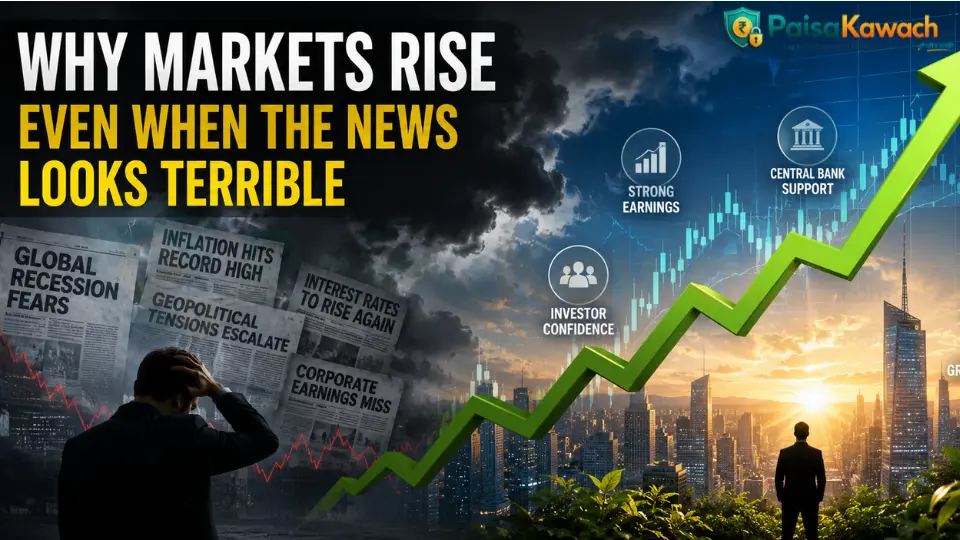
Turn on any financial news channel or open a news app, and you'll often see headlines filled with uncertainty: geopolitical conflicts, slowing economies, inflation concerns, rising interest rates, corporate layoffs, or fears of recession. Yet, surprisingly, global stock markets sometimes continue climbing as if none of these problems exist. For many investors, this creates one of the biggest mysteries in finance: Why do markets rise when the news looks terrible?
The answer lies in understanding that financial markets are not designed to reflect today's headlines—they are constantly attempting to estimate tomorrow's opportunities. Investors, institutions, hedge funds, pension funds, and multinational corporations are continuously evaluating future expectations rather than reacting solely to current events. By the time negative news becomes the headline everyone is discussing, professional investors may have already priced that information into the market weeks or even months earlier.
This article explores the hidden mechanics behind global market rallies, explaining why markets sometimes appear disconnected from reality, how expectations influence prices, and why understanding market psychology is often more valuable than following daily headlines.
The Biggest Misconception: Markets Do Not Mirror Today's News
One of the most common mistakes made by new investors is assuming that markets should move exactly according to the day's headlines. If economic news is negative, many naturally expect stock prices to fall immediately. Likewise, positive headlines are expected to push markets higher. In reality, financial markets rarely operate in such a straightforward way.
Markets function more like prediction machines than scoreboards. Every trading day represents millions of participants evaluating what businesses, industries, and economies might look like six months, one year, or even several years into the future. Prices constantly adjust as these expectations change.
Imagine driving a car while looking only in the rear-view mirror. You would know exactly where you've been, but not where you're going. News headlines often describe events that have already happened, while markets focus on what could happen next.
Why Headlines and Market Performance Often Diverge
Negative news does not automatically create falling markets because investors ask a different question. Instead of asking "Is today's news bad?", they ask "Will tomorrow be better or worse than today's expectations?"
- Markets continuously price future expectations rather than current conditions.
- Professional investors often react long before news reaches the general public.
- Companies are valued based on future earnings potential instead of today's headlines alone.
- Expectations changing matter more than whether the news is simply positive or negative.
Consider two hypothetical situations. In the first, a country's economy enters a recession exactly as economists predicted months earlier. Although the news appears alarming, markets may barely react because investors already expected it. In the second, economic growth slows only slightly but far more than analysts anticipated. Even though conditions appear better on paper, markets may fall sharply because expectations were disappointed.
This distinction between reality and expectations explains countless moments in financial history when markets moved in the opposite direction of public sentiment.
Understanding this concept is the foundation for interpreting almost every major market movement. Once investors recognize that prices reflect future expectations instead of present emotions, many seemingly irrational market rallies begin to make far more sense.
Markets Trade on Expectations, Not Emotions
Imagine two investors reading the exact same headline:
"Global manufacturing slows for the third consecutive quarter."
One investor immediately assumes the market will fall and decides to sell. The other asks a different question:
"Was this slowdown already expected?"
This simple difference in thinking separates emotional reactions from professional market analysis.
Financial markets are constantly balancing one powerful equation: Expectation versus Reality. Prices don't simply reflect what is happening today—they reflect whether today's developments are better or worse than what investors collectively expected yesterday.
Suppose analysts predicted that a company would earn $1.00 per share, but it reported earnings of $1.20. Even if overall profits were lower than last year, the stock could still rise because reality exceeded expectations.
Now reverse the situation. A company reports record-breaking profits, but investors were expecting even stronger results. Despite excellent performance, its share price may decline because expectations were too high.
This is why professional investors spend as much time studying market expectations as they do studying financial results themselves.
The Market Is Always Looking Ahead
Think of the stock market as standing on a hill, trying to see over the horizon. While newspapers explain what happened yesterday, markets are already estimating what businesses, consumers, governments, and industries might look like months from now.
- Investors buy future earnings, not yesterday's performance.
- Economic recoveries often begin before official data improves.
- Markets usually anticipate change long before it becomes obvious.
- Prices move when expectations change—not simply because news exists.
This forward-looking nature explains why markets have historically started recovering while unemployment remained high, consumer confidence was weak, or economic headlines continued to appear pessimistic.
By the time the average person feels comfortable investing again, many institutional investors have already spent months accumulating positions based on improving long-term expectations.
The Hidden Power of Investor Psychology
Financial markets are built on numbers, but they are driven by people. Every trade represents a decision made by someone interpreting information, managing risk, or pursuing opportunity. Because of this, psychology plays an enormous role in market behavior.
When uncertainty dominates the headlines, emotions become stronger than logic. Fear encourages investors to sell quickly, while optimism encourages them to buy aggressively. However, experienced investors understand that emotions often create opportunities instead of accurate forecasts.
One of the oldest sayings on Wall Street is that markets "climb a wall of worry." This phrase reflects an important reality: markets frequently perform well during periods when uncertainty is still high because expectations have already become extremely pessimistic.
If everyone expects disaster, it becomes surprisingly difficult for reality to be even worse. Small improvements, or simply fewer negative surprises, can trigger significant buying activity.
Why Fear Can Become Fuel for Future Rallies
Imagine a crowded theater where everyone rushes toward the exit at the first sign of smoke. Eventually, the theater becomes nearly empty. Once investigators confirm there is no serious danger, people slowly begin returning.
Financial markets often behave similarly.
- Heavy selling can push prices below long-term intrinsic value.
- Extreme pessimism reduces future selling pressure because many sellers have already exited.
- Long-term investors often buy when fear creates attractive valuations.
- Recoveries frequently begin while public confidence remains very low.
This does not mean every market decline immediately becomes a buying opportunity. Rather, it illustrates that prices often begin recovering long before public sentiment improves.
History repeatedly shows that some of the strongest market rallies have started during periods when news remained overwhelmingly negative. Investors who focused only on headlines often missed the earliest stages of those recoveries.
Why Large Institutions Think Differently Than Individual Investors
Retail investors often make decisions after reading headlines or watching financial news throughout the day. Large institutions operate very differently.
Asset managers, pension funds, sovereign wealth funds, insurance companies, and investment firms manage billions of dollars with investment horizons measured in years rather than days. Their objective is not simply reacting to news—it is identifying whether future cash flows, earnings, and economic conditions are likely to improve over time.
Because of their longer investment horizons, institutional investors often begin buying while uncertainty is still dominating the news cycle. Their decisions are based on valuation models, economic forecasts, industry trends, demographic shifts, productivity improvements, and corporate earnings expectations rather than daily emotional reactions.
How Professional Investors Evaluate Opportunities
Instead of asking whether today's news sounds good or bad, institutional investors usually ask more strategic questions.
- Has the market already priced in this negative event?
- Will company earnings likely improve over the next several quarters?
- Are quality businesses now trading below their estimated long-term value?
- What opportunities could emerge once uncertainty begins fading?
This difference in perspective explains why markets sometimes begin rising even while headlines remain overwhelmingly negative. Professional investors are not ignoring the bad news—they are evaluating whether the future is likely to become less negative than current expectations suggest.
Understanding this shift in perspective is one of the most valuable lessons any investor can learn. Headlines describe today's world. Markets attempt to price tomorrow's world.
Liquidity: The Invisible Force That Can Lift Entire Markets
Ask most investors why markets move higher, and you'll often hear familiar answers: strong earnings, positive economic data, or investor optimism. While these factors certainly matter, there is another force working quietly in the background that many people overlook—liquidity.
Liquidity refers to how much money is available to flow through the financial system. When businesses can borrow more easily, consumers continue spending, investment funds receive new capital, and banks actively lend, more money becomes available to purchase financial assets. That additional demand can support rising market prices even during periods filled with negative headlines.
Think of liquidity as water flowing through a river. A healthy river allows everything connected to it to thrive. When liquidity increases, financial markets often become more resilient because there is simply more capital looking for opportunities.
This is one reason why experienced investors monitor not only company earnings but also central bank policies, interest rates, lending conditions, and global capital flows.
Where Market Liquidity Comes From
Liquidity does not appear from a single source. It is created by many interconnected parts of the global financial system working together.
- Central bank monetary policies that influence borrowing costs.
- Commercial banks expanding lending to businesses and consumers.
- Institutional investors allocating new capital into markets.
- Corporate investments, retirement contributions, and international capital flows.
This explains why markets sometimes remain surprisingly strong despite widespread uncertainty. While headlines focus on individual events, the broader financial system may still have abundant capital searching for productive investments.
Corporate Earnings Matter More Than Headlines
News captures attention because it is immediate, emotional, and easy to understand. Corporate earnings are different. They require analysis, patience, and a deeper understanding of how businesses operate.
Yet over the long term, earnings are one of the strongest drivers of stock market performance.
Imagine two companies operating in the same challenging economic environment. Both face higher costs and slower consumer spending. One adapts by improving efficiency, launching new products, and expanding into faster-growing markets. The other fails to innovate and loses customers.
Although both experienced the same economic conditions, their long-term outcomes become completely different.
This illustrates why investors analyze businesses individually instead of relying only on broad economic headlines. Exceptional companies often continue growing even during difficult periods because they adapt faster than competitors.
Why Strong Businesses Continue Winning
Global markets reward companies that consistently create value, not necessarily those operating during perfect economic conditions.
- Businesses that innovate can expand even during economic slowdowns.
- Companies with healthy balance sheets are often better prepared for uncertainty.
- Diversified global operations reduce dependence on a single economy.
- Consistent profitability builds long-term investor confidence.
This is why investors often distinguish between a weak economy and a strong business. The two are not always the same.
The Difference Between the Economy and the Stock Market
Many people assume that the economy and the stock market move together every day. In reality, they measure very different things.
The economy reflects millions of businesses, workers, consumers, governments, and industries interacting over time. It includes employment, manufacturing, trade, wages, consumer spending, and production.
The stock market represents publicly traded companies whose future earnings investors are trying to estimate. While these two systems influence each other, they do not move in perfect synchronization.
A country may experience slower economic growth while globally diversified companies continue generating strong profits from international markets. Likewise, an economy may recover while investors remain concerned about future earnings, causing stock prices to lag.
Understanding this distinction helps explain why market movements often appear disconnected from everyday economic experiences.
Why the Economy and Markets Can Tell Different Stories
Although closely connected, these two systems operate on different timelines and respond to different drivers.
- The economy measures current activity across society.
- Markets estimate future corporate profitability.
- Publicly traded companies often earn revenue from multiple countries and industries.
- Investors value future cash flows more than today's economic headlines.
This difference explains why someone may hear constant discussions about slowing growth while simultaneously seeing major stock indices recovering.
Neither perspective is necessarily wrong—they are simply looking at different points on the timeline.
Why Global Diversification Changes Everything
Modern corporations rarely depend on a single country for growth. Many of the world's largest businesses generate revenue across dozens of markets, serving millions of customers in different economic environments.
When one region experiences slower growth, another may be expanding. Currency movements, technological innovation, demographic trends, and new consumer markets all influence long-term profitability.
Because of this diversification, investors often evaluate businesses through a global lens rather than focusing exclusively on domestic headlines.
A company may face temporary weakness in one market while achieving record growth elsewhere. Markets recognize this broader picture, which is another reason prices do not always move in line with local news.
For long-term investors, understanding global business dynamics is often more valuable than reacting to individual daily headlines.
The Biggest Mistake Investors Make: Confusing Headlines with Reality
Every day, millions of people consume financial news through television, social media, podcasts, newsletters, and mobile apps. Staying informed is important—but relying only on headlines to make investment decisions can be one of the costliest mistakes an investor makes.
News organizations have an important role: they report events as they happen. Financial markets have a different role: they continuously estimate what those events may mean for the future. Although these two worlds are connected, they rarely move in perfect harmony.
This difference explains why investors who react emotionally to every headline often buy after markets have already risen and sell after markets have already fallen. Instead of making decisions based on long-term fundamentals, they become trapped in a cycle of fear and excitement.
Successful investing is not about predicting tomorrow's headlines. It is about understanding how businesses create value, how economies evolve, and how expectations shape market prices over time.
Questions Every Investor Should Ask Before Reacting to News
Rather than making immediate decisions after reading dramatic headlines, consider asking a few critical questions.
- Has this information already been reflected in market prices?
- Will this event permanently change business fundamentals or only create short-term uncertainty?
- How might institutional investors interpret this development differently?
- Does this event change the long-term outlook, or only today's emotions?
These questions encourage thoughtful analysis instead of emotional reactions. While no approach guarantees success, disciplined thinking often leads to better long-term decision-making than simply following the daily news cycle.
Key Takeaways: Why Markets Sometimes Rise Despite Bad News
At first glance, rising markets during periods of negative news can seem irrational. However, once you understand how financial markets function, this apparent contradiction becomes much easier to explain.
Markets are not trying to predict today's headlines—they are attempting to estimate tomorrow's business environment. Prices reflect expectations, future earnings, liquidity, innovation, and investor confidence about what lies ahead. This is why markets sometimes recover long before economic data improves or public sentiment becomes optimistic.
None of this means markets are always correct. They can become overly optimistic, excessively pessimistic, or highly volatile. Yet over long periods, they generally move toward the underlying value created by businesses, productivity, and economic growth.
For investors, entrepreneurs, and anyone interested in understanding global finance, recognizing the difference between headlines and market expectations is one of the most valuable lessons available.
Five Lessons to Remember
- Markets are forward-looking and price future expectations rather than current headlines.
- Negative news does not always lead to falling markets if investors expected even worse outcomes.
- Liquidity, corporate earnings, and long-term economic trends often matter more than daily headlines.
- Professional investors usually evaluate probabilities and valuations instead of reacting emotionally.
- Long-term investing rewards patience, discipline, and understanding over constant prediction.
Frequently Asked Questions
Why can stock markets rise during a recession?
Markets often begin recovering before the economy does because investors expect business conditions and corporate earnings to improve in the future. By the time a recession is officially recognized, markets may have already priced much of the negative outlook into asset prices.
Do stock markets always reflect the economy?
No. While the economy and financial markets influence each other, they measure different things. The economy reflects current economic activity, while stock markets estimate the future earnings potential of publicly traded companies.
Why do investors say markets are "forward-looking"?
Stock prices represent what investors collectively believe companies may earn in the future, not simply what they earned yesterday. As expectations change, prices adjust—even if today's news remains negative.
Should investors ignore financial news?
No. Financial news provides valuable information about economic developments, corporate announcements, and global events. However, headlines should be viewed as one input among many rather than the sole basis for investment decisions.
Final Thoughts
Financial markets can appear unpredictable because they are influenced by millions of independent decisions made across the world every day. Headlines may shape public conversation, but markets are driven by something deeper: expectations about the future.
The next time you see markets climbing while the news seems overwhelmingly negative, remember that investors are not necessarily celebrating bad news. More often, they are asking a different question:
"Is tomorrow likely to be better than what everyone expected yesterday?"
That subtle shift in perspective explains countless market rallies throughout history and continues to shape global financial markets today. Understanding this principle won't eliminate uncertainty, but it will help you interpret market movements with greater clarity and confidence.
Keep Reading: More Personal Finance Insights
 How Geopolitics Moves Markets: Lessons from the US–Iran Conflict in 2026
Next →
How Geopolitics Moves Markets: Lessons from the US–Iran Conflict in 2026
Next →
 How AI Is Transforming Stock Market Investing in 2026: Opportunities and Risks
Comments
No comments yet. Be the first to comment!