Why Prices Ending in .99 Work Less Than They Used To, and What Retailers Are Doing Instead
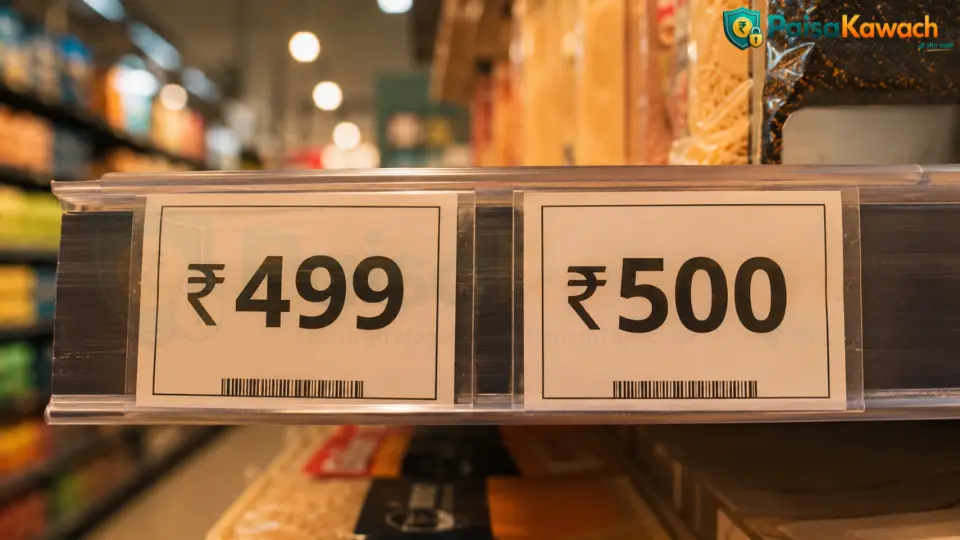
For most of the last century, if you wanted to sell something and make it feel cheaper than it actually was, you ended the price in .99. ₹499 instead of ₹500. $19.99 instead of $20. It was simple, it was everywhere, and for a long time, it genuinely worked. Shoppers consistently perceived .99-ending prices as meaningfully cheaper than round numbers just one unit higher, even though the actual difference was negligible.
That trick hasn't disappeared. But its effectiveness has measurably eroded, and the reason isn't that psychology stopped working. It's that an entire generation of shoppers grew up seeing .99 pricing so constantly that it stopped registering as a signal at all. When a technique becomes universal, it stops functioning as information, because it no longer distinguishes a genuine deal from ordinary pricing.
Retailers noticed this decline well before most consumers consciously did, and they didn't abandon price psychology. They simply moved on to subtler techniques that don't rely on a trick shoppers have already learned to see through.
The classic explanation is "left-digit bias": people read prices left to right and anchor heavily on the first digit. ₹499 gets mentally filed as "four hundred something," while ₹500 gets filed as "five hundred," even though the actual gap is one rupee. This bias is real and well-documented, but it depends on the shopper not consciously noticing the trick being used on them.
The Problem: Everyone Learned the Trick
Left-digit bias works best when a shopper is processing a price quickly, without deliberate scrutiny. That was a reasonable assumption decades ago, when .99 pricing was novel enough to slip past conscious attention. It is a much weaker assumption today, after decades of near-universal exposure to the exact same pattern on nearly every price tag, menu, and checkout screen.
Once a technique becomes ubiquitous, it stops functioning as a signal and starts functioning as background noise. Shoppers today don't necessarily do the math consciously, but many have absorbed, at some intuitive level, that a .99 ending doesn't mean anything special. It's simply what prices look like. When everything ends in .99, nothing about ending in .99 tells you a product is genuinely a good deal.
The Data Behind the Decline
Studies on price-ending effects conducted more recently than the original research from decades past have found smaller effect sizes than earlier studies, particularly among younger, digitally native shoppers who do a large share of their price comparison online, where side-by-side numeric comparison is easy and left-digit anchoring has less room to operate. When you can see ₹499 and ₹520 stacked directly on top of each other on a comparison page, the psychological trick that depends on reading one price in isolation loses much of its power.
- Left-digit bias depends on prices being processed quickly and in isolation, not compared side by side
- Decades of universal .99 pricing have made the pattern feel like default noise rather than a meaningful signal
- Online shopping, where direct numeric comparison is easy, weakens the specific mechanism .99 pricing relies on
What Retailers Are Actually Doing Now
Rather than abandoning pricing psychology altogether, retailers have shifted toward techniques that don't depend on a single, widely recognized trick. These newer approaches tend to work on subtler cognitive mechanisms, ones shoppers haven't yet been trained to discount.
Counterintuitively, many premium and direct-to-consumer brands now deliberately use round numbers like ₹2,000 ($24) instead of ₹1,999 ($23.99). A clean round price signals confidence and quality, distancing the brand from the "discount trick" association .99 pricing now carries in shoppers' minds.
Round-Number Pricing as a Premium Signal
One of the more interesting shifts is the deliberate return to round numbers, but for the opposite reason .99 pricing was originally used. Where .99 pricing signals "bargain," round numbers now increasingly signal "premium" and "confident." A ₹2,000 price tag reads as considered and deliberate. A ₹1,999 price tag increasingly reads as a discount-store tactic. Brands positioning themselves as higher-end have picked up on this and shifted toward round pricing specifically to avoid looking like they're playing the old game.
Drip Pricing: Splitting the Cost Across the Checkout Flow
A much more significant shift than .99 endings has been the move toward what's known as drip pricing: showing an attractively low base price upfront, then revealing additional mandatory costs, service fees, taxes, delivery charges, one step at a time as the checkout process continues. By the time the true total appears, the shopper has already committed enough attention and effort to the purchase that abandoning it feels like a bigger loss than simply accepting the higher final number.
- An attractively low headline price gets shown first, before any mandatory add-on costs
- Additional fees are revealed incrementally through the checkout process, not all at once upfront
- By the final step, sunk cost in time and attention makes abandoning the purchase feel costlier than accepting the real total
Anchoring Through Fake "Original" Prices
Another technique that has grown significantly more sophisticated than .99 pricing ever was is strikethrough anchoring: showing a crossed-out "original" price next to a current, lower price, even when the item may never have actually sold at that original price for any meaningful length of time, or at all. This isn't really about the final price looking small in absolute terms. It's about the final price looking small relative to a reference point the retailer controls entirely.
Unlike .99 pricing, which shoppers have learned to mentally discount, strikethrough anchoring continues to work because the comparison itself feels like useful, objective information, "here's what it used to cost, here's what it costs now", rather than an obvious psychological nudge. Regulators in several countries have begun cracking down on clearly fabricated reference prices, but enforcement remains inconsistent, and the technique remains widespread.
Why This Anchor Works Better Than a Single Price Ending
A .99 ending only ever gives you one number to react to. A strikethrough anchor gives you two: a reference point and a "discounted" point, and the relationship between them does the psychological work, regardless of what either individual number actually looks like. This makes it considerably more flexible and harder to consciously discount than a price-ending trick, because the shopper's attention is directed toward the size of the apparent discount, not the suspicious specificity of the final digit.
- Strikethrough pricing provides a comparison point the retailer fully controls, not just a single number to react to
- The perceived size of the "discount" does the psychological work, regardless of whether the original price was ever real
- Regulatory scrutiny exists in some markets, but enforcement remains inconsistent and the technique stays common
Before trusting a "was ₹X, now ₹Y" price tag, check a price history tool or browser extension that tracks the item's actual historical price. Many "original" prices shown in strikethrough were never the item's typical selling price at all.
Personalized and Dynamic Pricing: The Biggest Shift of All
Perhaps the most significant change since the .99 era isn't a new price-ending convention at all, but the move toward dynamic and personalized pricing, where two shoppers looking at the identical product may see genuinely different prices based on browsing history, device type, location, or purchase timing. This shift makes price psychology far more individualized and far harder to detect than a uniform pricing rule ever was.
Where .99 pricing applied the same trick to every shopper equally, and was therefore possible to learn and discount collectively, dynamic pricing operates differently for each individual, making it much harder for shoppers to build the kind of shared, collective awareness that eventually blunted the effectiveness of .99 endings.
Why Personalized Pricing Is Harder to "Learn Around"
Collective consumer skepticism toward .99 pricing developed precisely because the technique was uniform and visible to everyone at once, allowing the pattern to become common knowledge over time. Personalized pricing removes that shared visibility. If your price and a friend's price for the identical item genuinely differ, there is no single, learnable pattern to become skeptical of, only a fragmented, individually experienced pricing environment that resists the kind of collective psychological immunity that eventually wore down the .99 trick.
- Dynamic pricing personalizes the price itself, not just the psychological framing around a shared price
- Without a uniform, shared pattern, consumers cannot build the same collective skepticism that blunted .99 pricing
- This makes modern pricing techniques structurally harder to detect and discount than older, uniform tricks
What This Means for How You Actually Shop
None of this means every business using round pricing is being more honest, or that every .99 price tag is meaningless. It means that price psychology hasn't disappeared, it has simply moved to techniques that current shopper awareness hasn't caught up to yet, the same way .99 pricing itself once was.
Questions Worth Asking at Checkout
- Is the price I'm seeing the same price everyone else would see right now, or could it be personalized based on my device or browsing history
- Am I seeing the full total upfront, or is this a base price that mandatory fees will be added to later in the checkout flow
- If there's a "discount" shown, does an independent price history actually support the claimed original price
The Bigger Pattern: Tricks Expire, Psychology Doesn't
The decline of .99 pricing isn't really a story about one specific technique failing. It's a story about how psychological tricks have a shelf life once they become common knowledge, and about how the underlying human tendencies those tricks exploit, anchoring, reference-point comparison, incremental commitment, don't go away just because one particular expression of them stops working.
Retailers didn't get less interested in influencing perception when .99 pricing lost some of its edge. They simply moved to methods current collective awareness hasn't caught up to. Recognizing that pattern, rather than any single pricing trick, is what actually helps you shop with clearer eyes.
Keep Reading: More Personal Finance Insights
 The Specific Reason Your Bank Rounds Interest Calculations in Its Favor, Not Yours
Next →
The Specific Reason Your Bank Rounds Interest Calculations in Its Favor, Not Yours
Next →
 Why Grocery 'Shrinkflation' Is Easier to Hide in Some Products Than Others, and How to Actually Spot It
Comments
No comments yet. Be the first to comment!