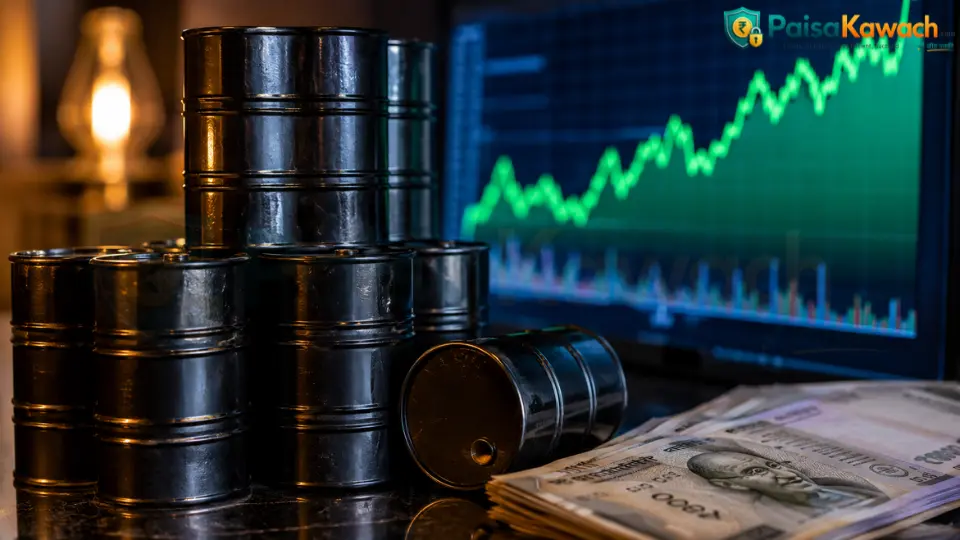
It started as a geopolitical crisis on the other side of the world — a war between the US, Israel, and Iran, fought over a 104-mile waterway called the Strait of Hormuz. Within 17 days, it has disrupted India's crude supply, crashed the Sensex by its worst weekly margin in four years, pushed the rupee to record lows — and quietly killed the dosa counter at Infosys campuses across three cities. That last detail is not trivial. It is the most visceral sign of how deeply this energy shock has penetrated Indian daily life. When a geopolitical war reaches the corporate canteen, it has crossed every firewall that separates global events from the everyday Indian.
📊 Crisis Snapshot — 17 March 2026
LPG Black Market
₹3,000 / cylinder
Nifty 50 (Mon close)
23,408 (+257 pts)
FII Outflow (Mon)
₹9,365 Crore
USD / INR
₹92.35 (record zone)
India VIX
21.51 (elevated)
Crisis Day
Day 17 of blockade
Companies Disrupted
6+ major IT firms
🏠 Corporate India
From Household Gas to Corporate Kitchens: The LPG Crisis Goes Mainstream
Most energy crises announce themselves through petrol pump queues or cooking gas shortages at home. This one has done something rarer — it has walked straight into the glass-and-steel campuses of India's most prestigious technology companies, disrupting the daily rhythms of hundreds of thousands of urban workers who had no idea a war in the Persian Gulf would determine what they eat for lunch.
The mechanism is straightforward, even if the scale is not. The government, under the Essential Commodities Act, has prioritised domestic household LPG to protect 333 million homes. That rationing has slashed commercial LPG deliveries — the kind that power industrial burners and live cooking counters at corporate campuses, railway kitchens, hospital canteens, wedding halls, and restaurant chains. What follows is a chain reaction now visible across India's biggest employers.
333M
Indian homes on
LPG cooking gas
60%
India's LPG from
imports
6+
Major IT firms with
canteen disruptions
₹3,000
Black market price
per LPG cylinder
Company by Company: Who Did What
Infosys
Menu Slashed
India's second-largest IT firm emailed employees across Bengaluru, Pune, and Chennai on 11 March, describing an "impending situation" with LPG. From 12 March, live cooking counters — including dosa and omelette stations — were suspended. Food courts now operate on a limited menu with some items sourced externally. Employees are asked to bring meals from home. Over 300,000 employees affected across three cities.
HCLTech
WFH Declared
India's third-largest IT firm by revenue took the most decisive step: it offered Chennai office employees work-from-home on 12 and 13 March after canteens ran completely out of LPG. Tapan Acharya, CRO at Keka HR: "The cylinder shortage is prompting some companies to literally rewire and repeat the Covid-era WFH model." Other HCL cities — Noida, Lucknow, Bengaluru, Hyderabad — were not equally affected.
TCS
Bring Your Tiffin
At TCS's Commerce Zone campus in Pune's Yerawada, employees were told to bring their own lunchboxes. A TCS employee told a national daily: "Only dal-rice was available at the canteen till Friday. We have been advised to bring our own tiffin as the LPG supply shortage has caused a reduction in menu options." TCS's main Pune operations office was less affected — the impact is uneven even within a single company.
Cognizant
BYOF Advisory
Cognizant issued a formal "Bring Your Own Food" (BYOF) advisory company-wide. It is also exploring alternate food vendors using induction or solar-based cooking instead of LPG — a pivot that signals the longer-term operational rethinking now underway at large corporates. Cognizant employs over 350,000 people in India.
Wipro
Canteen Cuts
Wipro has reduced canteen offerings across campuses and withdrawn high-gas cooking options. Like peers, it is pivoting to induction-cooked basics like dal-rice and pre-packaged meals. Employee unions are flagging inconvenience to HR, particularly for long-distance commuters who depend entirely on campus meals during their workday.
HTC Global Services
Full Shutdown
HTC Global informed employees that canteen services at Chennai, Bengaluru, and Hyderabad offices are fully shut. Only packed snacks are available until normalisation. A more severe response than most Indian IT majors — suggesting smaller corporate kitchen operations have far thinner LPG reserves to draw on in a prolonged shortage.
🚉
Railway Crisis
IRCTC: India's Train Meals Are Now at Risk
The Indian Railways Catering and Tourism Corporation has directed station kitchens to switch from LPG to microwave ovens and induction cooktops for passenger meals. But station canteen managers are pushing back: "Cooking food for thousands of passengers on induction stoves is simply not practical given the passenger load." If IRCTC kitchens shut, the impact falls hardest on millions of daily long-distance train travellers — especially in tier-2 and tier-3 cities where onboard food is often the only meal option.
"We urge IT companies to allow a 'work from hometown' option for the time being, till LPG gas supply is streamlined and canteens run back to normal. Hundreds of thousands of migrant tech workers are now caught between strict five-day office attendance mandates and empty cafeterias."
— Pavanjit Mane, President, Forum for IT Employees (FITE), Maharashtra
💡 The Bigger Picture
The corporate canteen crisis is not just an HR inconvenience — it is a measurable drag on productivity and employee morale at a time when India's IT sector is already navigating US trade probe uncertainty, rupee depreciation, and global demand softness. A return-to-office mandate becomes a flashpoint when the office can no longer feed its own workers.
🏭 Energy Markets
Brent at $104: The Two Outcomes India Is Watching Closely
Brent crude climbed as high as $106 on Sunday before settling around $103–$105 in early Tuesday trade. Both Brent and WTI have now logged four consecutive weeks of gains — the longest winning streak since 2022. Brent was trading near $70 per barrel on 27 February. Within two weeks of the US-Israel strikes on Iran, it crossed $100. The Strait of Hormuz, through which roughly 20% of global oil passes, went from a shipping lane to a war zone overnight.
For India — which imports 85% of its crude — every $10 rise in Brent adds approximately ₹70,000–80,000 crore to the annual import bill, widens the current account deficit, pressures the rupee, and eventually feeds into retail inflation across fuel, food, paint, tyres, plastics, and aviation. At $103, India is paying roughly 47% more per barrel than it was three weeks ago.
The Two Binary Outcomes That Will Define India's Markets
🔥 If US Strikes Kharg Island
$115–$120
Kharg Island handles over 90% of Iran's crude exports. A US military strike removes roughly 1.5 million barrels per day from global supply overnight. Brent spikes to $115–$120. For India: rupee collapses further, CAD blows out, inflation spikes, RBI is forced to act, and Nifty could test 22,000–22,500. This is the tail risk to hedge against.
⚓ If Hormuz Coalition Confirms
$82–$88
A confirmed multi-nation naval escort through Hormuz is the single biggest positive catalyst of 2026. Brent falls sharply as supply risk premium evaporates. For India: rupee recovers, FIIs return, Nifty rallies 5–7%, and LPG supply normalises within 2–3 weeks. This is the relief scenario markets are waiting for.
📢 Why IEA's Release Isn't Enough
The International Energy Agency released an unprecedented
400 million barrels from emergency reserves. But
S&P Global estimates the supply loss from just 1–11 March alone was 430 million barrels — already exceeding the entire release. Ben Emons, CIO of FedWatch Advisors, called it "a water pistol, not a bazooka." The problem is a physically closed pipe. No reserve release restores supply through a blocked Strait.
How the Crude Shock Ripples Through India
| Sector / Item | Impact | Status |
|---|
| LPG (Domestic) | Shortage; black market at ₹3,000/cylinder | Crisis |
| Corporate Canteens | Infosys, TCS, HCL, Cognizant, Wipro disrupted | Active |
| Aviation Fuel | IndiGo fuel surcharge activated 14 March | Active |
| Current Account Deficit | +₹70–80K Cr/yr per $10 Brent rise | Worsening |
| Rupee | Record lows; RBI intervening daily | Under Pressure |
| Retail Inflation (CPI) | 3.21% now — imported inflation building | Risk Rising |
| OMCs (HPCL/BPCL/IOCL) | ₹45/litre diesel loss; ₹2,000 Cr/day bleed | Critical |
| Fertilizer / Urea | Urea up 43% globally; Kharif sowing at risk | Building |
| Coal / Upstream Oil | Revenue windfall; Coal India +4% this week | Positive |
📈 Investor Outlook
What Indian Investors Should Watch and Do This Week
🚢
Hormuz Coalition Announcement — Most Important Trigger
WSJ reports this could come as early as this week. If confirmed even in principle, expect Brent to fall $10–$15 per barrel and Nifty to rally 3–5% in a single session. This one event changes everything for India's energy and market outlook simultaneously.
⚓
22 Indian Ships Still in Persian Gulf
MEA provides daily briefings. Each successful crossing is a positive sentiment signal. The Indian Navy's bilateral corridor with Iran is currently the only operational route — and it remains fragile. A single hostile incident could close it.
📊
F&O Monthly Expiry — Thursday, 20 March
Expiry week plus geopolitical volatility means wide intraday swings in both directions. Watch 23,700 put OI and 24,000 call OI. Keep positions light. Post-expiry Friday close is the cleanest market signal for the balance of March.
💰
Buy: Coal India, ONGC, Oil India, Defence PSUs
The only sectors with structural tailwinds in the current environment. Coal India sits at record inventory. ONGC and Oil India benefit directly from high crude realisations. Defence PSUs are seeing geopolitical re-rating of their order books.
🚫
Avoid: Auto, OMCs, L&T, IT (near term)
Auto faces fuel cost and demand headwinds. OMCs are bleeding ₹2,000 crore per day. L&T has heavy Middle East order exposure. IT faces US trade probe pressure and rupee-denominated margin compression. None of these pressures resolve quickly.
💡 PaisaKawach View
The canteen story is not a human-interest sidebar. It is the clearest signal that this energy crisis has penetrated India's formal economy more deeply than most people acknowledge. When the country's largest tech employers — companies that collectively employ over 1.5 million people — are telling workers to bring their own dabbas, the supply chain disruption has crossed from commodity markets into operational business reality. That is a different kind of crisis. And it will take a different kind of resolution — not just ships crossing Hormuz, but sustained, normalised energy supply — before corporate India can truly return to business as usual.
Disclaimer: This article is published for informational and educational purposes only. All data and quotes are sourced from publicly available reports as of 17 March 2026. This does not constitute investment advice. Please consult a SEBI-registered financial advisor before making any financial decisions. PaisaKawach.com is not responsible for financial decisions made based on this content.
India LPG crisis corporate 2026, Infosys canteen LPG shortage, HCLTech WFH LPG crisis, TCS Wipro LPG shortage India, IRCTC railway meals LPG shortage, Brent crude $104 India March 2026, Hormuz LPG crisis India, commercial LPG shortage corporate India, India energy crisis business impact 17 March 2026, Cognizant BYOF LPG crisis, FITE Maharashtra LPG crisis IT workers, India Hormuz energy crisis markets


 India's Energy Crisis & Market Shock: How the Strait of Hormuz War Is Reshaping India's Economy — 16 March 2026
Next →
India's Energy Crisis & Market Shock: How the Strait of Hormuz War Is Reshaping India's Economy — 16 March 2026
Next →
 HDFC Bank Chairman Exit Triggers Stock Fall: What Atanu Chakraborty’s Resignation Means for Investors