India–Middle East Trade Corridor in 2026: Emerging Business Opportunities, Strategic Shifts, and Economic Impact
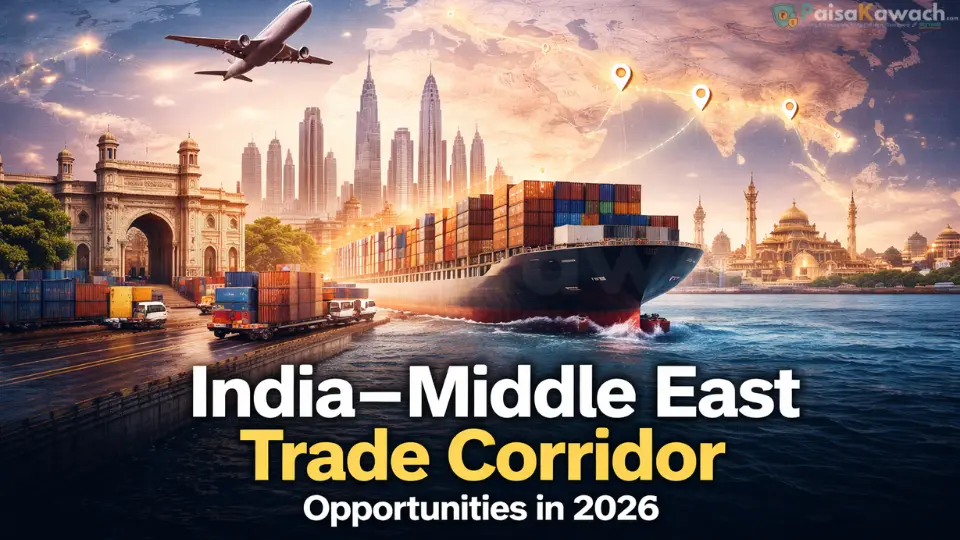
India–Middle East Trade Corridor: Why It Matters in 2026
The India–Middle East trade corridor has moved from a long-term strategic concept to a tangible economic reality in 2026. As global supply chains recalibrate and geopolitical alliances evolve, this corridor is emerging as one of the most consequential trade routes for India’s external commerce, investment flows, and strategic positioning.
Stretching across South Asia, the Arabian Peninsula, and onward to Europe and Africa, the corridor is not merely about faster shipping routes. It represents a structural shift in how India engages with energy markets, manufacturing ecosystems, logistics networks, and regional geopolitics. For businesses, this transformation is opening up new opportunities across sectors—from ports and infrastructure to technology, exports, and financial services.
Unlike traditional trade routes that evolved organically over decades, the India–Middle East trade corridor is being actively shaped by policy alignment, capital investment, and geopolitical intent. This makes it particularly relevant for companies planning medium- to long-term strategies in 2026 and beyond.
India–Middle East Trade Corridor Snapshot
- Key regions involved: India, Gulf Cooperation Council (GCC), Levant, Europe
- Primary drivers: Supply chain diversification, energy security, geopolitical realignment
- Core sectors impacted: Logistics, energy, manufacturing, exports, finance
- Strategic timeline: Accelerated development post-2024, expansion phase in 2026
- Business relevance: Long-term trade cost reduction and market access
Understanding the Corridor: More Than a Trade Route
The term “India–Middle East Trade Corridor” refers to a multi-modal network of maritime routes, ports, rail links, logistics hubs, and digital trade frameworks connecting India with the Middle East and beyond. Unlike legacy sea routes dependent on a single chokepoint, the corridor is designed to offer redundancy, resilience, and speed.
At its core, the corridor aims to integrate Indian manufacturing and services with Middle Eastern logistics capabilities and Europe’s consumption markets. This integration is particularly significant at a time when global trade is becoming more regionalised and politically sensitive.
For India, the corridor reduces overdependence on any single geography while strengthening ties with energy-rich Gulf economies. For Middle Eastern countries, it diversifies economic engagement beyond hydrocarbons and positions them as critical nodes in global trade.
Why 2026 Is a Turning Point
While discussions around enhanced India–Middle East connectivity have existed for years, 2026 marks a shift from planning to execution. Infrastructure projects are reaching operational phases, policy coordination is improving, and businesses are beginning to factor the corridor into their supply chain decisions.
This timing coincides with broader global trends: slowing globalisation, rising geopolitical risk, and increasing emphasis on trusted trade partnerships. As a result, the corridor is no longer a speculative idea—it is becoming embedded in trade strategies.
Logistics and Infrastructure: The Backbone of Opportunity
Logistics is the most immediate beneficiary of the India–Middle East trade corridor. Ports, shipping companies, freight forwarders, and warehousing operators are witnessing increased interest as cargo flows begin to diversify.
Indian ports on the western coast are seeing capacity expansion and modernisation to handle higher volumes and specialised cargo. Simultaneously, Middle Eastern ports are positioning themselves as transshipment and value-added logistics hubs rather than mere transit points.
For logistics companies, the corridor offers an opportunity to move up the value chain—from basic transport to integrated supply chain solutions.
Rail connectivity and inland logistics within the Middle East further enhance the corridor’s appeal. Faster movement of goods from ports to consumption centres reduces transit time, improves inventory management, and lowers working capital requirements for businesses.
Implications for Indian Exporters
Indian exporters stand to benefit significantly from improved logistics efficiency. Reduced transit times and lower uncertainty make Indian goods more competitive in Middle Eastern and European markets.
Export-oriented sectors such as engineering goods, chemicals, pharmaceuticals, textiles, and food products are particularly well positioned. For small and mid-sized exporters, access to reliable logistics infrastructure can be a decisive factor in scaling operations.
Energy Trade: Stability and Strategic Leverage
Energy remains a central pillar of India–Middle East economic relations. The trade corridor strengthens India’s access to energy resources while offering Middle Eastern producers a stable and growing demand base.
Beyond crude oil and natural gas, the corridor is increasingly relevant for new energy segments such as green hydrogen, renewable energy equipment, and energy storage solutions. India’s push toward energy transition aligns with Gulf countries’ diversification strategies.
This evolving energy relationship creates opportunities for Indian companies in engineering, project management, and energy services, as well as for financial institutions involved in funding large-scale projects.
Risk Mitigation Through Diversification
One of the corridor’s less discussed benefits is risk mitigation. By diversifying energy sourcing routes and partnerships, India reduces exposure to supply disruptions and geopolitical shocks.
For businesses dependent on energy inputs, this stability translates into better cost predictability and planning confidence—critical factors in capital-intensive industries.
Manufacturing and Value Chains: A Regional Rebalance
The India–Middle East trade corridor is accelerating a reconfiguration of manufacturing value chains. Instead of a linear model where goods move from Asia to Europe, the corridor enables a hub-and-spoke approach with the Middle East as an intermediary manufacturing and assembly base.
Indian manufacturers can leverage this structure to access new markets while optimising production costs. Joint ventures and contract manufacturing arrangements are becoming more common as companies seek to localise parts of their operations closer to end markets.
For Middle Eastern economies, this trend supports industrial diversification goals by attracting manufacturing investment and technology transfer.
Sectors Poised for Growth
- Automobile components and electric vehicle supply chains
- Pharmaceutical formulation and packaging
- Food processing and agri-based exports
- Electronics assembly and precision engineering
These sectors benefit from proximity to raw materials, energy availability, and improved market access through the corridor.
Trade Finance and Banking: Expanding the Financial Layer
As trade volumes grow, so does the need for sophisticated financial infrastructure. Banks, non-banking financial companies, and fintech firms are finding new opportunities in trade finance, cross-border payments, and currency risk management.
The corridor is encouraging closer cooperation between Indian and Middle Eastern financial institutions. This cooperation enhances credit availability for exporters and importers while supporting large infrastructure projects.
Efficient trade finance is often the difference between a trade corridor existing on paper and functioning effectively in practice.
For Indian banks with international ambitions, the corridor provides a platform to expand overseas presence and deepen relationships with global clients.
Technology and Digital Trade Enablement
Digital infrastructure is increasingly central to the success of the India–Middle East trade corridor. From customs clearance to shipment tracking, technology reduces friction and improves transparency.
Indian technology firms are playing a growing role in developing digital trade platforms, logistics software, and data analytics solutions tailored to cross-border commerce.
This creates export opportunities not just for goods, but for services and intellectual property—areas where India has a comparative advantage.
Data, Compliance, and Cybersecurity
As digital trade expands, issues around data governance and cybersecurity gain prominence. Businesses operating along the corridor must navigate multiple regulatory regimes while protecting sensitive commercial information.
This environment is driving demand for compliance services, cybersecurity solutions, and regulatory technology—opening another avenue for Indian firms.
Geopolitical Dimensions and Strategic Alignment
The India–Middle East trade corridor cannot be separated from its geopolitical context. It reflects a broader alignment of strategic interests among participating countries, including economic resilience, regional stability, and balanced global engagement.
For India, the corridor strengthens ties with key partners without compromising strategic autonomy. For Middle Eastern countries, it provides a pathway to diversify alliances and reduce dependence on any single global power.
This geopolitical stability enhances business confidence, encouraging long-term investments rather than short-term speculative activity.
Challenges and Constraints Businesses Must Consider
Despite its promise, the corridor is not without challenges. Infrastructure gaps, regulatory inconsistencies, and political sensitivities can slow progress if not managed effectively.
Businesses must also account for execution risk. Large-scale projects often face delays, and trade volumes may take time to reach projected levels.
Understanding these risks—and building flexibility into business models—is essential for companies seeking to benefit from the corridor.
What the Corridor Means for Indian SMEs
While large corporations dominate headlines, small and medium enterprises (SMEs) may be among the biggest long-term beneficiaries. Improved logistics, digital platforms, and trade finance access lower entry barriers for smaller exporters.
SMEs in manufacturing, agri-processing, and specialised services can tap into Middle Eastern markets that value quality, reliability, and competitive pricing.
Government support programs and industry associations will play a key role in ensuring SMEs can navigate regulatory and operational complexities.
Outlook: How Businesses Should Position for 2026 and Beyond
The India–Middle East trade corridor is still in its formative phase, but its trajectory is clear. Businesses that engage early—through partnerships, pilot projects, or market exploration—stand to gain a first-mover advantage.
Rather than viewing the corridor as a single opportunity, companies should see it as an evolving ecosystem. Success will depend on adaptability, collaboration, and a long-term perspective.
As global trade continues to fragment, corridors built on trust, alignment, and shared economic interests are likely to outperform traditional routes. In that context, the India–Middle East trade corridor represents not just an opportunity, but a strategic imperative for forward-looking businesses.
Keep Reading: More Personal Finance Insights
 When the Budget Does Not Align With You: How Individuals, Investors, and Businesses Should Respond
Next →
When the Budget Does Not Align With You: How Individuals, Investors, and Businesses Should Respond
Next →
 How to Save, Earn, and Build Wealth From Zero Before Starting Your Own Business — A Complete Guide for First-Generation Entrepreneurs
Comments
No comments yet. Be the first to comment!