Photo By:Patrick Robert Doyle on Unsplash
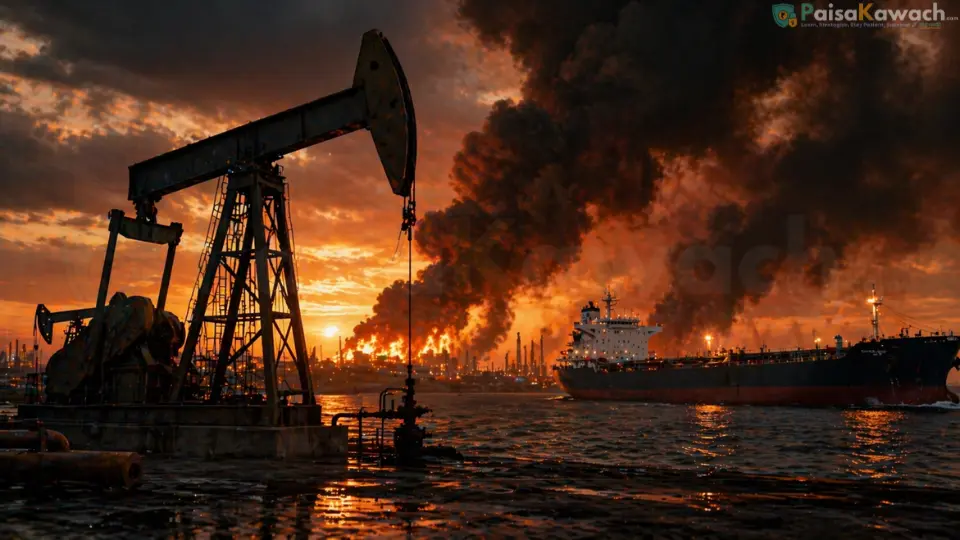
Global markets are entering a critical phase on April 24, 2026, as oil prices approach $110 per barrel amid escalating tensions in the Strait of Hormuz. This is no longer a temporary disruption — it is a full-scale economic risk event impacting markets, inflation, and global growth.
The most important takeaway: Rising oil prices are now driving global uncertainty, and the economic impact is already being felt worldwide.
After several days of escalating geopolitical tensions, the situation in the Strait of Hormuz has intensified further. Reports of ship seizures, increased military presence, and stalled diplomatic negotiations have pushed oil prices sharply higher. This has created immediate ripple effects across financial markets and global economies.
The Strait of Hormuz is one of the most strategically important waterways in the world, responsible for transporting nearly 20% of global oil supply. Any disruption in this region directly impacts energy availability and pricing, making it a central factor in global economic stability.
This is not just a geopolitical issue — it is a direct economic shock affecting fuel prices, inflation, and everyday costs.
Oil prices nearing the $110 mark represent a significant escalation compared to earlier levels. High energy costs increase transportation expenses, manufacturing costs, and ultimately consumer prices. This leads to rising inflation, which affects both developed and emerging economies.
For central banks, this creates a difficult policy environment. After months of managing inflation through interest rate adjustments, rising oil prices could force them to maintain tighter monetary policies. This would increase borrowing costs and slow economic growth.
Higher oil → higher inflation → higher interest rates → slower growth. This cycle is now actively shaping global market behavior.
Financial markets are already responding to these developments. The earlier optimism seen during ceasefire discussions has faded, replaced by caution and risk aversion. Investors are increasingly shifting toward safer assets such as the US dollar and gold, while equities face pressure.
The shift from “optimism” to “risk management” is one of the clearest signals that markets are entering a volatile phase.
Another major concern is the impact on global supply chains. Disruptions in oil transportation affect not only fuel availability but also the movement of goods and raw materials. Industries that rely heavily on logistics, such as manufacturing and aviation, are particularly vulnerable.
Businesses are already adjusting their strategies in response to these challenges. Many companies are delaying investments, reducing expansion plans, and focusing on cost control. This cautious approach reflects the uncertainty surrounding the global economic outlook.
Industries like airlines, shipping, and heavy manufacturing are among the most exposed, as fuel costs directly impact their profitability.
The broader economic impact is also becoming visible. In regions such as Europe, rising energy costs are affecting consumer confidence and increasing financial pressure on households. Governments are facing higher spending requirements while dealing with slower economic growth.
This is no longer limited to financial markets — the real economy is now feeling the impact through higher prices and reduced economic activity.
Currency markets are reflecting this shift as well. The strengthening of the US dollar indicates a move toward safety, while emerging market currencies are under pressure. This highlights the global nature of the current risk environment.
Interestingly, despite the broader challenges, certain sectors such as technology and artificial intelligence continue to show resilience. Strong earnings and long-term growth potential are helping these sectors maintain investor interest, creating a mixed market environment.
This divergence between sectors is a key characteristic of the current market phase. While some areas of the economy continue to perform well, others are struggling under the weight of rising costs and uncertainty.
This “split market” reflects uncertainty rather than stability, as investors selectively allocate capital to sectors perceived as safer or more resilient.
Looking ahead, the trajectory of global markets will depend on several critical factors. The most important is the stability of oil prices and the outcome of geopolitical developments in the Middle East. Any further escalation could push oil prices even higher, intensifying inflation and economic pressure.
On the other hand, any progress in negotiations or de-escalation could provide relief and stabilize markets. However, given the current situation, uncertainty is likely to remain high in the near term.
- Oil prices nearing $110 due to escalating Hormuz tensions
- Global markets turning volatile after recent optimism
- Inflation risks rising with higher energy costs
- Central banks may maintain higher interest rates
- Supply chain disruptions affecting global trade
- Investors shifting toward safe-haven assets
- Technology sector showing relative strength
- Global economy entering a high-risk phase
In conclusion, April 24, 2026, marks a significant turning point for the global economy. The escalation of geopolitical tensions and rising oil prices have created a challenging environment for markets, businesses, and policymakers. While opportunities may still exist, the risks are clearly increasing, and caution is essential.
The coming days will be critical in determining whether the situation stabilizes or escalates further, shaping the direction of global markets and economic growth.
stock market today 2026, oil near 110 impact, hormuz crisis escalation, global market volatility, inflation oil prices relationship, geopolitical impact economy, financial news April 24 2026