
Onion at ₹38, Sugar Diverted From Exports — What's Actually Behind the Government's Pre-Diwali Price Moves
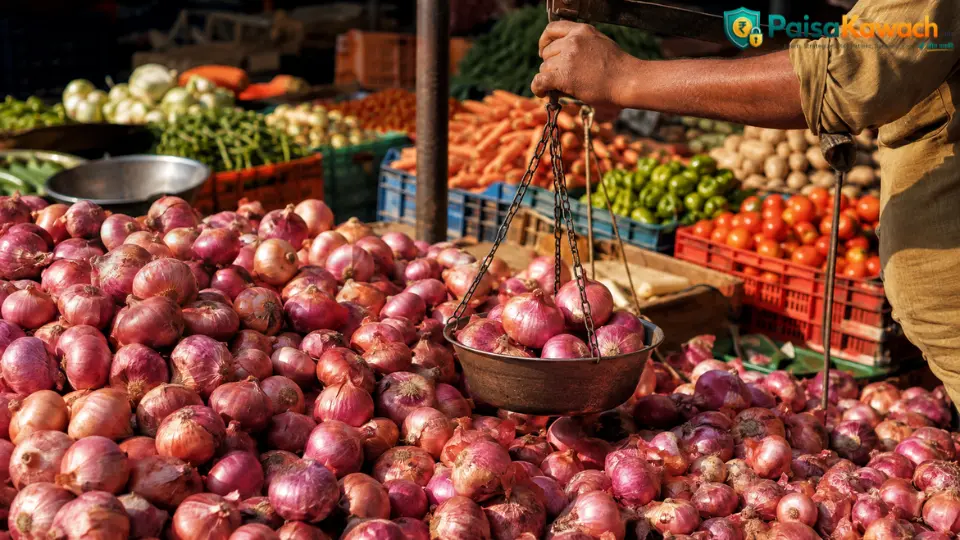
Every year, around this same time, a familiar pattern begins — the government starts talking about onions, buffer stocks, and export curbs, and most people skim past it as routine bureaucratic news. It isn't routine this year in one specific sense: the timing and scale of the current intervention, arriving on both onion and sugar simultaneously, is worth understanding properly if you're the one doing the household grocery shopping over the next two months, right through Diwali and the wedding season that follows.
What Actually Happened With Onions
The Department of Consumer Affairs has begun a calibrated release of onions from the government's buffer stock, with retail sales launched at ₹35 per kg through NCCF and NAFED outlets, mobile vans, and select retail chains including Safal and Kendriya Bhandar in Delhi. As of August 26, the all-India average retail price of onion stood at ₹37.87 per kg — meaning the government-subsidised rate is already running a couple of rupees below the open market price, a gap designed specifically to pull average prices down as more of this stock reaches consumers.
The scale of preparation behind this is genuinely larger than in recent years. For 2026-27, the government set a procurement target of 2 lakh metric tonnes of Rabi onion specifically for the Price Stabilisation Fund, with procurement beginning back on May 15 through NAFED and NCCF. As of the latest figures, around 1.21 lakh tonnes have already been procured. In a first for this buffer program, the Central Warehousing Corporation has been engaged as the dedicated storage agency for this year's stock — a structural change aimed at reducing spoilage and improving how quickly stock can actually reach markets when needed.
Why the Timing Matters More Than the Numbers Themselves
Onion prices in India follow a well-documented seasonal pattern, typically climbing through the festive stretch that runs from Onam and Ganesh Chaturthi through Durga Puja, Dussehra, Diwali, and into the wedding season — a period of consistently elevated demand across millions of households at the same time. The government's own messaging explicitly frames this release as pre-emptive, timed to arrive before that seasonal demand surge fully kicks in, rather than as a reactive scramble after prices have already spiked sharply. That distinction is genuinely meaningful: intervention timed ahead of a demand spike tends to be considerably more effective at moderating price swings than intervention that arrives only after retail prices have already climbed and consumer frustration has set in.
- The buffer release began before the core festive season fully arrives, reflecting a deliberately pre-emptive rather than reactive approach to price management this year
- Engaging the Central Warehousing Corporation as a dedicated storage agency for the first time suggests the government is trying to improve the speed and reliability of stock disbursement compared to previous years
- The government has stated further releases will be calibrated based on market conditions, arrivals, and demand, meaning the scale of intervention could expand meaningfully if prices climb faster than currently expected
The Sugar Story Running in Parallel
Alongside the onion measures, the government is diverting 3.5 lakh tonnes of sugar originally intended for export back into the domestic market, as local sugar prices have come under upward pressure. This kind of export-to-domestic diversion is a familiar policy tool, but its timing alongside the onion intervention is worth noting — it suggests the government is watching multiple essential commodities simultaneously heading into the same festive stretch, rather than reacting to a single isolated price problem.
Why Sugar and Onion Together Signals Something Broader
A single commodity facing seasonal price pressure is normal and expected every year. Two major kitchen staples requiring active government intervention in the same window is a somewhat stronger signal that broader supply-chain or demand-side pressures are building across food markets heading into the festive season, rather than either issue being purely crop-specific or isolated to one commodity's own particular supply story.
- Diverting export-bound sugar back to domestic markets directly increases local supply without requiring new production, offering a faster fix than waiting for the next harvest cycle
- Coordinated intervention across two separate essential commodities in the same period suggests the government is treating this festive season's price pressure as a broader, multi-commodity concern
- Both measures share the same underlying logic: increasing domestic availability specifically ahead of peak seasonal demand, rather than after prices have already climbed
What This Means for Your Kitchen Budget
For an ordinary household, the practical takeaway isn't to panic-buy or stockpile — that behavior tends to worsen exactly the kind of short-term price spikes these interventions are designed to prevent. It's simply useful to know that subsidised onion is available at ₹35 per kg through NCCF, NAFED, Safal, and Kendriya Bhandar outlets and mobile vans in several cities, running below the current open-market average, and that the government has explicitly signalled willingness to expand this release further if prices climb faster than expected through the festive months.
A Useful Habit for the Coming Two Months
Rather than tracking every daily price movement, the more useful habit through Diwali and the wedding season is checking whether your city has an active NCCF, NAFED, or Kanda Express-linked subsidised outlet nearby — the government's rail-based Kanda Express initiative alone moved nearly 88,000 tonnes of onions to 16 cities last year, a sharp increase from roughly 12,000 tonnes to five cities the year before, showing the distribution network itself has scaled up considerably. Knowing where your nearest subsidised outlet is can meaningfully soften the impact of any short-term price spike during the busiest shopping weeks of the year.
- Subsidised onion at ₹35 per kg is already available through multiple retail channels in several cities, running below the current open-market average price
- The government's expanded rail-based distribution network (the Kanda Express initiative) has scaled up substantially, improving how quickly buffer stock reaches consuming centres compared to previous years
- Checking for a nearby subsidised outlet is a more useful preparation step through the festive season than reacting to daily price headlines in isolation
The Bigger Pattern Worth Understanding
This isn't the first year the government has released buffer onion stock or diverted export sugar ahead of a festive season — it's become a fairly consistent, recurring tool. What makes this year's version worth paying attention to is the combination of earlier timing, expanded storage infrastructure, and simultaneous action on two separate commodities, all arriving before the core festive demand surge rather than after it. Understanding this pattern once means you'll recognise it every year going forward, and can plan your festive-season shopping with a clearer sense of where genuine relief is available, rather than reacting to price headlines as they appear.
Keep Reading: More Insights You Might Like

Comments
No comments yet. Be the first to comment!