Why Businesses Separate Revenue From Cash: The Difference Between Sales, Profit and Money in the Bank
One of the most important ideas in business finance is also one of the easiest to misunderstand: revenue is not the same thing as cash.
A company can make a sale today, record revenue today, and still wait weeks or months before receiving the money. A different company can receive a large amount of cash today but recognize that amount as revenue over a longer period, depending on what the payment represents and the applicable accounting rules.
This distinction explains why a business can appear profitable while struggling to pay its bills, or appear to have plenty of money in the bank even though its current operating performance is weak.
Accounting systems therefore separate economic activity from cash movements. The International Accounting Standards Board explains that accrual accounting is designed to show the effects of transactions in the periods in which those effects occur, even when the related cash receipts or payments happen in a different period. This gives users information about performance and resources that cash movements alone cannot provide.
Understanding this difference is useful not only for accountants. Business owners, investors, managers, lenders and employees can all make better decisions when they know why revenue and cash are reported separately.
Revenue Answers One Question, Cash Answers Another
Revenue asks: How much value did the business earn from its ordinary activities during a period?
Cash asks: How much money actually entered or left the business during that period?
Those questions are related, but they are not identical.
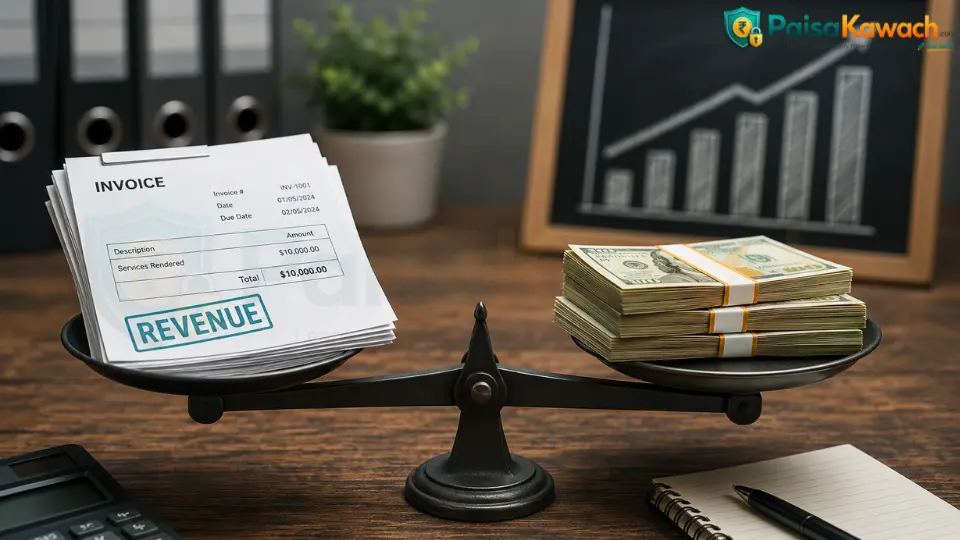
Imagine a consulting company completes a $10,000 project in December and sends the customer an invoice that is payable in 60 days. Under an applicable accrual-based accounting framework, the company may recognize the earned revenue in December even though the $10,000 does not arrive in its bank account until February.
The December financial statements can therefore show $10,000 of revenue without showing a $10,000 increase in cash.
When the customer finally pays, the company's cash increases, but the payment is not necessarily another $10,000 of December or February revenue. The later cash receipt settles an amount that was already recognized as receivable.
A simple example
Consider a small software consulting business:
- December 15: The company completes a project worth $20,000.
- December 20: The company invoices the customer for $20,000.
- December 31: The customer still has not paid.
- January 30: The customer pays the $20,000 invoice.
If the business is using accrual accounting and the revenue recognition requirements have been satisfied, the economic activity can affect December's revenue even though the cash does not arrive until January.
The unpaid amount can generally appear as an accounts receivable rather than cash. The business has a right to receive money from the customer, but it does not yet have that money available in its bank account.
This is one reason financial statements use several different measures instead of presenting a single number called “money made.”
Why Businesses Cannot Reliably Measure Performance Using Cash Alone
Cash is real and essential, but cash timing can distort the apparent performance of a business when considered by itself.
Suppose a customer pays a company $120,000 upfront for a 12-month service contract. The business may have received the entire amount in January, but that does not automatically mean January's economic performance was $120,000 of revenue. Depending on the arrangement and applicable accounting rules, the payment may relate to services that the company will provide over future months.
In other words, cash can arrive before the business has earned all of the related revenue.
The opposite can also happen. A business can earn revenue before receiving cash.
That creates two different timing problems:
- Revenue before cash: The business has earned money from customers but is waiting for payment.
- Cash before revenue: The business has received money but still has obligations to provide goods or services in the future.
- Revenue and cash at different times: The accounting period and the cash-settlement period do not always match.
Accrual accounting exists partly to place economic activity into the periods where it belongs rather than simply recording everything when money moves through a bank account. The IFRS Conceptual Framework specifically notes that accrual accounting provides a better basis for assessing an entity's past and future performance than information based solely on cash receipts and payments.
The invoice is not the bank balance
This is one of the most useful distinctions for small-business owners.
An invoice represents an amount that a customer owes under the applicable terms. It does not mean that the business can spend that money today.
A company could have $100,000 of outstanding customer invoices and only $5,000 in its bank account.
That company may have substantial assets in the form of receivables, but it can still struggle to make payroll, pay suppliers or cover rent if those customers do not pay on time.
That is why growing revenue does not automatically solve a cash-flow problem.
Revenue, Profit and Cash Are Three Different Financial Signals
Another common mistake is to treat revenue, profit and cash as three different names for the same result.
They measure different things.
Revenue generally describes income recognized from a business's activities before expenses are deducted.
Profit reflects the difference between recognized income and recognized expenses under the applicable accounting framework.
Cash represents money available in cash and cash equivalents, subject to how those amounts are defined and presented in the relevant financial statements.
These figures can move in different directions during the same month.
How the three numbers can diverge
- A company can have high revenue and low cash because customers have not paid their invoices yet.
- A company can have high profit and low cash because profit includes non-cash items or because cash is tied up in receivables, inventory or other assets.
- A company can have high cash and low current revenue because it received financing, owner investment, a loan or customer payments relating to future obligations.
This is why serious financial analysis does not stop at the income statement.
The cash-flow statement provides information about how cash and cash equivalents changed during the period. Under IAS 7, cash flows are classified into operating, investing and financing activities, providing a different perspective from the income statement.
The Accounts That Explain Where the Difference Goes
When revenue and cash do not match, the difference usually has a logical accounting explanation.
Accounts receivable: revenue has been earned, but cash has not arrived
Accounts receivable represents amounts customers owe the business.
For example, a company might provide $50,000 of services in March and invoice the customers with payment due in April. The March accounting records may reflect the earned revenue while the $50,000 remains an amount receivable rather than cash.
The financial risk is obvious: if customers pay late or fail to pay, the business may have reported revenue without receiving the expected cash on time.
Deferred or unearned revenue: cash arrived, but the work remains
Consider a customer who pays $12,000 upfront for an annual service.
The business has cash, but it may still have an obligation to provide services during the following months. Depending on the applicable accounting rules and the contract, the amount may be recorded as a liability until the related performance obligations are satisfied.
That means a strong bank balance does not automatically mean the company has earned all of the money it has received.
Inventory: profit and cash can move at different speeds
A retailer can spend cash purchasing inventory long before the inventory is sold.
For example, a business might pay a supplier $80,000 for goods in June. The goods may remain in inventory for several months before customers purchase them.
Cash has already left the business, but the accounting treatment is not necessarily the same as immediately treating the entire purchase as an expense of the current period.
This is another reason cash-based observations can produce misleading conclusions about short-term profitability.
Why Cash Flow Can Matter More Than Revenue for Survival
Revenue tells you about business activity, but businesses ultimately need enough liquidity to meet their obligations.
A company cannot normally pay employees with an outstanding invoice. It cannot pay a supplier with a promise that a customer will pay next month. It cannot use reported profit to settle a bill unless that profit has resulted in accessible funds.
This is why a rapidly growing company can sometimes experience financial stress despite impressive sales.
The growth trap
Imagine a company that grows from $100,000 to $300,000 in monthly sales.
At first glance, that sounds excellent.
But suppose customers are allowed to pay 60 days after receiving invoices while the company must pay employees and suppliers within two weeks.
As sales grow, the amount of money tied up in receivables can also grow.
The company may therefore need additional working capital to finance the gap between paying its own bills and collecting money from customers.
This creates a counterintuitive situation:
- More sales can create more accounts receivable.
- More accounts receivable can increase the amount of cash tied up in the business.
- More cash tied up in receivables can increase short-term funding pressure.
The company can be economically successful and still experience a liquidity problem.
Why Investors Look at Both Profitability and Cash Generation
Investors typically need to understand both the reported financial performance of a company and its ability to generate cash.
A profitable business that consistently converts its operating performance into cash can have very different financial characteristics from a business whose reported profits are accompanied by rapidly increasing receivables or inventory.
This does not mean that every difference between profit and cash is suspicious. Timing differences are a normal part of accrual accounting.
The important question is why the numbers differ and whether the difference makes economic sense.
Questions worth asking
- Are receivables increasing faster than revenue?
- Is the company collecting customer invoices efficiently?
- Is cash being consumed by inventory growth?
- Is the business receiving customer payments before delivering the promised service?
- Are financing activities providing cash that could be mistaken for operating strength?
Cash-flow information can therefore act as an important second lens through which financial performance is evaluated. IAS 7 explicitly provides for the reconciliation of profit or loss with operating cash flow under the indirect method by adjusting for non-cash transactions, accruals and deferrals, among other items.
Cash Accounting and Accrual Accounting Are Not the Same
It is important to distinguish between the general idea of separating revenue from cash and the specific accounting method a business uses.
Under a cash method, income is generally reported when it is received, while expenses are generally recognized when they are paid, subject to the applicable tax and accounting rules.
Under an accrual method, income is generally recognized when earned and expenses when incurred, rather than simply when money changes hands. The IRS describes these differences in its guidance for U.S. taxpayers, although tax rules are jurisdiction-specific and should not be generalized to every country.
A worldwide reader should be careful with tax rules
The underlying economic distinction between earning revenue and receiving cash is broadly useful, but tax accounting rules are not universal.
Different jurisdictions can have different requirements for revenue recognition, tax reporting, inventory, advance payments, small-business accounting methods and changes in accounting methods.
For example, the IRS permits both cash and accrual methods in circumstances defined by U.S. tax law, while also imposing specific rules and restrictions on certain businesses.
Therefore, a general business-finance article should not be used to decide how a particular company must calculate taxable income.
The Most Useful Mental Model: Three Timelines
A simple way to understand this entire subject is to imagine that every transaction can have several timelines.
The three-timeline model
- Performance timeline: When the business actually provides the product or service and earns the related income.
- Accounting timeline: When the transaction is recognized under the applicable accounting framework.
- Cash timeline: When money actually enters or leaves the bank account.
Sometimes all three happen on the same day.
Sometimes they are separated by weeks, months or even longer periods.
That separation is not necessarily an accounting error. It is often exactly what the financial statements are designed to show.
Consider a yearly software subscription paid in advance. The cash timeline may begin on January 1. The service-performance timeline extends across the year. The revenue recognition timeline may similarly extend across the service period according to the applicable accounting requirements.
Looking at only the January bank statement would tell only part of that story.
Why Separating Revenue From Cash Makes Financial Statements More Useful
Imagine two businesses, each reporting $1 million in annual revenue.
Business A collects most customer payments quickly. Its customers generally pay within a few weeks, and its receivables remain under control.
Business B reports the same revenue but allows customers to delay payment for months. Receivables are growing rapidly, and the company needs increasing amounts of working capital to keep operating.
The two businesses have identical revenue, but they do not have identical financial profiles.
Separating revenue from cash allows the reader to see that difference.
Likewise, imagine two companies with the same amount of cash in the bank.
One generated that cash from normal operations. The other borrowed the money.
The bank balances may look identical, but the economic meaning is completely different.
This is why financial statements provide multiple perspectives rather than reducing a business to one number.
What Business Owners Should Watch in Practice
For a small or growing company, the lesson is not to ignore revenue. Revenue is a critical indicator of demand and business activity.
The lesson is to never interpret revenue without considering its conversion into cash.
A practical monthly review
- Compare revenue with actual cash collected from customers.
- Review how much money customers still owe the business.
- Check whether receivables are growing faster than sales.
- Review upcoming supplier, payroll, tax and financing obligations.
- Separate operating cash generation from cash raised through loans or investments.
- Investigate unusually large differences between reported profit and operating cash flow.
These checks can help reveal problems before they become obvious in the bank account.
The Big Idea
A business does not become financially healthy simply because it reports more revenue.
Revenue measures one aspect of economic performance. Cash measures liquidity. Profit measures the relationship between recognized income and expenses. Accounts receivable, inventory, payables, debt and other balance-sheet items help explain why these numbers can differ.
The separation is deliberate.
Revenue tells you what the business has earned. Cash tells you what has actually moved into or out of the business. Neither number, by itself, tells the entire financial story.
Once you understand that distinction, many seemingly confusing business situations become easier to explain: profitable companies running short of cash, rapidly growing companies needing financing, large upfront customer payments that are not immediately equivalent to earned revenue, and differences between accounting profit and operating cash flow.
For anyone learning business finance, this is one of the most useful concepts to master because it changes the question from “How much money did the company make?” to the much more informative questions: “When was it earned, when was it recognized, when was it collected, and where is the cash now?”
Keep Reading: More Investing Basics Insights
 RBI Is Rolling Out Plastic ₹10 and ₹20 Notes, Here's Why and What It Actually Means for You
Next →
RBI Is Rolling Out Plastic ₹10 and ₹20 Notes, Here's Why and What It Actually Means for You
Next →
 Retail Traders Lost ₹91,685 Crore in F&O Trading Last Year, Here's What the Data Actually Shows
Comments
No comments yet. Be the first to comment!