Sensex Eyes 77,000 on Expiry Day as Micron's Blowout Quarter Lifts Global Tech, But Iran Inspection Standoff Keeps Rupee on Edge

Indian equity markets head into Thursday's session, June 25, 2026, with genuine momentum behind them for the first time this week. A sharp recovery on Wednesday, a blowout earnings report from US memory-chip giant Micron Technology, and a continued slide in crude oil prices have combined to lift sentiment across Dalal Street. Yet beneath the optimism, an unresolved diplomatic standoff between the United States and Iran over nuclear site inspections is quietly keeping risk managers, currency traders, and the Reserve Bank of India on alert, a reminder that this rally is being built on a foundation that could shift quickly.
Market Update: Nifty Reclaims 24,000, Sensex Nears Expiry-Day Test
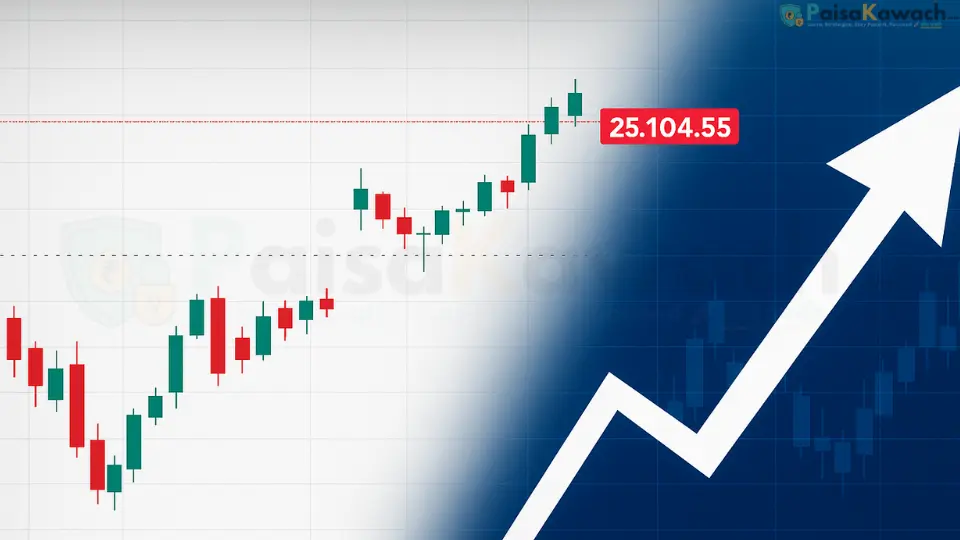
Wednesday's session was a clean reversal of the pain seen earlier in the week. The Nifty 50 surged 197.55 points, or 0.83 percent, to close at 24,021.65, decisively reclaiming the psychologically important 24,000 mark. The BSE Sensex matched the move, jumping 790 points to settle at 76,991.22. The rally was led by Bank Nifty, which surged 1.68 percent on expiry-day short covering, while Nifty IT staged an impressive 2.05 percent recovery after two consecutive sessions of heavy selling. Nifty Realty also joined the advance, climbing 2.17 percent.
The intraday range told its own story of a market finding its footing. The Nifty 50 swung from a session low of 23,789.25 to a session high of 24,090.05 before settling near the top of that range, a sign that buyers stepped in firmly at lower levels. India VIX, the market's fear gauge, eased to 13.33 from 13.94, reflecting reduced anxiety about near-term volatility even as the broader global backdrop remains unsettled.
Today, June 25, is the BSE Sensex weekly options expiry, and this adds a layer of intraday complexity that traders cannot ignore. Option sellers are currently defending the 77,000 level as the max-pain point, a price at which the maximum number of options contracts would expire worthless. This dynamic typically pulls the index toward that level as expiry approaches, and the effect is usually most pronounced between 2:00 PM and 3:15 PM, when option writers actively manage their positions. With Wednesday's Sensex close at 76,991.22, just nine points below the max-pain level, the setup suggests a high probability of a relatively range-bound outcome for the broader market today, barring a fresh shock from global markets.
IT Stocks Lead the Comeback After a Punishing Two-Day Selloff
Information technology stocks, which had been the worst-performing segment of the market through Monday and Tuesday, staged a strong comeback on Wednesday. Infosys closed at 1,056.60 rupees, up 2.65 percent, while the broader Nifty IT index's 2.05 percent gain made it one of the best-performing sectors of the day. ICICI Bank was the standout performer in the banking space, closing at 1,373.60 rupees, up 2.64 percent, as financials rode the wave of Bank Nifty expiry-related buying.
This recovery in IT is particularly significant because it comes just hours before what may be the single most important data point for the sector all week: the market reaction to Micron Technology's earnings, reported after the US market closed on Wednesday. Because Indian IT stocks tend to move in close correlation with the Nasdaq and broader US technology sentiment, a strong reaction to Micron's numbers could extend Wednesday's bounce into Thursday's session and beyond.
Micron's Blowout Quarter Resets the Global Tech Narrative
The earnings report that the entire global tech and semiconductor complex had been waiting for finally arrived, and it did not disappoint. Micron Technology reported fiscal third-quarter revenue of 41.46 billion dollars, smashing the 35.25 billion dollar consensus estimate by nearly 18 percent and representing growth of almost 346 percent compared to the 9.3 billion dollars reported in the same quarter a year earlier. Non-GAAP earnings per share came in at 25.11 dollars, comfortably beating the 20.28 dollar estimate by close to 24 percent, marking the company's seventh consecutive quarter of earnings beats.
The scale of the profitability improvement was just as striking as the revenue growth. GAAP net income surged to 28.24 billion dollars, up from a mere 1.89 billion dollars in the prior-year period, while gross margins expanded dramatically to 84.6 percent on a GAAP basis, compared to just 37.7 percent a year earlier. Micron's leadership did not hold back in describing the results. Chief Executive Officer Sanjay Mehrotra called it an exceptional quarter, highlighting that data center revenue alone exceeded 25 billion dollars for the period, putting the business on an annualized run rate of more than 100 billion dollars.
Markets responded immediately and decisively. Micron's stock, which had closed the regular Wednesday session down slightly at 1,047.20 dollars after a brutal selloff earlier in the week, rocketed higher in after-hours trading, rising as much as 15 percent to trade near 1,199.52 dollars. This pushed the company's market capitalization to approximately 1.16 trillion dollars. The rally was not contained to Micron alone. The VanEck Semiconductor ETF jumped roughly 3 percent in after-hours trading, while the Roundhill Memory ETF surged closer to 10 percent, as investors concluded that fears of an AI-spending slowdown had been overdone, at least for now.
Perhaps the most important detail for long-term investors was Micron's disclosure of 16 long-term strategic customer agreements signed with data center operators and automakers, locking in sales commitments over three-to-five-year periods. Management indicated that roughly half or more of the company's future revenue could eventually come from these binding agreements, a structural shift that, if it holds, would reduce the historical boom-and-bust cyclicality that has long made memory-chip stocks notoriously volatile. Guidance for the current quarter was equally aggressive, with the company projecting revenue of approximately 50 billion dollars, plus or minus 1 billion dollars, alongside non-GAAP earnings per share guidance of 31 dollars, plus or minus 1 dollar.
Crude Oil Extends Its Slide to Multi-Month Lows
Away from equities, the crude oil market is sending an unmistakably bullish signal for India's macro outlook. Oil prices fell below 71 dollars a barrel on Wednesday, marking the lowest level seen since before the US-Iran conflict first erupted, as rising tanker traffic through the Strait of Hormuz and continued progress in peace negotiations boosted confidence that supply disruptions are easing. Brent crude dropped 0.8 percent to settle near 76.4 dollars, while West Texas Intermediate slipped 0.9 percent to around 72.6 dollars, with both benchmarks touching multi-month lows during the session.
A particularly telling signal came from the futures curve itself. Brent's prompt spread, a closely watched indicator of near-term supply tightness, shifted into bearish contango on Wednesday for the first time since the conflict began, suggesting traders now see ample near-term supply rather than scarcity. This pricing comes even as official data from the US Energy Information Administration showed that American crude inventories have fallen to their lowest level since 1984, a divergence that some analysts attribute to aggressive inventory liquidation across the Middle East rather than a genuine recovery in production. For energy-importing economies like India, the sustained decline in crude prices offers real relief in the form of lower inflationary pressure, reduced import bills, and improved margins for fuel-sensitive sectors such as aviation, paints, and tyres.
- Nifty 50 closed up 0.83 percent at 24,021.65 on Wednesday, reclaiming the 24,000 level; Sensex jumped 790 points to 76,991.22.
- Today, June 25, is the Sensex weekly options expiry, with option sellers defending the 77,000 max-pain level, creating the highest volatility risk between 2:00 PM and 3:15 PM.
- Micron Technology posted fiscal Q3 revenue of 41.46 billion dollars and EPS of 25.11 dollars, both smashing estimates, sending shares up as much as 15 percent in after-hours trade.
- Crude oil fell below 71 dollars a barrel, the lowest level since before the US-Iran conflict began, as Strait of Hormuz tanker traffic normalizes.
- A key sticking point remains unresolved: Iran insists nuclear site inspections will only happen after a final deal is signed, even as the US claims Tehran has fully agreed to allow inspectors back.
- The rupee remains under structural pressure, having touched a record low near 96.96 against the dollar before RBI intervention helped stabilize it, with forex reserves falling to 681.4 billion dollars as a result.
The Unresolved Fault Line: Iran's Nuclear Inspection Standoff
While markets have rallied on the assumption that a lasting US-Iran peace framework is taking shape, a critical sticking point remains unresolved and deserves close attention from investors. The head of the United Nations' atomic energy agency has stated that inspections of Iran's nuclear enrichment sites are a required part of the interim deal currently being negotiated. Iran, however, has taken a starkly different position, insisting that any such inspection visit would only be permitted after a final, comprehensive deal is formally signed, not before. Adding to the confusion, the US side has publicly claimed that Tehran has fully and completely agreed to allow inspectors to return to the bombed nuclear facilities, a claim that stands in direct contradiction to Iran's own stated position.
This is not a minor technical disagreement. It is precisely the kind of verification gap that has repeatedly caused oil markets to swing sharply over the past several weeks, with single sessions seeing three-to-five percent moves in either direction depending on whether diplomatic signals turned positive or negative. The entire rally in risk assets, including the drop in crude oil to multi-month lows, rests heavily on the assumption that this interim framework holds and eventually converts into a final agreement. If verification talks stall or break down entirely, the same tanker traffic through the Strait of Hormuz that has been driving oil prices lower could reverse course just as quickly, sending crude back toward its wartime highs and reintroducing the kind of volatility that hit Indian IT and banking stocks earlier this week.
What This Means for the Rupee and RBI Policy
For India specifically, the Iran-related uncertainty connects directly to currency and monetary policy. The Reserve Bank of India's own recent assessments make clear that global shocks tied to this conflict have already had a measurable impact on the domestic economy. India's foreign exchange reserves fell to 681.4 billion dollars for the week ending May 22, a decline that reflects heavy central bank intervention aimed at protecting the rupee from excessive volatility. During the period of most acute market pressure, the rupee weakened to a record low near 96.96 against the US dollar before RBI action helped stabilize the currency. Economists have pointed to a combination of global dollar strength, elevated crude prices at the time, and foreign capital outflows as the primary drivers behind that depreciation.
The RBI's own policy decisions reflect how seriously the central bank is taking these external risks. At its June meeting, the RBI kept its key repo rate unchanged at 5.25 percent for a third consecutive meeting, maintaining a neutral policy stance explicitly because of the weakening rupee and the inflationary pressure stemming from the Middle East conflict. More tellingly, the central bank lowered its GDP growth forecast for the current fiscal year to 6.6 percent, down from an earlier estimate of 6.9 percent, while simultaneously raising its inflation forecast to an average of 5.1 percent for the year, up from a previous estimate of 4.6 percent. The RBI specifically cited higher LPG, base metal, plastic, and rubber prices, all of which are sensitive to global crude and commodity price swings, as key drivers behind the upward revision to its inflation outlook.
This is a critical point of context for investors evaluating today's market optimism. The same crude oil decline that is being celebrated as a tailwind for Indian markets is happening against a backdrop where the RBI has already had to revise its growth forecast downward and its inflation forecast upward, specifically because of the volatility this Iran-related uncertainty has created over recent months. The central bank's own messaging has been consistent: India's economic fundamentals remain comparatively strong, with domestic demand, healthier bank balance sheets, and government-led infrastructure investment all providing support, but resilience is not the same as immunity. The RBI has been explicit that India remains vulnerable to imported inflation, sudden oil price spikes, and broader global market volatility, even as it continues to outperform many other large economies currently facing weaker consumer demand and slowing industrial activity.
FII and DII Flows: A Tug of War Continues
Institutional flow data continues to highlight a familiar pattern playing out in Indian markets this year. Domestic institutional investors have provided a strong cushion against volatility, with DII buying totaling 66,215 crore rupees on a month-to-date basis in June alone, a figure that helps explain why Indian markets have managed to recover relatively quickly from sharp selloffs like the one seen earlier this week. Foreign institutional investors, by contrast, have remained considerably more cautious through the year as a whole, reflecting the broader unease created by global rate uncertainty, a historically strong US dollar, and the unresolved geopolitical situation in the Middle East. This divergence between steady domestic buying and more hesitant foreign participation is likely to remain a defining feature of Indian market dynamics through the remainder of this fiscal year, particularly as global central banks, including the US Federal Reserve, continue weighing their next moves on interest rates.
Technical Outlook for Thursday's Session
From a technical perspective, Wednesday's strong close has shifted the near-term setup back toward cautious optimism. Analysts now place 23,900 as the critical post-rally support level for the Nifty 50, a zone that aligns closely with Wednesday's opening price of 23,795, which was quickly reclaimed during the session. A sustained hold above 23,900 would keep the broader outlook constructive and open the door toward the next resistance zone near 24,150. On the downside, given that today marks the Sensex weekly expiry, traders should be prepared for the possibility of a temporary dip toward 23,950 or below during the volatile 2:00 PM to 3:15 PM window, a pattern that occurs as option writers actively defend the 77,000 max-pain level on the Sensex. Such a dip, if it occurs, is generally viewed by technical analysts as expiry-related noise rather than a genuine trend reversal, particularly given the meaningful compression already seen in India VIX.
What Investors Should Watch Going Forward
For investors and traders tracking Indian markets, the days ahead present a genuinely layered set of catalysts to monitor closely. First, today's Sensex expiry and the defense of the 77,000 max-pain level will determine whether Wednesday's recovery can hold through the close. Second, the broader market reaction to Micron's blowout earnings, and whether that optimism translates into sustained buying in Indian IT names such as Infosys, TCS, and LTIMindtree over the coming sessions, will be an important signal for whether the global AI trade still has momentum. Third, and perhaps most importantly for the medium-term outlook, any fresh development in the unresolved Iran nuclear-inspection standoff has the potential to abruptly reverse the recent decline in crude oil prices, with direct knock-on effects for the rupee, RBI policy, and India's broader inflation trajectory.
Given the multiple moving parts at play, from a record-breaking US tech earnings season to an unresolved geopolitical standoff thousands of miles away, investors are well advised to avoid overreacting to any single day's price action and instead maintain a diversified, well-considered approach to their portfolios. As always, readers should consult a qualified financial advisor and verify the latest data directly from NSE and BSE before making investment decisions. This article is intended for informational and educational purposes only and does not constitute investment advice.
Keep Reading: More Insights You Might Like
 Sensex, Nifty Track Global Selloff as Micron Earnings, Fed Rate Decision Loom Large
Next →
Sensex, Nifty Track Global Selloff as Micron Earnings, Fed Rate Decision Loom Large
Next →
 Sensex, Nifty End Volatile Week Above Key Levels as Oil Crash, Israel-Lebanon Deal Reshape Market Mood
Comments
No comments yet. Be the first to comment!