Sensex, Nifty End Volatile Week Above Key Levels as Oil Crash, Israel-Lebanon Deal Reshape Market Mood

Indian equity markets wrapped up one of the most eventful weeks of 2026 so far, absorbing a sharp bout of expiry-driven volatility, a dramatic collapse in India's volatility gauge, and a fast-moving geopolitical narrative out of West Asia that flipped crude oil from a source of fear to a source of relief. With Friday, June 26 closed for Muharram, the week effectively compressed three major events — a Nifty weekly expiry, a Sensex monthly expiry, and a sweeping de-escalation in the Strait of Hormuz standoff — into just four trading sessions.
How the Week Unfolded: Monday to Friday
The week began on a buoyant note. Indian markets reopened on Monday, June 22 with broad-based gains after a weak Friday close driven by IT-stock weakness. The Sensex opened around 339 points higher, and Nifty IT, Pharma, Auto, FMCG and Metal all traded in the green as the market digested news of a US-Iran peace framework announced over the preceding weekend. However, optimism was tempered almost immediately: Iran's move to disrupt a key transit point and a US threat to resume strikes injected fresh uncertainty, even as Brent crude held below $80 a barrel on hopes that the worst of the supply-disruption risk was behind the market.
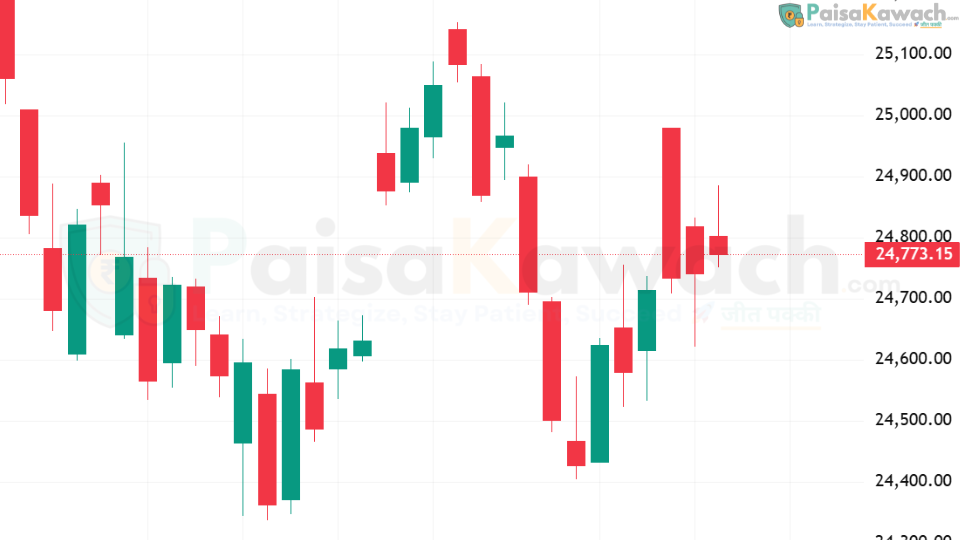
Tuesday brought the week's sharpest test. The Nifty's weekly expiry session triggered a sell-off that dragged the index down to its intraday low of the week — 23,789.25 — while India VIX, the market's fear gauge, spiked to an opening high of 27.32 for the week. Bank Nifty also slipped to its weekly low near 57,076 amid profit-booking in banking counters that had rallied hard in preceding sessions. FII flows remained a drag, with foreign institutional investors recording net outflows even as domestic institutional investors continued to absorb the selling.
The turning point came on Wednesday and Thursday. Crude oil, which had been sliding through the week as tanker traffic through the Strait of Hormuz accelerated to its fastest pace since the conflict began, gave Indian equities a powerful tailwind. Brent crude tumbled toward the $70s, then briefly toward $69 a barrel — its lowest level since February 27, the Friday before the Iran conflict first escalated — as Saudi Arabia resumed loading tankers at its Ras Tanura terminal and Gulf producers ramped up exports. The Bank Nifty posted its best single session of the week on Wednesday, up roughly 1.68%, as easing oil prices fed directly into the inflation and current-account-deficit outlook for India, the world's third-largest crude importer.
By Thursday, the Sensex and Nifty had recovered most of the week's early losses. The Sensex touched a weekly high of 77,803.18 intraday before settling at 77,100.47 on its monthly expiry — a clean settlement above the 77,000 "max pain" level that removed a chunk of the futures-and-options overhang heading into July. The Nifty 50 closed the week at 24,056.00, holding above the closely watched 24,000 psychological support level despite the volatility, while India VIX compressed dramatically from its Monday high of 27.32 to just 13.05 by Thursday — one of the sharpest weekly volatility contractions of the year, signalling that traders had largely priced out near-term geopolitical tail risk.
Financials were the standout sector for the week. The Reserve Bank of India clarified on Tuesday that commercial banks, including their overseas branches, can now extend loans to non-residents — or issue standby letters of credit to overseas lenders — against FCNR(B) deposits mobilised under the special swap scheme the central bank launched earlier this month. Banks were also permitted to place a lien on such deposits and lend directly to depositors without requiring liquidation. State Bank of India is already offering nine times leverage on these deposits, and brokerage Nomura has estimated the scheme could draw in roughly $55 billion of foreign currency inflows, with the bulk expected in August and September. The move follows a nearly $60 billion drawdown in India's forex reserves from their February peak of $728 billion, as the RBI sold dollars to defend the rupee through the West Asia conflict. Reserves have since started to recover, rising by $963 million to $672.587 billion in the week to June 19, with gold reserves alone jumping $4.11 billion.
The rupee mirrored the oil-driven mood swings through the week, weakening toward 95 per dollar on bouts of dollar strength and rising US rate-hike expectations, before strengthening back toward 94.3 as crude's collapse and likely RBI intervention provided support. Sector-wise for the week, banking and auto stocks led the gainers' board — Mahindra & Mahindra, Maruti Suzuki and IndiGo all posted strong advances — while IT, metals, Power Grid and Bharti Airtel lagged.
Global Markets: A Tale of Two Halves
While Indian markets spent the week climbing a wall of worry, Wall Street told a more cautious story. US equities were rattled through the week by an escalating sell-off in artificial-intelligence-linked stocks. Concerns over the scale of AI data-center spending, a New York Times report suggesting OpenAI may delay its IPO to next year, and South Korean chipmaker SK Hynix's plans for a nearly $30 billion US listing combined to pressure semiconductor names. The Nasdaq Composite slid into its fifth consecutive losing session by Friday, finishing the week down 4.6%, even though the Dow Jones Industrial Average — boosted by non-AI names such as Caterpillar, Johnson & Johnson and McCormick — touched a fresh intraday record above 52,600 and ended the week up 0.6%. The S&P 500 fell nearly 2% over the five sessions.
The standout corporate event of the week was Micron Technology's blockbuster earnings report on Wednesday evening, which showed record quarterly revenue of $41.46 billion and adjusted earnings of $25.11 per share. Micron shares surged more than 15% on Thursday on the back of surging demand for high-bandwidth memory, even as the broader semiconductor complex remained jittery over capital-spending sustainability. Elsewhere in dealmaking, Merck agreed to acquire life-sciences firm Bio-Techne for $11.3 billion, sending Bio-Techne shares up 19%, while Apple fell sharply after announcing price increases on its MacBook and iPad lineups, and Microsoft stock dropped after confirming higher Xbox console pricing.
Asian markets bore the brunt of the global tech unwind. South Korea's Kospi index plunged 8% intraday on Friday, triggering a circuit breaker, before closing down 5.8% for the day as the sell-off in US chip stocks spread across the region. The volatility underscored how concentrated global equity gains have become in a handful of AI-linked names, and how quickly sentiment can reverse when that trade wobbles.
The week's defining geopolitical development came on the diplomatic front: US Secretary of State Marco Rubio announced a US-brokered framework agreement between Israel and Lebanon, which Israeli Prime Minister Benjamin Netanyahu welcomed as a first step toward lasting regional peace and security. Analysts caution that Iran may still try to undermine the framework, and tensions flared separately when former President Donald Trump accused Iran of violating its ceasefire with the US by launching attack drones at commercial vessels transiting the Strait of Hormuz — even as actual tanker traffic through the waterway kept climbing toward its fastest pace since the conflict began. That contradiction — rising rhetoric alongside falling real-world disruption — was, in many ways, the story of crude oil's entire week: Brent erased its entire post-war risk premium, falling back to levels last seen the Friday before the conflict began, as fears of a supply shortage gave way to fears of an emerging 2026 global supply glut, with Iraq pushing OPEC for a higher production quota to recoup wartime losses.
What It Means Going Into Next Week
For Indian markets, the technical and macro backdrop heading into the new week looks constructive on balance. India VIX at multi-month lows, a clean Sensex monthly expiry settlement, and Nifty holding above its 24,000 floor all support a cautiously positive baseline. Tuesday, June 30 brings a heavy triple-expiry day — Nifty weekly and monthly expiry alongside Bank Nifty's monthly expiry — which could reintroduce short-term volatility. The most important swing factor remains the durability of the Israel-Lebanon framework and whether US-Iran talks hold through the weekend; any flare-up in the Strait of Hormuz could just as quickly send oil — and the rupee — back the other way.
Globally, investors are bracing for non-farm payrolls data and a holiday-shortened week in the US ahead of the July 4 break, with the AI-infrastructure spending debate likely to remain the dominant swing factor for global risk appetite. For India, the bigger structural story may be the RBI's forex-deposit push: if even a fraction of the projected $55 billion in NRI inflows materialises over August and September, it would mark a meaningful rebuilding of the reserve buffer that was drawn down during the West Asia conflict — and a cushion against the next bout of global volatility, whenever it arrives.
- Sensex closed the week at 77,100.47, Nifty 50 at 24,056.00, both holding key psychological support levels
- India VIX compressed from 27.32 to 13.05 — one of the sharpest weekly drops this year
- Brent crude fell nearly 10% on the week, erasing its entire West Asia war risk premium
- RBI cleared banks to lend against FCNR(B) deposits; Nomura estimates $55 billion in potential NRI inflows
- US-brokered Israel-Lebanon framework announced; Iran-US tensions over Strait of Hormuz persist
- Nasdaq fell 4.6% on the week on AI-spending and OpenAI IPO-delay concerns; Dow hit a fresh record high
- Micron posted record quarterly revenue of $41.46 billion; Merck to acquire Bio-Techne for $11.3 billion
Keep Reading: More Insights You Might Like
 Sensex Eyes 77,000 on Expiry Day as Micron's Blowout Quarter Lifts Global Tech, But Iran Inspection Standoff Keeps Rupee on Edge
Next →
Sensex Eyes 77,000 on Expiry Day as Micron's Blowout Quarter Lifts Global Tech, But Iran Inspection Standoff Keeps Rupee on Edge
Next →
 Stock Market Today June 29, 2026: Fed Rate-Hike Bets, US-Iran Ceasefire, and Persistent-Nagarro Deal Drive Global Markets
Comments
No comments yet. Be the first to comment!