The First 90 Days of a One-Person Business: What to Spend Money On and What to Avoid
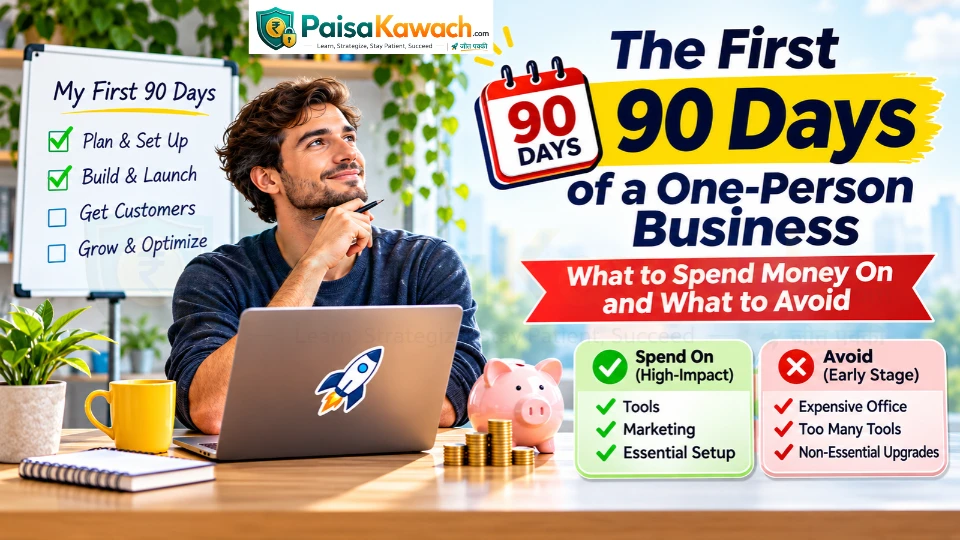
Your first 90 days are not a shopping spree. They are a series of small tests.
Every new founder faces the same temptation: buy the perfect website, subscribe to five apps, order business cards, and call it progress. But the milestone that matters is simpler: can you solve a real customer's problem, get paid, and repeat the process without running out of cash?
This guide gives solo entrepreneurs a 90-day spending plan, a startup-budget calculator, a break-even tool, and a practical checklist.
Whether you are starting a consulting practice, design service, tutoring business, independent agency, or small online venture, the central question is not “What should a professional business look like?” It is “What do I need to spend to make the next customer outcome possible?”
Important: Figures and examples in this article are illustrative planning tools, not universal spending targets. Legal obligations, insurance, taxes, and licensing vary by industry and location. A food business, regulated professional, or product seller may require more up-front investment than a home-based service business.
Before You Spend Anything: Separate Essential Costs From Attractive Distractions
List every possible purchase in three groups: required to operate safely and legally, directly helps you secure or serve a paying customer, and nice to have. This simple distinction prevents the common mistake of confusing setup activity with actual business traction.
Pay for the bottleneck—not for the appearance of success
- Spend early: required registrations and permits; a reliable way to communicate, invoice, and receive payment; essential equipment you do not already own; appropriate insurance where needed.
- Test before upgrading: a domain, landing page, scheduling app, email marketing, CRM, accounting software, and paid acquisition.
- Delay unless proven necessary: premium logos, elaborate branding packages, office leases, expensive equipment upgrades, stockpiled inventory, and annual software contracts.
The U.S. Small Business Administration's startup-cost guidance recommends distinguishing one-time expenses from ongoing monthly expenses. That distinction matters: a one-time purchase can hurt your starting cash; an unnecessary subscription can keep hurting your cash every month.
Try the Interactive 90-Day Startup Budget Calculator
Set your available startup money, one-time essentials, recurring costs, and personal safety reserve. The calculator shows whether your current plan fits within the cash you can actually risk. Change any number to explore different scenarios.
What can your first 90 days really afford?
Formula: available funds − one-time essentials − (3 × monthly business expenses) − untouched reserve. Taxes, debt payments, inventory, and living expenses must be added separately where applicable. Currency selection changes the symbol/format only; it does not convert exchange rates.
Days 1–30: Prove Somebody Wants Your Offer
Your mission: get evidence before you invest heavily
Start with a narrowly defined offer: “I help [specific customer] solve [specific problem] through [clear service or product].” Speak with potential buyers, ask how they solve the problem today, and seek a paid pilot, deposit, or small first order whenever appropriate. Compliments are encouraging; paid demand is stronger evidence.
Where your money should go during month one
- Essentials: required legal setup, reliable internet, necessary tools, payment collection, and a basic recordkeeping system.
- Trust: one clear services page or credible professional profile explaining the offer, proof of work, contact method, and next step.
- Customer learning: sample materials or a small prototype that lets a buyer evaluate the offer without a large commitment.
A practical experiment: contact 20 relevant prospects with a thoughtful, specific message. Track replies, discovery conversations, proposals, and paid conversions. Twenty is a manageable test size, not an industry benchmark or guaranteed route to a sale.
What to avoid in days 1–30
- Buying traffic before your offer and landing page are clear.
- Purchasing expensive equipment to feel ready rather than because work requires it.
- Building a complex website with dozens of pages before anyone has bought the core offer.
Days 31–60: Deliver, Measure, and Fix the Real Friction
Once real customers arrive, the most useful spending decisions become visible. Maybe you need more reliable invoicing, faster delivery, better packaging, or an appointment scheduler. Buy the fix only after you can identify the cost of the current problem.
Spend based on measurable constraints
- Customer experience: replace unreliable tools when failures cause delays or rework.
- Payment operations: use straightforward invoices, clear terms, and systematic follow-ups to reduce avoidable delays.
- Time savings: test automation on repetitive tasks once you know how frequently the tasks occur and how much time they consume.
For example, a scheduling tool costing $12 per month could be reasonable if it consistently saves 90 minutes of profitable work. But it is a poor purchase if nobody is booking meetings yet. Evaluate the actual value of your time and whether the saved minutes can be used productively.
Days 61–90: Double Down on What Customers Already Validate
By the third month, you should know more about which customers respond, which offers sell, and which steps consume too much effort. This is when selective growth spending becomes more defensible.
Three sensible investments after early traction
- Repeatable customer acquisition: invest in the channel that generated qualified conversations or sales, not the channel with the flashiest engagement numbers.
- Retention: create a follow-up routine, recurring service option, or simple after-sale check-in where it genuinely benefits customers.
- Financial visibility: update a 13-week cash forecast, reconcile transactions, and compare gross profit per project or order.
Do not confuse revenue with take-home income. Direct delivery costs, refunds, software, payment fees, taxes, and your own time all affect whether the business is viable.
Interactive Break-Even Calculator: How Many Sales Pay for Your Month?
Use this tool to estimate the number of sales needed to cover your monthly fixed business costs. It uses contribution margin: your selling price minus the variable cost per sale.
Find your minimum monthly sales target
Rounds up to whole sales. Assumes a consistent price and variable cost. Excludes income taxes, debt repayments, capacity limits, and other costs unless you include them in the inputs. This is a planning model, not a profitability guarantee.
The Spend-or-Skip Decision Quiz
Before buying a tool, service, or piece of equipment, answer these questions. The result is a decision aid—not an automatic approval to spend.
Should you buy it this week?
1. Is it legally required or necessary to serve a current paying customer safely?
2. Can you identify a specific revenue, time, or risk problem it solves?
3. Can you afford it without dipping into essential bills or your safety reserve?
A Simple 90-Day Example: Solo Designer With a Small Starting Budget
Imagine a designer beginning with $3,000 available for the venture. They set aside $1,200 that they cannot risk, spend $450 on essential setup, and budget $150 per month for ongoing business costs. Their modeled 90-day spending is $900, leaving $900 unallocated after the reserve. These are illustrative numbers, not typical industry costs.
| Expense | Decision | Why |
|---|---|---|
| Needed business registration | Pay when required | Compliance is not optional |
| Basic portfolio and contact page | Keep lean | Helps prospects judge fit |
| Premium logo package | Delay | Does not yet solve a proven bottleneck |
| Annual CRM subscription | Test free/manual first | Volume may not justify the commitment |
| Specialized design software | Buy if project requires it | Directly supports paid delivery |
The point is not that branding and software never matter. It is that timing and evidence matter more than looking established on day one.
Your Interactive First-90-Days Action Checklist
Tick off the activities you complete. Your progress is saved in this browser on this device when storage is available; the checklist does not send your information to a server.
Progress: 0 of 9
Frequently Asked Questions
How much does it cost to start a one-person business?
It depends on your business model, location, legal requirements, tools, and whether you sell services or physical products. Start by separating one-time essentials, recurring costs, and an untouched safety reserve. A home-based consulting business may have a very different cost structure from an inventory-based retail venture.
Should I build a website before getting my first client?
Often a simple portfolio, one-page site, or professional profile with an offer and contact method is enough to begin conversations. A complex custom site is usually easier to justify once the offer is validated. Some industries or sales channels require a full website earlier.
When should a solopreneur pay for advertising?
Consider paid advertising after you have a clear offer, a way to measure qualified leads or purchases, and sufficient cash for a controlled test. Track customer acquisition cost and contribution margin rather than impressions alone.
What is the biggest money mistake in the first 90 days?
A common risk is taking on recurring costs before understanding customer demand and cash flow. That said, skipping legal compliance, essential insurance, or safe delivery practices can be a far more serious mistake.
Can I run a one-person business while employed full-time?
Often yes, subject to your employment agreement, local rules, available time, and potential conflicts of interest. Budget for the business without assuming it will immediately replace your salary.
At Day 90, Ask These Five Questions Before Spending More
- Did anyone pay for the core offer, and what made them decide?
- Which activity produced the best qualified leads or repeat sales?
- After direct costs, how much is left per sale or project?
- What must be funded in the next 13 weeks, including taxes and obligations?
- What is the smallest next investment that could remove a real growth bottleneck?
Remember: You are buying evidence, not a business identity.
In the first 90 days, your advantage as a solo founder is flexibility. Keep your commitments modest, talk to customers, document your numbers, and spend when there is a reason—not because every other entrepreneur seems to own the tool.
Sources and Editorial Notes
Planning principles are informed by the U.S. Small Business Administration's startup-cost guidance and its business-planning guide. The spending scenarios, formulas, quiz, and 90-day workflow are original educational examples created for this article. For taxes, registrations, and insurance, consult the official authority and qualified advisers in your jurisdiction.
Keep Reading: More Gen Z Finance Insights

Comments
No comments yet. Be the first to comment!