Will FD Rates Go Up After RBI’s 0.25% Rate Hike?
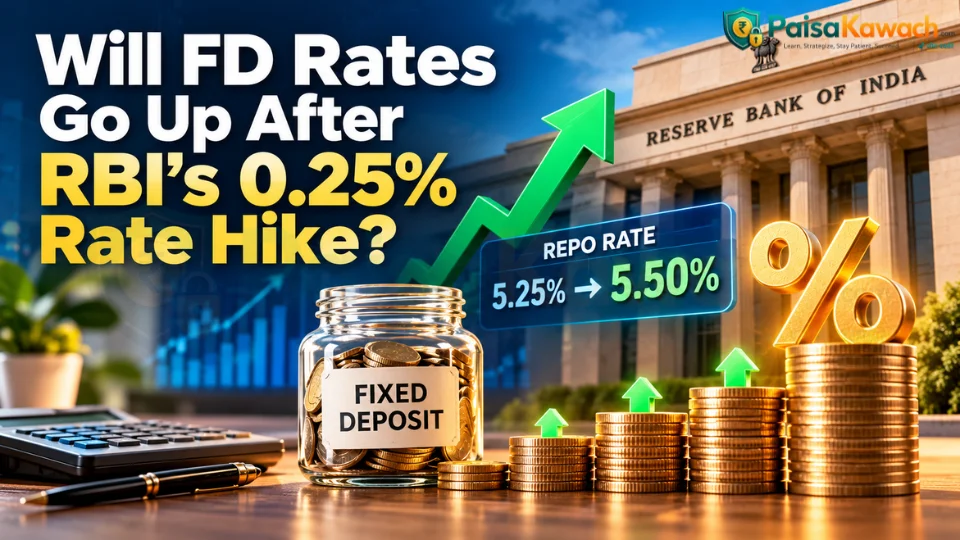
The Reserve Bank of India has raised the repo rate by 0.25 percentage point, taking it from 5.25% to 5.50%.
For home-loan borrowers, the immediate concern is whether borrowing will become more expensive.
For savers, the question is almost the opposite:
Will fixed deposit rates now go up?
The short answer is:
Possibly, but not automatically and not immediately at every bank.
A 25-basis-point increase in the repo rate does not force banks to increase fixed deposit rates by exactly 0.25%.
Some banks may raise selected FD rates quickly. Others may wait several weeks. Some may increase only certain tenures, while others may decide they already have enough deposits and do very little.
That makes this a more interesting decision than simply assuming:
“RBI raised rates, so my bank FD will also rise by 0.25%.”
This guide explains what could happen next, what happens to an FD you already own, whether you should wait before booking a new deposit, and how much difference even a 0.10% or 0.25% increase actually makes.
Quick Answer: Will FD Rates Rise After the RBI Hike?
What the RBI Hike Means for Fixed Deposits
A repo-rate increase can create upward pressure on FD rates, but banks still decide how much and when to revise them.
Why Can FD Rates Rise After a Repo Rate Hike?
Banks need money to lend.
One of the main ways they obtain that money is through deposits from customers.
When interest rates in the economy rise, banks may need to offer better returns to attract or retain deposits.
This becomes especially relevant when:
- Loan demand is strong.
- Banks need additional funding.
- Competing banks raise deposit rates.
- Government securities offer attractive yields.
- Small savings schemes offer competitive rates.
- Banking-system liquidity becomes tighter.
If a bank already has plenty of deposits and does not urgently need more funding, it may have less incentive to immediately raise FD rates.
Why FD Rates May Not Rise Immediately
This is where many savers misunderstand how interest rates work.
The RBI controls the repo rate.
It does not directly set the exact FD rate offered by your bank.
A bank can look at several factors before changing deposit rates.
1. How Much Money the Bank Already Has
If a bank has abundant liquidity, it may not need to aggressively compete for new deposits.
In that situation, increasing FD rates immediately would raise the bank's funding cost without providing much benefit.
2. How Fast Its Loans Are Growing
A bank experiencing strong loan growth may need to attract more deposits to fund that lending.
That can increase the incentive to offer better FD rates.
3. What Competitors Are Offering
Banks do not price deposits in isolation.
If competitors start offering significantly better returns, a bank may have to revise its own rates to avoid losing deposits.
4. Which FD Tenure the Bank Needs
A bank does not necessarily need to raise every FD tenure equally.
It might increase:
- 1-year rates.
- 400-day special deposits.
- 18-month rates.
- 2-year deposits.
while leaving 3-year or 5-year rates unchanged.
Could FD Rate Hikes Take Weeks?
Yes.
There is no rule saying banks must revise fixed deposit rates the day after an RBI policy decision.
Industry experts quoted after the October hike said some banks may respond within days, while others may take several weeks depending on liquidity and funding requirements.
That means you should not assume today's FD rate is automatically obsolete tomorrow.
What Happens to an Existing FD?
If you already have a fixed deposit, a new RBI rate hike normally does not change the interest rate on that deposit.
Suppose you booked:
- ₹5 lakh FD.
- 2-year tenure.
- 6.75% annual interest.
If your bank raises the rate for new 2-year FDs to 7.00% next month, your existing deposit generally continues earning 6.75% until maturity.
That is because the interest rate was fixed when you booked the deposit.
Does That Mean You Should Break Your Existing FD?
Not automatically.
This is one of the easiest mistakes to make when deposit rates begin rising.
Breaking an FD early can involve:
- Premature withdrawal penalty.
- A lower applicable interest rate for the period actually completed.
- Loss of expected interest.
- Tax consequences depending on your situation.
A new FD paying 0.25% more does not automatically mean switching is profitable.
Interactive Check: What Kind of FD Saver Are You?
I already have an FD and it matures in a few weeks
You may have little reason to break it early. You can wait for maturity and compare the available rates at that time.
I already have an FD with more than 2 years left
Do not break it simply because headlines say FD rates may rise. Compare the new rate benefit against any premature withdrawal penalty and lost interest.
I have cash and want to open a new FD today
You could book the full amount now, wait for possible revisions, or stagger the deposit across several dates. The best choice depends on whether certainty or the possibility of a slightly higher future rate matters more to you.
I depend on FD interest for monthly income
Do not delay an essential income plan purely because rates might rise. Consider staggering maturities so you are not forced to lock all your money at one rate.
I am a senior citizen
Compare senior-citizen rates separately because many banks offer an additional spread above ordinary deposit rates.
How Much Difference Does a 0.25% Higher FD Rate Actually Make?
Rate headlines can make a 0.25% increase sound enormous.
Let's look at the actual rupee difference.
Suppose you invest ₹5 lakh, approximately $5,200, for one year.
| FD Amount | Rate | Approx. Simple Annual Interest |
|---|---|---|
| ₹5,00,000 | 6.50% | ₹32,500 |
| ₹5,00,000 | 6.75% | ₹33,750 |
The difference is approximately:
₹1,250 over one year before tax.
That is useful money, but it also shows why you should not leave a large amount sitting idle for months simply hoping for a tiny rate increase.
₹1 Lakh FD: What Does +0.25% Mean?
For ₹1 lakh:
- 6.50% = approximately ₹6,500 annual interest.
- 6.75% = approximately ₹6,750 annual interest.
- Difference = approximately ₹250 per year before tax.
The exact maturity value can vary because banks may compound interest quarterly or according to the product structure.
₹10 Lakh FD: What Does +0.25% Mean?
For ₹10 lakh:
- 6.50% simple annual interest = ₹65,000.
- 6.75% simple annual interest = ₹67,500.
- Difference = ₹2,500 per year before tax.
The larger your deposit, the more meaningful even a small rate change becomes.
Should You Wait Before Booking a New FD?
This is probably the most important practical question right now.
The answer depends on why you are opening the FD.
Waiting Can Make Sense If:
- You do not urgently need to lock the money.
- You expect banks to revise deposit rates soon.
- You are comfortable keeping the money temporarily in a safe liquid account.
- You are willing to monitor rate changes.
Waiting May Not Make Sense If:
- You need guaranteed income immediately.
- You are leaving a large sum idle in a low-interest account.
- The current rate is already attractive for your goal.
- You are trying to perfectly time interest rates.
The Better Alternative: FD Laddering
Instead of trying to predict exactly where deposit rates will go, you can divide your money into multiple deposits.
This strategy is often called an FD ladder.
Example: ₹6 Lakh FD Ladder
Instead of putting ₹6 lakh into one 3-year FD, you could divide it:
- ₹2 lakh for 1 year.
- ₹2 lakh for 2 years.
- ₹2 lakh for 3 years.
When the first FD matures, you can review the rates available at that time.
If rates have increased, you may reinvest at a higher rate.
If rates have fallen, part of your money is still locked into the older higher-rate deposits.
Interactive FD Ladder Check
I have ₹1 lakh or less
You may not need a complicated ladder. Two deposits with different maturity dates can already provide useful flexibility.
I have ₹5 lakh
You could consider dividing the amount into 2-3 deposits rather than locking everything on one date.
I have ₹10 lakh or more
A multi-tenure ladder can reduce reinvestment risk and give you periodic access to part of the money.
Could Short-Term FD Rates Rise First?
Possibly.
Banks do not necessarily want to lock themselves into high long-term deposit costs if they believe inflation and interest-rate pressure could eventually ease.
That can make shorter or special-tenure deposits more likely candidates for selective rate revisions.
For example, a bank might offer a special:
- 400-day FD.
- 444-day FD.
- 18-month FD.
rather than raising every 5-year deposit rate.
Why Government Bond Yields Matter
Bank FDs compete with other relatively conservative investments.
If government securities offer attractive yields, investors may decide not to place all their money in bank deposits.
Banks may therefore need to improve deposit rates if alternative fixed-income products become more competitive.
Why Small Savings Schemes Matter
Government-backed small savings products can also compete with bank FDs.
Examples include:
- Public Provident Fund.
- National Savings Certificate.
- Senior Citizens' Savings Scheme.
- Sukanya Samriddhi Account.
- Post Office time deposits.
These products have different eligibility rules, tax treatment, liquidity and maturity periods, so an interest rate alone is not enough to determine which is better.
Could Small Finance Banks Raise FD Rates More Aggressively?
They could, because smaller banks sometimes use higher deposit rates to attract funding.
However, higher interest should never be the only factor in choosing a deposit.
You should also consider:
- The institution itself.
- Deposit insurance limits.
- Your total exposure to that bank.
- Premature withdrawal rules.
- Branch and digital servicing.
Important: Understand Deposit Insurance
Eligible bank deposits in India are covered by deposit insurance up to the applicable DICGC limit per depositor per bank, subject to the rules of the scheme.
That means someone placing a very large amount in one institution should understand how deposit insurance works rather than focusing only on the highest advertised interest rate.
Do not chase an extra 0.25% while ignoring concentration risk.
Senior Citizens: Could Rates Improve?
Senior citizens can potentially benefit more from an upward deposit-rate cycle because many banks offer an additional interest-rate spread for eligible senior depositors.
For example, if an ordinary depositor rate rises from 6.50% to 6.75%, an eligible senior-citizen rate may also be revised depending on the bank's pricing policy.
But again, this is not automatic.
Each bank decides its rate schedule.
What Happens When Your Existing FD Matures?
This is when the RBI hike becomes more directly relevant to many savers.
If your FD matures after banks have increased rates, you can reinvest the maturity amount at whatever new rate is available then.
That means people with deposits maturing over the next few weeks or months may naturally gain access to higher rates without paying any premature withdrawal penalty.
Should You Enable Auto-Renewal?
Be careful with automatic renewal when rates are changing.
If your FD renews automatically, the bank usually applies the interest rate available for the relevant tenure on the renewal date.
That can be convenient.
But you may want to compare:
- Different tenures at the same bank.
- Other banks.
- Special FD schemes.
- Other suitable fixed-income options.
before allowing a large deposit to renew automatically.
What If Rates Rise Again Later?
This is the risk of locking your entire amount today.
If the RBI continues tightening and banks subsequently increase FD rates again, someone who locked everything for five years today cannot automatically switch to the new rate.
This is another reason laddering can be useful during a rising-rate environment.
What If This Is the Only RBI Hike?
That is also possible.
Inflation and economic conditions can change.
If the RBI does not raise rates again and banking-system liquidity remains comfortable, the increase in FD rates may be smaller than savers expect.
This is why waiting indefinitely for the "perfect" FD rate can backfire.
Should You Wait One Month?
There is no universal answer.
Think about the trade-off.
Suppose ₹10 lakh currently earns almost nothing while you wait for a 0.25% better FD rate.
If you wait too long, the interest you lose during the waiting period can offset some or all of the benefit from the slightly higher future rate.
Example: Waiting Can Have a Cost
Suppose a bank currently offers 6.50% on a deposit.
You expect it might become 6.75%.
The extra annual interest on ₹5 lakh would be approximately ₹1,250 before tax.
If you leave ₹5 lakh earning a much lower return for several months while waiting, you may sacrifice a meaningful amount of interest.
This does not mean you should rush into an FD.
It simply means waiting also has a financial cost.
Should You Choose a 1-Year or 5-Year FD Now?
The correct tenure depends on your goal.
A Shorter FD Can Be Useful When:
- You think rates may rise further.
- You need liquidity sooner.
- You want regular opportunities to reinvest.
A Longer FD Can Be Useful When:
- You are satisfied with today's rate.
- You want predictable income.
- You believe rates may eventually fall.
- You do not need the money soon.
Do Not Ignore Taxes
FD interest is not the same as your final post-tax return.
Interest income can be taxable according to your applicable tax rules and total income.
That means a higher advertised FD rate does not necessarily increase your take-home return by the full headline amount.
When comparing deposits, consider your after-tax return rather than only the advertised rate.
Interactive Decision: Should You Book, Wait or Ladder?
I need guaranteed income now
Booking at least part of the money now may be more practical than waiting indefinitely for a possible higher rate.
I can wait a few weeks
You may choose to monitor bank rate revisions after the RBI hike, but remember that higher FD rates are not guaranteed.
I don't want to predict rates
Consider laddering the deposit across different maturities or booking the money in stages.
My existing FD matures soon
Waiting until normal maturity is often simpler than breaking the deposit and paying a penalty just to chase a slightly higher rate.
I found a much higher rate at another bank
Compare the institution, deposit insurance, tenure, premature withdrawal terms, tax treatment and convenience before moving solely for a higher headline rate.
What Should You Check Before Opening an FD?
- The exact annual interest rate.
- The tenure.
- Compounding frequency.
- Maturity value.
- Premature withdrawal penalty.
- Auto-renewal settings.
- Senior-citizen rate if applicable.
- Interest payout frequency.
- Tax treatment.
- Deposit insurance considerations.
Five Mistakes to Avoid After an RBI Rate Hike
1. Assuming Every Bank Will Raise FD Rates by 0.25%
There is no automatic one-to-one transmission.
2. Breaking a Good Existing FD Immediately
Premature withdrawal penalties can erase the benefit of a slightly better new rate.
3. Waiting Indefinitely
Waiting for the perfect rate can create its own opportunity cost.
4. Choosing the Highest Rate Without Looking at the Institution
Safety, deposit insurance and concentration matter too.
5. Locking All Your Money Into One Maturity Date
Laddering can provide better flexibility during a changing interest-rate cycle.
Your Post-RBI FD Checklist
- □ Check my current bank's FD rates.
- □ Compare at least 2-3 tenures.
- □ Check whether my existing FD matures soon.
- □ Do not break an old FD without calculating the penalty.
- □ Compare senior-citizen rates if applicable.
- □ Consider an FD ladder instead of one large deposit.
- □ Check deposit insurance limits.
- □ Compare post-tax returns.
- □ Review auto-renewal settings.
- □ Monitor bank rate changes over the next few weeks.
Frequently Asked Questions
Did RBI raise the repo rate in October 2026?
Yes. RBI raised the repo rate by 25 basis points, from 5.25% to 5.50%.
Will bank FD rates now increase by 0.25%?
Not necessarily. Banks decide their own deposit rates based on funding needs, liquidity, competition and tenure.
How quickly can FD rates rise after an RBI hike?
Some banks may revise deposit rates within days, while others may take several weeks or longer.
Will my existing FD interest rate increase?
Normally no. An existing fixed-rate FD generally continues at the rate agreed when the deposit was booked.
Will a new FD get a higher rate?
Possibly, if your bank revises its deposit rate schedule before you book the new FD.
Should I break my existing FD?
Do not decide based only on the new headline rate. Compare premature withdrawal penalties and the actual additional interest you would earn.
Should I wait before opening an FD?
You can wait if you have flexibility and expect rate revisions, but there is no guarantee rates will rise materially. Waiting also has an opportunity cost.
Is laddering useful right now?
It can be. Laddering spreads your deposits across different maturity dates and reduces the need to perfectly predict interest rates.
Will senior citizens get higher rates?
Many banks offer additional interest to eligible senior citizens, but each bank determines its own rate schedule.
Could FD rates remain unchanged even after the repo hike?
Yes. A bank with sufficient liquidity may decide it does not need to significantly increase deposit rates.
Could some banks raise rates more than 0.25%?
Potentially. Deposit pricing is competitive, so a bank can make a larger change on a particular tenure if it wants to attract funds.
Could some banks raise only short-term FD rates?
Yes. Banks can selectively revise individual tenures rather than changing every maturity bucket.
A Simple Example for Non-Finance Readers
Imagine RBI raises its policy rate by 0.25%.
Your bank currently offers:
6.50% on a 1-year FD.
The bank does not have to change it to 6.75%.
It might:
- Keep it at 6.50%.
- Increase it to 6.60%.
- Increase it to 6.75%.
- Raise only a special 400-day FD.
- Wait several weeks before doing anything.
That is why the correct question is not:
“RBI increased rates by 0.25%, so when do I get 0.25% extra?”
The better question is:
“Does my bank need more deposits, and which tenures is it likely to reprice?”
Final Takeaway
RBI's 0.25% repo-rate hike is potentially good news for fixed deposit savers, but it does not guarantee an immediate or identical increase in FD rates.
Banks will make their own decisions based on liquidity, loan growth, deposit competition and funding requirements.
Some may increase selected FD rates quickly.
Others may wait.
Your existing fixed deposit will normally continue at its original contracted rate.
New deposits and renewals are the ones most likely to benefit if banks begin revising rates upward.
If you are considering a new FD, you do not necessarily need to choose between putting everything in today or waiting with everything in cash.
You can split the money, stagger deposits, or create an FD ladder.
That reduces the need to correctly predict exactly where interest rates go next.
And if you already hold an FD, do not break it simply because another bank advertises a slightly higher rate.
Calculate the penalty, remaining tenure and actual additional interest first.
A rising-rate environment can benefit savers.
But the best result usually comes from managing your deposits carefully rather than chasing every rate headline.
Keep Reading: More Gen Z Finance Insights

Comments
No comments yet. Be the first to comment!