If RBI Raises the Repo Rate on October 7, How Much Could Your EMI Increase?
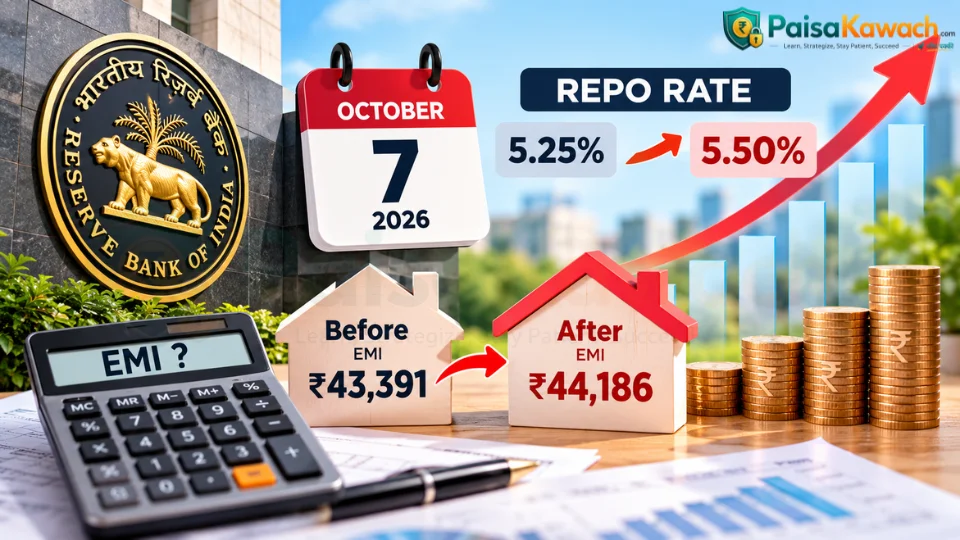
If the Reserve Bank of India raises the repo rate on October 7, 2026, one question will matter most to millions of borrowers:
How much could my EMI increase?
The answer is not the same for everyone.
Your actual EMI depends on how much loan principal you still owe, how many years remain, your current interest rate, the benchmark linked to your loan, your next reset date and how much of any policy-rate change your lender passes on to you.
As of the previous RBI policy review, the repo rate stood at 5.25%, while the next Monetary Policy Committee meeting is scheduled for October 5-7, 2026. A rate increase has been discussed by economists, but the actual decision will only be known when RBI announces it. :chatgpt-content-reference{index="0"}
This guide therefore does not assume that your loan will definitely become more expensive.
Instead, it lets you calculate different possibilities yourself.
You can test:
- Your current interest rate.
- A 0.10% increase.
- A 0.25% increase.
- A 0.50% increase.
- A possible future rate cut.
The calculator works instantly without refreshing the page.
Interactive EMI Calculator: Before vs After Rate Change
Enter your current outstanding loan amount, remaining tenure and interest rates below.
EMI Before vs After Interest Rate Change
Change any value to instantly see how a different loan rate could affect your EMI and total interest.
Monthly EMI
₹43,391Monthly EMI
₹44,186Your EMI could increase by approximately ₹794 per month.
For an existing loan, enter the principal you still owe rather than the amount you originally borrowed. Results use a standard reducing-balance EMI calculation and are estimates only.
Quick Answer: How Much Could a 0.25% Rate Increase Change Your EMI?
Consider a borrower with ₹50 lakh, roughly $52,000, outstanding and 20 years remaining.
At an annual interest rate of 8.50%, the standard EMI is approximately:
₹43,391 per month.
If the rate rises to 8.75%, the EMI becomes approximately:
₹44,186 per month.
The difference is about:
₹794 per month.
Over 12 months, that is roughly ₹9,533 in additional EMI payments.
| Loan Detail | Before | After |
|---|---|---|
| Outstanding Loan | ₹50 lakh | ₹50 lakh |
| Remaining Tenure | 20 years | 20 years |
| Interest Rate | 8.50% | 8.75% |
| Approximate EMI | ₹43,391 | ₹44,186 |
| Monthly Difference | - | About ₹794 |
| Total Interest | About ₹54.14 lakh | About ₹56.05 lakh |
The additional lifetime interest in this simplified example is roughly ₹1.91 lakh if the higher rate continues for the entire remaining 20-year tenure and the tenure itself does not change.
Why Can a Tiny Interest Rate Change Cost So Much?
Home loans usually involve two things that magnify small rate changes:
- A large outstanding principal.
- A long repayment period.
A difference of 0.25 percentage point might seem insignificant on ₹10,000.
It matters much more when applied to ₹50 lakh or ₹1 crore for hundreds of monthly instalments.
What Is the RBI Repo Rate?
The repo rate is a policy interest rate used by the Reserve Bank of India.
It influences financial conditions and borrowing costs across India's banking system.
Consumers do not borrow their home loans directly from RBI at the repo rate.
Instead, banks price loans according to the benchmark and spread applicable to the individual loan.
Changes in monetary policy can eventually influence those benchmarks.
Does a 0.25% RBI Hike Mean Your Loan Rate Also Rises by 0.25%?
No.
This distinction is essential.
An RBI repo-rate increase does not automatically add exactly the same percentage-point increase to every home loan on the same day.
Your actual result can depend on:
- The benchmark linked to your loan.
- Your lender's spread.
- Your contractual reset frequency.
- Your next reset date.
- Whether your interest rate is fixed or floating.
A Simple Example
Imagine your loan rate is calculated as:
Benchmark + Lender Spread = Your Loan Rate
For example:
- Benchmark: 6.50%
- Lender spread: 2.00%
- Home-loan rate: 8.50%
If the benchmark later becomes 6.75% while the spread remains unchanged, the resulting loan rate could become 8.75%.
Actual bank pricing structures can differ, so check your own loan documents rather than relying solely on this illustration.
What Are Basis Points?
Interest-rate news frequently uses the term basis points.
- 1 basis point = 0.01%
- 10 basis points = 0.10%
- 25 basis points = 0.25%
- 50 basis points = 0.50%
- 100 basis points = 1.00%
If a rate rises from 8.50% to 8.75%, it has increased by 25 basis points.
Interactive Check: Could Your Loan Be Affected?
My home loan has a floating interest rate
Your loan may respond to benchmark changes. Check which benchmark your loan uses and when your rate resets.
My home loan has a fixed interest rate
A policy-rate change may not immediately alter your contractual rate. Check whether your loan is fixed for its entire tenure or only for an introductory period.
I don't know whether my loan is fixed or floating
Check your sanction letter, loan agreement, latest loan statement or online loan account.
My bank has already told me my new interest rate
Use the exact old and new rates from your lender in the calculator above. That gives you a much better estimate than guessing from the RBI repo rate alone.
Your Loan Reset Date Can Delay the Impact
Suppose RBI changes its policy rate on October 7.
Your home loan may not change on October 8.
Many floating-rate loans use a specific reset schedule.
Your loan could reset monthly, quarterly or on another interval specified in your agreement.
For example, if your next reset date is November 1, an October policy change may only affect your loan from that reset date.
Another borrower might not experience the change until December.
₹20 Lakh Loan Example
Consider ₹20 lakh, around $20,800, outstanding for another 20 years.
At 8.50%, the EMI is approximately:
₹17,356.
At 8.75%, the EMI becomes approximately:
₹17,674.
That is an increase of about ₹318 per month.
₹50 Lakh Loan Example
- Outstanding balance: ₹50 lakh.
- Remaining tenure: 20 years.
- Old rate: 8.50%.
- New rate: 8.75%.
- Old EMI: approximately ₹43,391.
- New EMI: approximately ₹44,186.
- Monthly increase: approximately ₹794.
₹1 Crore Loan Example
Now consider ₹1 crore, approximately $104,000, outstanding with 20 years remaining.
- EMI at 8.50%: approximately ₹86,782.
- EMI at 8.75%: approximately ₹88,371.
- Monthly increase: approximately ₹1,589.
- Annual increase: approximately ₹19,065.
The percentage-point increase is identical in all three examples.
The difference in rupees becomes larger as the outstanding loan becomes larger.
Why Remaining Tenure Matters
The number of years left on your loan can dramatically change your interest-rate exposure.
Imagine two borrowers who both owe ₹50 lakh.
One borrower has three years remaining.
The other has 20 years remaining.
The second borrower has many more months during which the remaining principal can attract interest.
This is why you should always enter the remaining tenure rather than the original tenure when using the calculator.
Use Outstanding Principal, Not Your Original Loan Amount
Suppose you originally borrowed ₹60 lakh.
After making EMIs for several years, your principal balance has fallen to ₹46 lakh.
The correct amount to enter in the calculator is:
₹46 lakh.
Do not enter the original ₹60 lakh because you no longer owe that full amount.
How Is EMI Calculated?
A standard reducing-balance EMI uses this formula:
EMI = P × r × (1+r)^n ÷ ((1+r)^n − 1)
Where:
- P = outstanding principal.
- r = monthly interest rate.
- n = number of remaining monthly instalments.
The calculator performs this calculation automatically whenever you change an input.
Will Your Bank Raise EMI or Extend the Tenure?
A higher floating rate does not necessarily mean that only your EMI changes.
Depending on your loan and the options available, a lender may:
- Increase your EMI and keep tenure broadly unchanged.
- Keep EMI similar and increase tenure.
- Change both EMI and tenure.
- Allow you to make a partial prepayment.
- Offer another repayment option permitted under the loan terms.
Why Extending Tenure Can Be Expensive
Keeping the same EMI can feel easier because your monthly budget does not immediately change.
But extending the loan means paying interest for additional months.
The total lifetime interest can therefore rise even if your monthly EMI barely changes.
Interactive Decision: Which Outcome Matters Most?
I want my monthly EMI to remain as low as possible
A longer tenure can reduce immediate monthly pressure. Compare the additional lifetime interest before choosing this option.
I want to finish my loan on the original date
If interest rates rise, you may need to accept a higher EMI to preserve the original repayment timeline.
I have additional savings available
A partial prepayment can reduce principal and future interest, but avoid emptying money needed for emergencies.
I cannot afford a higher EMI
Contact your lender before missing a payment. Ask what tenure or repayment alternatives are available under your loan agreement.
Should You Prepay Your Home Loan?
A possible rate increase does not automatically mean you should make a large prepayment.
Consider:
- How much emergency cash you have.
- Whether you carry expensive credit-card debt.
- Whether you have a high-interest personal loan.
- Your remaining home-loan tenure.
- Your current effective loan rate.
- Whether you will need your savings soon.
- Any applicable prepayment conditions.
Liquidity matters too.
Saving interest on a home loan may be useful, but leaving yourself without an adequate emergency fund can create a different financial problem.
Should You Transfer Your Home Loan to Another Bank?
A balance transfer can potentially reduce borrowing costs if another lender offers a meaningfully lower rate.
But switching can involve:
- Processing charges.
- Legal costs.
- Technical valuation charges.
- Documentation expenses.
- Administrative fees.
- Your time and paperwork.
Compare the total savings against the total switching cost.
The potential benefit is generally more meaningful when you have a large outstanding balance and many years remaining.
What If the Rate Rises by 0.50%?
You can test this immediately.
If your current rate is 8.50%, click the +0.50% button.
The calculator will use 9.00% as the hypothetical new interest rate.
This can be useful as a household stress test even if such a change does not happen immediately.
What If Interest Rates Fall?
The calculator works for rate cuts too.
Click the -0.25% option.
A current rate of 8.50% will become a hypothetical 8.25%.
If the remaining tenure is unchanged, the estimated EMI will decline.
Does a Repo Rate Change Affect Personal Loans?
Broader interest-rate conditions can affect pricing on new personal loans and some floating-rate loans.
Many existing personal loans, however, use fixed interest rates.
A genuinely fixed-rate loan does not normally change simply because the RBI changes its policy rate.
What About Car Loans?
New car-loan rates can also respond to wider interest-rate conditions.
Existing fixed-rate and floating-rate loans can behave differently.
What About Credit Cards?
Credit-card interest rates are generally much higher than home-loan rates and do not move in a simple one-for-one relationship with the RBI repo rate.
For many households, reducing revolving credit-card debt can have a larger financial impact than reacting to a small home-loan rate change.
Can Fixed Deposit Rates Rise Too?
Potentially.
Banks may increase selected deposit rates when they need to attract additional funding.
But an RBI rate increase does not require every bank to raise every fixed-deposit rate by exactly the same amount.
What Happens to an Existing FD?
An existing fixed-rate deposit normally continues at the rate agreed when it was booked.
If your bank introduces higher rates later, an older FD does not usually receive the new rate automatically.
Five Common Mistakes Borrowers Make
1. Assuming the Repo Rate Is Your Home-Loan Rate
It is not. Your loan has its own benchmark and pricing structure.
2. Assuming Every Policy Change Reaches Your Loan Immediately
Your reset date matters.
3. Entering Your Original Loan Amount
Use the outstanding balance instead.
4. Looking Only at EMI
Total interest can be just as important.
5. Making a Major Decision Based on a Forecast
Economist expectations are not the same thing as an official RBI decision.
Your Home Loan Rate Checklist
- □ Find my current outstanding principal.
- □ Check my current interest rate.
- □ Check my remaining tenure.
- □ Confirm whether my loan is fixed or floating.
- □ Identify my loan benchmark.
- □ Find my next reset date.
- □ Enter my numbers into the calculator.
- □ Test a +0.10% scenario.
- □ Test a +0.25% scenario.
- □ Test a +0.50% scenario.
- □ Test a -0.25% scenario.
- □ Compare both EMI and total interest.
- □ Check whether my household budget can absorb a higher EMI.
- □ Compare a higher EMI with a longer tenure.
- □ Review prepayment without draining emergency savings.
- □ Compare refinancing costs before changing lenders.
Frequently Asked Questions
How much can EMI rise if my interest rate increases by 0.25%?
It depends on your balance and tenure. On a ₹50 lakh loan with 20 years remaining, a move from 8.50% to 8.75% increases the standard EMI from approximately ₹43,391 to ₹44,186, or around ₹794 per month.
What does a 25-basis-point increase mean?
It means an increase of 0.25 percentage point.
Will my EMI increase immediately after an RBI rate hike?
Not necessarily. Your loan's benchmark and reset schedule determine when an applicable rate change reaches you.
Which amount should I enter in the calculator?
For an existing loan, enter the principal amount you still owe.
Can I use the calculator for a car loan?
Yes, if it follows a standard reducing-balance EMI structure.
Can I use it for a personal loan?
Yes, under the same assumption.
Does the calculator require a page refresh?
No. Changing an input or clicking a quick scenario recalculates the results directly in the browser.
What if my lender extends the tenure instead of increasing EMI?
The calculator assumes that the remaining tenure stays unchanged. An extended-tenure arrangement will produce different results and may increase lifetime interest further.
Can a lower rate reduce my EMI?
Yes. Enter a lower rate in the New Interest Rate field or use the -0.25% scenario.
Is a 0.25% increase really significant?
It can be. The monthly impact may appear small, but large loan balances and long remaining tenures can turn a modest rate change into substantial additional interest.
Final Takeaway
An interest-rate headline does not tell you how much your home loan will actually cost.
Your own loan details matter much more.
A ₹50 lakh balance with 20 years remaining behaves differently from a ₹20 lakh balance with five years remaining.
The most useful numbers to know are:
- Your outstanding principal.
- Your current interest rate.
- Your possible new rate.
- Your remaining tenure.
- Your benchmark.
- Your reset date.
Under a simple example, moving from 8.50% to 8.75% on ₹50 lakh over 20 remaining years increases the standard EMI by about ₹794 per month and increases total interest by roughly ₹1.91 lakh if the higher rate continues throughout the period.
But you do not need to rely on that example.
Enter your own figures into the calculator above.
Test a small increase, a larger increase and even a possible future rate reduction.
That will show you whether an interest-rate change would be a minor adjustment to your budget or something you should plan for more carefully.
Keep Reading: More Gen Z Finance Insights

Comments
No comments yet. Be the first to comment!