UPI Charges From October 15: Are They Being Delayed? What Consumers Should Know
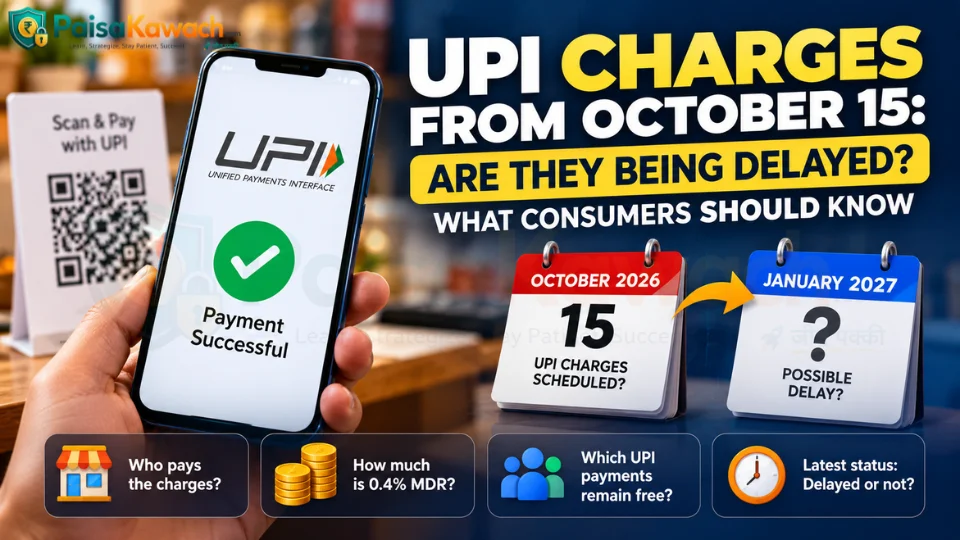
If you use UPI every day, you may have seen alarming headlines saying that UPI payments above ₹2,000 will become chargeable from October 15.
Then another set of headlines appeared saying the charges may be delayed until January 2027.
So what is actually happening?
As of October 10, 2026, the simplest answer is:
The proposed UPI Merchant Discount Rate framework is still scheduled to begin on October 15, but a postponement is being considered. No final postponement had been formally confirmed at the time of writing.
Merchant organisations, fintech companies and payment firms have asked the National Payments Corporation of India, or NPCI, to postpone implementation until January 2027.
A UPI Steering Committee meeting expected to discuss the issue on October 9 reportedly did not take place, leaving the final implementation date uncertain.
This means consumers should be careful with headlines saying either:
"UPI is becoming paid from October 15"
or:
"UPI charges have definitely been postponed."
Neither statement properly explains the situation.
More importantly, the proposed MDR is primarily a merchant-side payment processing fee. It is not simply a new charge that every consumer will automatically pay when sending ₹2,001 through UPI.
Let's break down what is proposed, what may be delayed, what remains free, and what an ordinary UPI user actually needs to watch.
UPI Charges October 15: Current Status
What Is Happening With the October 15 UPI MDR?
The fee framework was announced for October 15, but industry participants are requesting a postponement to January 2027.
What Exactly Is MDR?
MDR stands for Merchant Discount Rate.
It is essentially a payment-processing charge associated with accepting a digital payment.
The important word here is:
Merchant.
MDR is generally charged within the payment ecosystem for processing merchant transactions.
It is different from a customer being directly charged a ₹5 or ₹10 fee by their UPI app simply for making a payment.
Under the proposed UPI framework, an MDR of approximately 0.4% would apply to eligible person-to-merchant transactions above ₹2,000.
The proposed fee is capped at ₹300 for transactions of ₹75,000 and above.
Certain categories may have different fee structures.
How Much Is 0.4% MDR?
Here are some simple examples.
| Eligible UPI Payment | 0.4% MDR | Who Normally Bears It? |
|---|---|---|
| ₹2,000 | Generally outside proposed threshold | — |
| ₹2,001 | Approx. ₹8.00 | Merchant side |
| ₹5,000 | ₹20 | Merchant side |
| ₹10,000 | ₹40 | Merchant side |
| ₹25,000 | ₹100 | Merchant side |
| ₹50,000 | ₹200 | Merchant side |
| ₹75,000 | ₹300 | Merchant side |
| ₹1,00,000 | ₹300 cap | Merchant side |
The exact treatment can depend on the transaction type and merchant category.
Does That Mean You Will Pay ₹8 on a ₹2,001 UPI Purchase?
No, not automatically.
This is one of the biggest misunderstandings around the proposed change.
If you buy something worth ₹2,001 from a merchant, the MDR is designed as a merchant-side payment processing charge.
It is not supposed to appear automatically as:
Purchase: ₹2,001
UPI fee: ₹8
Total: ₹2,009
NPCI's framework says the MDR itself should not simply be passed on to the customer as a UPI charge.
Interactive Check: Will This Affect Your Payment?
I am sending ₹5,000 to a friend
This is a person-to-person payment rather than a merchant purchase.
The proposed merchant MDR does not apply in the same way to ordinary P2P transfers.
Sending money to family or friends is therefore different from paying a commercial merchant.
I am paying ₹1,500 at a shop
The proposed 0.4% MDR applies to eligible merchant payments above ₹2,000.
A ₹1,500 merchant transaction would therefore generally remain outside that proposed threshold.
I am paying ₹2,001 at a shop
This could fall above the proposed ₹2,000 threshold if the merchant and transaction are covered by the MDR framework.
At 0.4%, the merchant-side fee would be approximately ₹8.
That does not mean you should automatically be charged an additional ₹8.
I am paying ₹10,000 at a large store
At the proposed standard 0.4% MDR, the merchant-side processing cost would be approximately ₹40 if the transaction is eligible.
I am transferring ₹20,000 to my spouse
A normal person-to-person transfer is not the same as a merchant payment and remains outside the proposed merchant MDR structure.
I am paying a utility bill
Utility and certain other categories may have their own fee structure rather than the standard 0.4% calculation. Reports on the proposed framework indicate that some categories could attract a flat fee instead.
So Why Is the October 15 Rollout Being Reconsidered?
The biggest issue appears to be implementation complexity.
UPI is no longer used only for buying groceries or paying restaurants.
It is used for a huge range of payments, including:
- Retail purchases.
- Utility bills.
- Education payments.
- Fuel.
- Financial services.
- Loan repayments.
- Investment-related payments.
- Insurance.
- Subscription payments.
- Business collections.
Different categories can require different treatment.
Payment companies, merchants and banks therefore need systems capable of identifying the nature of a transaction correctly.
Why Merchants Are Asking for a Delay
Industry participants have reportedly asked NPCI to postpone implementation until January 2027.
Several reasons have been reported.
1. Festive Shopping Season
October is an important shopping period in India.
Merchants are concerned about introducing a new payment-processing cost during a high-volume festive sales period.
2. Technical Readiness
Payment platforms and banks need to correctly identify which transactions attract which MDR.
If systems are not configured properly, incorrect charges could be applied.
3. Merchant Category Confusion
Different businesses have different merchant category codes.
The correct MDR can depend on that classification.
4. Loan Repayment Confusion
One of the reported difficulties involves differentiating various financial-services transactions and loan payments.
Some loan repayments may be treated differently depending on whether they happen through AutoPay or manual payment.
5. Fear of Indirect Consumer Costs
Even if merchants are not supposed to directly add MDR to the customer's UPI payment, businesses may still attempt to recover higher operating costs through product pricing or other methods.
What Happened to the October 9 Decision?
A UPI Steering Committee meeting had been expected to discuss the potential postponement.
However, reports on October 9 said the meeting did not take place.
That left the proposed October 15 implementation date unresolved.
There was also no clear new date announced for when the committee would meet.
This is why the correct status as of October 10 is:
Possible postponement — not confirmed postponement.
What Happens If Nothing Changes Before October 15?
If there is no postponement or fresh direction before October 15, the previously announced framework would remain the relevant implementation plan.
Eligible merchant transactions above the specified threshold could begin attracting MDR according to the framework.
Consumers should still remember that this is not equivalent to every UPI payment becoming chargeable.
What Happens If It Is Delayed Until January?
If NPCI formally postpones the rollout until January 2027, the existing zero-MDR arrangement would broadly continue for the affected merchant transactions during the postponement period.
The extra time could be used to:
- Clarify transaction categories.
- Update payment systems.
- Resolve merchant classification issues.
- Clarify exemptions.
- Prepare banks and payment aggregators.
- Address concerns from small businesses.
₹2,000 vs ₹2,001: Why Is This Number Getting So Much Attention?
The proposed structure uses ₹2,000 as an important threshold for the standard merchant MDR.
That creates a strange-looking distinction.
A payment of:
₹2,000
may remain outside the standard MDR.
While:
₹2,001
could potentially fall under it.
At 0.4%, the MDR on ₹2,001 is approximately:
₹8.00.
Again, this is a merchant-side fee—not automatically an ₹8 consumer surcharge.
Would Splitting a Payment Avoid MDR?
Suppose a bill is ₹4,000.
Someone might wonder:
"What if I make two UPI payments of ₹2,000 each?"
Consumers should not assume that deliberately splitting transactions will always avoid merchant-payment rules.
Merchants and payment networks may have policies addressing transaction structuring, and the framework may evolve.
The important point for an ordinary customer is that you generally should not need to redesign normal purchases around MDR.
Could a Shopkeeper Ask You to Pay Extra?
This is probably the most important practical question for consumers.
Imagine your bill is:
₹10,000.
The proposed MDR at 0.4% would be:
₹40.
A shopkeeper might be tempted to say:
"UPI payment costs ₹40 extra."
But that is not how the proposed MDR is intended to work.
The fee is part of merchant-side payment processing.
Consumers should distinguish between:
- The merchant increasing the underlying price of a product.
- The merchant openly adding a special UPI surcharge.
They are not necessarily the same thing.
Can Businesses Indirectly Recover the Cost?
Possibly.
Businesses routinely have operating expenses such as:
- Rent.
- Electricity.
- Staff salaries.
- Card-processing fees.
- Delivery costs.
- Software costs.
- Taxes.
A business may incorporate these expenses into its overall pricing.
MDR could become another business cost.
That is different from explicitly displaying:
"UPI charge: ₹40."
Do Person-to-Person UPI Transfers Become Chargeable?
Under the proposed merchant MDR framework, ordinary P2P transfers remain outside the merchant fee.
For example:
- Sending ₹5,000 to your brother.
- Sending ₹10,000 to your spouse.
- Paying back ₹3,000 borrowed from a friend.
- Sending ₹20,000 to your parents.
are fundamentally different from paying a registered commercial merchant.
What About Small Merchants?
This is another area under discussion.
Reports indicate that exemptions for smaller merchants could potentially be widened.
One proposal under consideration would use annual turnover to determine which smaller merchants remain exempt.
Because that detail is still under discussion, consumers and small businesses should wait for the final NPCI framework rather than assuming a reported threshold is final.
Why Does UPI Need MDR At All?
This question has generated significant debate.
UPI transactions require infrastructure.
That includes:
- Bank systems.
- Payment apps.
- Payment gateways.
- Fraud monitoring.
- Security infrastructure.
- Dispute resolution.
- Customer support.
- Network capacity.
All of those systems cost money to operate.
Supporters of MDR argue that payment providers and banks need a sustainable revenue model to continue investing in infrastructure.
Opponents worry that charges could discourage merchants from accepting digital payments or indirectly increase costs for consumers.
Why Has UPI Been Free for So Long?
India has deliberately encouraged low-cost digital payments to accelerate adoption.
That strategy helped UPI become one of the country's dominant payment methods.
Today, UPI is accepted not only by large retailers but by:
- Street vendors.
- Small grocery stores.
- Auto-rickshaw drivers.
- Restaurants.
- Doctors.
- Freelancers.
- Local service providers.
That widespread adoption is one reason any change to merchant economics attracts so much attention.
How Big Has UPI Become?
UPI now handles an enormous volume of payments every month.
September 2026 reportedly recorded more than 24 billion UPI transactions worth roughly ₹29.37 trillion.
That scale means even a tiny processing percentage can create a very large revenue pool across the payments ecosystem.
Why Did Fintech Shares Fall on the Delay Reports?
Payment companies and banks could potentially earn additional revenue from MDR.
If implementation is postponed, that revenue also gets pushed further into the future.
That is why shares of some listed payments businesses fell sharply after reports that implementation might be moved to January.
The stock-market reaction does not mean consumers themselves suddenly save or lose that money.
It primarily reflects investor expectations about payment-company revenues.
Interactive Scenario: What Happens to Your Payment?
Scenario 1: ₹1,999 restaurant bill
This sits below the proposed ₹2,000 threshold for the standard merchant MDR.
The transaction would generally remain outside the proposed 0.4% merchant charge.
Scenario 2: ₹2,500 clothing purchase
If the transaction qualifies for the proposed 0.4% MDR:
₹2,500 × 0.4% = ₹10 merchant-side MDR.
The consumer should not automatically pay ₹2,510 simply because of MDR.
Scenario 3: ₹10,000 electronics purchase
At 0.4%, the merchant-side MDR would be approximately:
₹40.
Scenario 4: ₹50,000 payment
At 0.4%:
₹50,000 × 0.004 = ₹200.
Scenario 5: ₹1 lakh payment
A pure 0.4% calculation would produce ₹400.
However, the proposed standard MDR is capped at ₹300 for transactions of ₹75,000 and above.
Therefore the merchant-side fee would be capped according to the applicable rules.
Scenario 6: ₹10,000 sent to a friend
This is a P2P transfer, not a merchant purchase.
The merchant MDR framework does not apply in the same way.
UPI vs Credit Card: Is This the Same Thing?
No.
Credit and debit card payment networks already have established merchant-fee structures.
UPI has historically operated under a different zero-MDR approach for many transactions.
The proposed change begins introducing merchant economics more similar to other payment systems for certain transactions, but the details and rates are different.
Will Your UPI App Start Charging You?
The proposed MDR announcement does not mean Google Pay, PhonePe, Paytm, BHIM or your bank app will automatically begin charging consumers 0.4% on every payment.
The 0.4% figure relates to eligible merchant transaction processing.
This distinction is essential.
What Should Consumers Do Before October 15?
Very little needs to change in your daily behaviour.
You do not need to:
- Stop using UPI.
- Withdraw large amounts of cash.
- Split every ₹2,001 purchase.
- Delete your UPI apps.
- Panic about every transaction above ₹2,000.
The sensible approach is simply to watch for the final implementation announcement.
What Should Merchants Do?
Merchants have more reason to monitor the situation closely because they may directly face the payment-processing cost.
A merchant should check:
- Whether their category is covered.
- Whether they qualify for an exemption.
- Which UPI transactions attract MDR.
- Whether special rates apply to their category.
- How their payment provider will settle the charge.
- Whether their accounting system needs changes.
Three Headlines You Should Be Careful With
1. "UPI Will Cost 0.4% From October 15"
This is misleading because the proposed MDR is not simply a universal consumer transaction fee.
2. "All UPI Payments Above ₹2,000 Will Be Charged"
Also misleading.
Person-to-person payments and merchant payments are treated differently.
3. "UPI Charges Have Been Delayed Until January"
As of October 10, a postponement was being considered, but the final deferment had not been formally confirmed.
What Could Change Before October 15?
Several things are possible.
NPCI could:
- Proceed with October 15 as planned.
- Postpone implementation to January 2027.
- Modify merchant exemptions.
- Clarify category-specific fees.
- Issue additional operational instructions.
Until a formal decision is announced, any of these possibilities should be treated as possibilities rather than facts.
Consumer Checklist for October 15
- □ Do not assume every UPI payment will become chargeable.
- □ Remember that MDR is primarily a merchant-side fee.
- □ P2P payments are different from merchant transactions.
- □ Payments up to ₹2,000 remain important under the proposed framework.
- □ Check whether NPCI formally announces a postponement.
- □ Be cautious if a merchant adds a separate "UPI fee."
- □ Do not panic-withdraw cash because of MDR headlines.
- □ Look for the final rules rather than social-media forwards.
Merchant Checklist
- □ Confirm my merchant category code.
- □ Check whether I qualify for an exemption.
- □ Understand the MDR applicable to my transaction category.
- □ Ask my payment provider how the fee will be settled.
- □ Do not automatically pass MDR to consumers as a UPI surcharge.
- □ Monitor NPCI updates before October 15.
- □ Update accounting and reconciliation systems if required.
Frequently Asked Questions
Are UPI charges starting on October 15?
The announced MDR framework was scheduled for October 15, 2026. However, industry participants have requested a postponement to January 2027. As of October 10, a final postponement had not been formally confirmed.
Has the October 15 UPI MDR been cancelled?
No confirmed cancellation had been announced at the time of writing.
Has it definitely been delayed to January 2027?
No. January 2027 has been reported as a possible new date, but the deferment was still under consideration.
Will I pay 0.4% on every UPI transaction?
No. The proposed 0.4% MDR applies to specified eligible merchant transactions, not every UPI transaction.
Will sending ₹5,000 to a friend cost money?
Ordinary person-to-person UPI transfers remain outside the proposed merchant MDR framework.
What happens if I pay ₹2,001 to a shop?
If the merchant and transaction fall under the proposed framework, the transaction could attract merchant-side MDR. At 0.4%, ₹2,001 produces approximately ₹8 in MDR.
Does the customer pay that ₹8?
The MDR is meant to be borne on the merchant side rather than automatically added as a customer UPI charge.
How much is MDR on ₹10,000?
At 0.4%, it is approximately ₹40.
How much is MDR on ₹50,000?
At 0.4%, it is approximately ₹200.
How much is MDR on ₹1 lakh?
The simple 0.4% calculation gives ₹400, but the proposed standard framework includes a ₹300 cap for transactions of ₹75,000 and above.
Are payments below ₹2,000 free?
Under the proposed standard MDR structure, merchant transactions up to ₹2,000 remain outside the 0.4% levy.
Will small shopkeepers have to pay?
Small-merchant exemptions are part of the framework and further changes to those exemptions are reportedly being considered. The final rules should be checked once NPCI issues them.
Why could the implementation be delayed?
Merchant groups and payment companies have raised concerns about technical readiness, category classification, festive-season costs and uncertainty over how different types of payments should be treated.
Should I stop using UPI?
No. There is no reason for an ordinary consumer to stop using UPI simply because of the proposed MDR changes.
Final Takeaway
The biggest misunderstanding about the October 15 UPI change is the belief that every Indian making a payment above ₹2,000 will suddenly pay a 0.4% UPI fee.
That is not what the proposed framework says.
The 0.4% MDR relates primarily to eligible merchant transactions above ₹2,000.
Person-to-person transfers remain different.
The consumer is not supposed to automatically pay the merchant MDR as a separate UPI transaction charge.
At the same time, the implementation date itself is now uncertain.
October 15 was the announced start date.
Merchant groups, fintech companies and payment firms have asked for the implementation to be pushed to January 2027.
The UPI Steering Committee meeting expected to discuss the issue on October 9 reportedly did not take place, leaving the decision unresolved.
Therefore, as of October 10, the most accurate description is:
The October 15 UPI MDR framework has not yet been formally postponed, but a delay to January 2027 is under consideration.
For consumers, there is no reason to panic.
Continue using UPI normally and watch for the final NPCI announcement.
For merchants, however, the details matter much more.
Merchant category, transaction value, exemptions and transaction type can all determine whether a fee applies.
And until the final framework is confirmed, the best thing both consumers and businesses can do is distinguish between:
what has been announced, what has been proposed, and what has actually been confirmed.