"Very Little Will Be Left" — Inside the Week Trump Threatened to Erase Iran, and What It Means Right Now
Six months in, most long-running conflicts settle into a grim, predictable rhythm — enough that headlines about them start blurring together. This week broke that rhythm. What's unfolded over the past several days isn't an incremental escalation; it's a genuine step up in both scale and rhetoric, and understanding exactly where things stand right now matters, whether you're tracking this for its human cost, its market impact, or simply trying to make sense of a crisis that's been running since February.
What Actually Happened
US forces struck Islamic Revolutionary Guard Corps sites across southern Iran — near Bandar Abbas, and at Konarak, Chabahar, Qeshm, and Sirik. Four IRGC Aerospace Force personnel were killed in a separate strike in Kermanshah, identified by Iranian state media as Reza Mohammadi, Shahram Jafari, Alireza Shakiba, and Jafar Kahrizi. Iran's parliamentary National Security Committee chairman responded publicly: "these crimes will not go unpunished."
Trump confirmed the strikes were retaliation for two things: Iran's attempted mine-laying operation in the Strait of Hormuz, and recent attacks on a US military base in Jordan. He didn't stop at confirming the strikes — he issued a direct, escalatory warning on Truth Social, stating that if Iran retaliates, "they will be hit again at a much harder and higher level, but it will not be the biggest attack of them all, that is waiting in the wings and, when it is over, there will be very little left of the Islamic Republic of Iran."
Why This Language Matters Beyond the Strikes Themselves
Military statements from senior officials are usually carefully calibrated to avoid over-committing to a specific future action. This one wasn't. Explicitly referencing a larger, still-unused strike option "waiting in the wings," and describing a potential outcome where "very little" of Iran's government would remain, is a meaningfully different kind of statement than a routine warning against future retaliation. It signals that the current strikes, serious as they are, are being framed publicly as one step short of a considerably larger option still being held in reserve.
The Tanker Attacks: When the Conflict Directly Hit Commercial Shipping
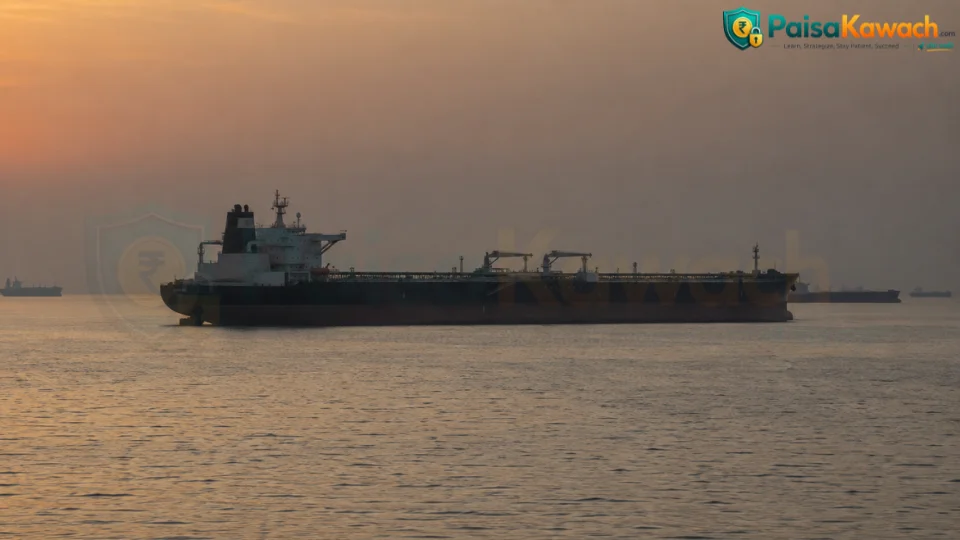
Separately, two supertankers carrying Saudi oil were struck by unknown projectiles within minutes of each other while transiting outbound through the Strait of Hormuz. This detail deserves attention on its own, distinct from the military strikes against IRGC sites. Military-to-military exchanges, however serious, are at least contained to combatants. An attack on two commercial oil tankers, hit almost simultaneously, is a direct strike against global energy infrastructure and international shipping — the exact kind of event this entire six-month crisis has been organized around trying to prevent.
Oil markets reacted immediately and sharply. Brent crude, already up 2% on the day from the IRGC strikes, jumped almost 2% further specifically on the tanker attack reports. As one energy analyst summarized the moment: the tit-for-tat missile exchanges validate the view that "even if not a 'forever war,' this conflict will run and run."
Why Two Simultaneous Tanker Strikes Is a Different Kind of Signal
A single tanker incident could plausibly be attributed to a mine, a mechanical failure, or an isolated attack. Two supertankers struck by unknown projectiles within minutes of each other, in the same stretch of water, is a pattern that's much harder to read as anything other than a coordinated action — a level of deliberateness that raises the stakes considerably for how seriously the international shipping industry has to treat continued passage through the Strait, regardless of what military-to-military exchanges are happening in parallel.
The Bigger Picture: Six Months, and Counting
It's worth stepping back to see how far this crisis has actually traveled. It began February 28, 2026, when US and Israeli strikes killed Iran's Supreme Leader Ali Khamenei, triggering Iran's closure of the Strait of Hormuz — a waterway that, before the crisis, carried roughly a quarter of the world's seaborne oil trade and a fifth of its liquefied natural gas. What followed has included a formal US naval blockade of Iran (April 13 to June 18, then resumed July 14 and ongoing), a brief attempted diplomatic track through the Islamabad Talks that ultimately failed, and now, this week's sharp new escalation. The toll so far includes at least 20 seafarers and one port worker killed, with 35 injured and one person still missing — figures that will likely rise given this week's tanker attacks.
Why "Running and Running" Might Be the Most Accurate Description Available
Six months is long enough that this crisis has stopped fitting neatly into the language usually used for shorter conflicts — it's not accurately described as a single war with a clear beginning and pending end, nor is it fully a "forever war" in the sense of permanent, unchanging low-level conflict. It's something in between: a conflict that periodically de-escalates into relative quiet, then re-escalates sharply, as it did this week, without ever fully resolving in either direction. Understanding it this way is more useful than expecting any single week's headlines to represent a final turning point — this week's escalation may prove decisive, or it may simply be the latest cycle in a pattern that's already repeated several times since February.
Where Things Stand Right Now
As of today, the situation is genuinely live and unresolved: fresh Iranian casualties from this week's strikes, two damaged commercial oil tankers, an explicit presidential threat of a larger reserve option, and oil markets pricing in continued elevated risk. Markets are closed for the weekend, but the pressure this week's developments have added to oil prices, currency markets, and inflation expectations will be the first thing traders have to digest the moment trading resumes.
Keep Reading: More Insights You Might Like

Comments
No comments yet. Be the first to comment!