Three Fractures, One World Economy: Why AI Stocks, Iran, and China Sentiment Are All the Same Story

Some weeks hand you one big story. This week handed the world three at once, arriving from three completely different directions — a stock market correction brewing in Asian semiconductors, a military campaign in the Persian Gulf that refuses to actually end, and a slow shift in how the world perceives its two largest economies. Read in isolation, each looks like its own contained event. Read together, they reveal something more uncomfortable: global markets are being asked to absorb a valuation shock, a supply shock, and a geopolitical realignment simultaneously, and the honest answer is that nobody yet knows how much simultaneous uncertainty the system can hold before something has to give.
The AI Trade Gets Its First Real Stress Test
For much of 2026, the story in global equities has had one dominant engine: artificial intelligence infrastructure spending, and the semiconductor companies building the chips underneath it. That engine sputtered badly overnight. Semiconductor stocks tumbled across Asia, dragging regional indices down with them, as investors grew visibly more skeptical that a rally built this heavily on AI enthusiasm can keep justifying its own valuations. South Korea's Kospi, an index widely treated as a bellwether for global AI investment given its concentration in memory-chip makers, slumped by as much as 7.3% in a single session — the kind of single-day move usually reserved for genuine crisis events, not routine profit-taking.
What makes this particular selloff worth taking seriously is where it happened. It wasn't a broad, diffuse market wobble. It was concentrated precisely in the companies supplying the physical infrastructure — memory chips, foundry capacity — that the entire AI buildout depends on. South Korea's own financial regulators moved quickly, signaling upcoming measures to address controversy around leveraged ETFs tied to these chipmakers, an acknowledgment that a meaningful share of the recent run-up may have been amplified by leveraged retail positioning rather than fundamentals alone.
Why a Regional Chip Selloff Becomes a Global Problem
The uncomfortable truth for global investors is that AI infrastructure spending has become one of the few consistent growth engines supporting equity valuations worldwide, even as other parts of the global economy — trade, manufacturing, consumer spending — have looked comparatively sluggish. If the market starts genuinely questioning whether AI capex can keep justifying itself, the correction doesn't stay contained to Korean chipmakers. It reaches directly into the American technology names, the Middle Eastern sovereign funds that have poured capital into AI infrastructure, and the pension funds and index funds worldwide that have quietly become far more concentrated in this single theme than most of their holders realize.
- A single-day 7% decline in a bellwether index signals the market is repricing risk rapidly, not gradually — a pattern that historically precedes broader volatility rather than a quiet, isolated correction
- Regulatory scrutiny of leveraged ETFs suggests part of the recent AI rally was mechanically amplified, meaning any unwind could move faster than the original run-up
- Global portfolios with concentrated technology and semiconductor exposure are more vulnerable to this specific shock than diversified indices might suggest on the surface
Iran: The Conflict That Refuses to Resolve Cleanly
Just two days after cancelling his proposed 20% fee on ships transiting the Strait of Hormuz, the same administration confirmed fresh military strikes against Iran, explicitly aimed at degrading capabilities Iranian forces have used against commercial shipping in the corridor. This is the detail that got lost in the celebration around the fee's cancellation: withdrawing a toll is a diplomatic and commercial gesture, but it does nothing to stop the underlying military escalation that made the corridor dangerous in the first place.
Oil prices reflect this reality more honestly than headlines do. Crude climbed again on news of the fresh strikes, with benchmark prices holding stubbornly in the high-$70s to mid-$80s range — well above where they traded before this entire episode began. The market isn't pricing in resolution. It's pricing in an open-ended military campaign with no clear endpoint, punctuated by diplomatic gestures that address fees and tolls but not the actual armed conflict generating the underlying risk.
The Compounding Effect Nobody Is Modeling Cleanly
This is where the three stories start to intersect in ways that matter more than any of them individually. A world already nervous about an AI valuation correction does not need a second source of uncertainty layered on top — but that's exactly what a continuing, unresolved Iran conflict provides. Elevated oil prices squeeze consumer spending power globally, add cost pressure to already-inflated import bills in oil-dependent economies, and complicate the exact central bank calculations that equity markets rely on to price future growth. A market trying to digest a chip-sector correction and an open-ended Gulf conflict at the same time has considerably less room to absorb a third shock — which is precisely what showed up next.
- Fresh military strikes despite a cancelled fee confirm the conflict itself has not de-escalated, only the commercial toll arrangement around it
- Oil prices remaining elevated well above pre-crisis levels signal markets are pricing in sustained risk, not a resolved situation
- Energy-import-dependent economies face compounding pressure just as they're also absorbing volatility from the unrelated AI-sector correction
The Quiet Shift: Global Sentiment Moves Toward China
The third story is the one least likely to make a headline chart, and arguably the one with the longest tail. New data following the recent Trump-Xi meeting in Beijing shows a notable shift in how the world perceives its two largest economies — improving views of China alongside declining views of the United States. Sentiment shifts like this rarely move markets in a single trading session. They move capital allocation decisions over years: where multinational companies choose to build supply chains, which currency blocs neutral countries lean toward, and how much diplomatic leverage each superpower carries into the next round of trade negotiations.
This matters enormously for how the other two stories eventually resolve. A world economy leaning more toward China for trade and manufacturing relationships is a world where US leverage over global supply chains — including the semiconductor supply chains at the center of the AI correction, and the energy diplomacy surrounding Iran — gradually weakens. None of this shows up in a single day's stock ticker. It shows up in how the next decade of global economic architecture gets built.
Why This Isn't Just a Diplomatic Footnote
Perception shifts of this kind have historically preceded real reallocation of trade relationships, not followed them. Companies and countries that sense a durable shift in global alignment tend to hedge early — diversifying supply chains, denominating more trade in alternative currencies, seeking alternative technology partnerships — well before the shift becomes obvious in official trade statistics. If this sentiment shift proves durable rather than temporary, it becomes the slow-moving current underneath the two faster-moving stories above, shaping how much economic leverage each major power retains as it tries to manage its own crisis.
Reading the Three Together
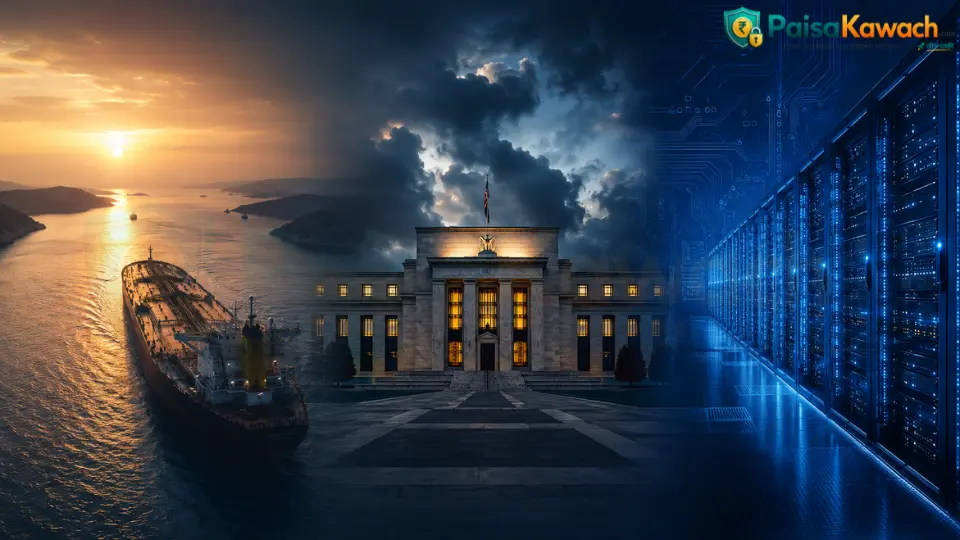
None of these three stories individually would justify calling this a moment of global economic fragility. An Asian tech correction alone is a sector story. A continuing Iran conflict alone is an energy story. A sentiment shift alone is a slow-burning diplomatic story. But arriving together, in the same week, they describe a world economy being tested on three separate fronts simultaneously — valuation, energy supply, and geopolitical alignment — with very little slack left to absorb a fourth. That is the actual story worth watching, not any single headline inside it.
Keep Reading: More Insights You Might Like
 Trump Cancelled the Hormuz Fee. Your Grocery Bill Didn't Get the Memo.
Next →
Trump Cancelled the Hormuz Fee. Your Grocery Bill Didn't Get the Memo.
Next →
 When Good News Stops Working: Inside the Week the AI Trade Started Doubting Itself
Comments
No comments yet. Be the first to comment!