US-Iran Ceasefire Collapses, Fed Turns Hawkish, PepsiCo Earnings — What's Moving Markets on July 9, 2026

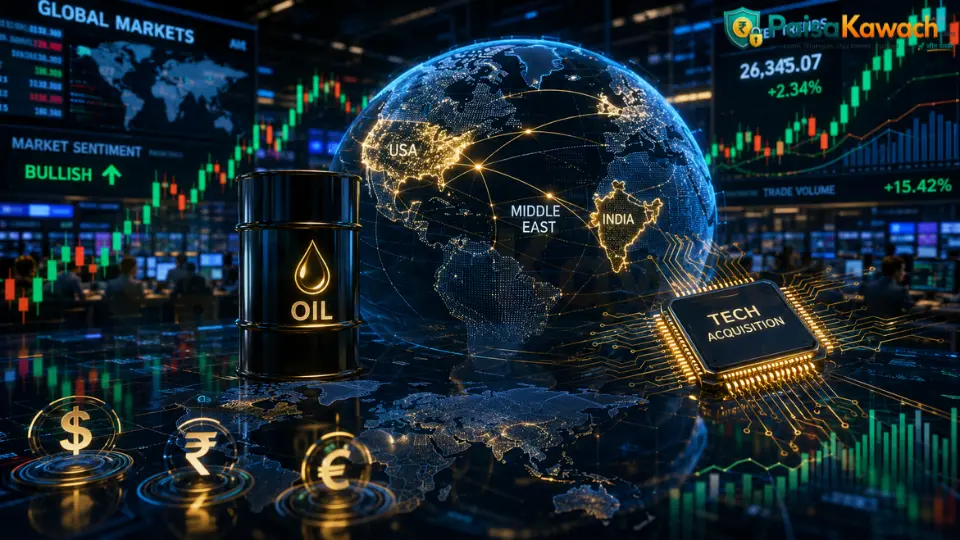
Three shockwaves are hitting global financial markets simultaneously on July 9, 2026. The fragile US-Iran ceasefire has collapsed after fresh attacks on commercial vessels in the Strait of Hormuz, sending oil prices surging back above $78 per barrel and erasing weeks of hard-won inflation relief. Federal Reserve minutes released Wednesday confirmed that policymakers are prepared to resume interest rate hikes, adding a second layer of pressure on equities and emerging market currencies. And this morning, PepsiCo delivers its Q2 2026 earnings before market open — the first major consumer company to report this season, offering the clearest early signal yet on whether the American consumer is cracking under the weight of persistent inflation. For investors in India and across Asia, all three events carry direct and immediate consequences.
1. US-Iran Ceasefire Collapses — Oil Spikes Back Above $78, Strait of Hormuz at Risk Again
The peace that markets had priced in is gone. On Tuesday, July 7, the United States military launched what it described as a "series of powerful strikes" against Iran after three commercial vessels transiting the Strait of Hormuz came under attack. The following day, President Donald Trump stood before reporters at the NATO summit in Ankara, Turkey, and declared the ceasefire with Iran officially over. "I don't want to deal with them anymore. As far as I'm concerned, it's over," Trump said. He later threatened further strikes, warning that Iran's bridges, electricity plants, and desalination facilities were potential targets. Iran responded by threatening to close the Strait of Hormuz to all maritime traffic if US military strikes continued — a move that would immediately choke off roughly 20% of the world's daily oil supply. The peace framework signed on June 17, which had reopened the chokepoint and sent oil prices tumbling from their April high of $126 per barrel all the way down to $72, has now unravelled in a matter of days. Front-month ICE Brent crude futures settled 5.2% higher at $78.02 per barrel on Wednesday and briefly touched $80.59 intraday — a single-session swing of 8.7% that caught nearly every major bank off guard. The US EIA had just slashed its Q3 Brent outlook by $27 per barrel to $74 on July 7, the same day the strikes began. JP Morgan, Barclays, Morgan Stanley, and UBS had all cut their 2026 oil forecasts in the days prior. Every one of those calls is now under urgent review.
Brent crude briefly hit $80.59 per barrel intraday on July 8 — an 8.7% single-session surge — after Trump declared the US-Iran ceasefire "over" at the NATO summit in Ankara. Iran has threatened to close the Strait of Hormuz, through which 20% of the world's oil supply passes, if US strikes continue.
What This Means for Indian Markets and the Rupee
India imports roughly 85% of its crude oil requirements and is among the most exposed large economies to any sustained spike in global energy prices. The relief that lower oil had brought — narrowing the current account deficit, supporting the rupee, easing retail inflation, and giving the Reserve Bank of India room to hold or cut rates — is now at serious risk of reversing. Every $10 rise in Brent crude adds approximately $12–15 billion to India's annual import bill. With Brent already back above $78 and the geopolitical situation deteriorating, equity sectors most directly exposed include oil marketing companies like HPCL and BPCL, aviation stocks like IndiGo and Air India, and paint and tyre manufacturers that use petroleum-derived inputs. Nifty Energy and Nifty Auto will be the key sectoral gauges to watch at the open. The Dow Jones Industrial Average dropped 576.76 points or 1.09% to close at 52,348.39 on Wednesday, while the S&P 500 fell 0.28% to 7,482.71 — a clear signal that risk-off sentiment is the dominant mood heading into today's session.
- Brent crude back above $78, WTI at $73.52: The ceasefire collapse reversed weeks of price declines in a single session, with Brent hitting $80.59 intraday and analysts warning that a full Hormuz closure could push prices back toward $100 or higher.
- Dow fell 576 points, airlines down 2–4%: American Airlines dropped nearly 4%, United Airlines fell roughly 2.5%, and Delta, Southwest, and JetBlue each shed about 2% as the prospect of surging jet fuel costs and travel disruptions weighed on the sector globally.
- India directly in the crossfire: Rising crude pressures the rupee, widens the current account deficit, revives retail inflation, and complicates RBI rate policy — making this the most consequential macro event for Indian markets this week.
2. Federal Reserve June Minutes Signal Rate Hike Is Back on the Table
The Federal Reserve's June meeting minutes, released Wednesday, delivered a hawkish signal that was already unsettling for markets — and the oil shock from the Iran ceasefire collapse has now made the Fed's job significantly harder. The minutes, covering the June 16–17 FOMC meeting where the Fed voted unanimously to hold rates at 3.50–3.75% for the fourth consecutive time, revealed that policymakers are actively prepared to resume interest rate hikes if inflation remains stubbornly elevated. In a notable development, the minutes highlighted an increasing focus inside the committee on inflationary pressures generated by the ongoing boom in artificial intelligence infrastructure investment and strong business spending — a signal that the Fed is watching more than just consumer prices. This was the first set of minutes released under new Fed Chair Kevin Warsh's tenure, and the tone was unmistakably cautious. The latest dot plot had already shown nine of the Fed's 18 officials expecting at least one rate hike before the end of 2026. With oil prices now spiking again on the Iran ceasefire breakdown, those expectations have become considerably more credible. The 10-year US Treasury yield rose, the dollar strengthened, and gold — already above $4,130 per ounce as a safe-haven asset — extended its gains. The next scheduled FOMC meeting is July 28–29, making the next three weeks a critical window for Fed communication and economic data to shape expectations.
Federal Reserve minutes from the June 16–17 meeting confirmed that nine of 18 Fed officials have pencilled in at least one rate hike for 2026. With oil prices surging again on Iran war re-escalation, the Fed's inflation problem has become more acute — making a September rate hike increasingly likely and a rate cut essentially off the table for the rest of the year.
Global Capital Flow Risk for Emerging Markets
A hawkish Federal Reserve and rising oil prices are a particularly damaging combination for emerging market economies. When the Fed raises rates, the yield differential between US assets and EM assets widens, pulling capital out of countries like India, Indonesia, Brazil, and South Africa and back into dollar-denominated instruments. This puts pressure on currencies, raises the cost of dollar-denominated debt, and can trigger equity outflows from foreign institutional investors. India's rupee is already under pressure from the renewed oil shock. If the July 28–29 FOMC meeting delivers a rate hike on top of elevated oil prices, the double squeeze on India's macro environment would be significant. The June jobs report — which showed a soft 57,000 nonfarm payrolls against a consensus of 115,000 — had briefly calmed rate hike fears and taken the probability of a September hike from 65% down to 53.5%. But with oil back above $78 and inflation expectations rising again, that probability is likely moving higher today.
- Nine Fed officials expect a 2026 rate hike: The minutes confirmed a broadly hawkish committee, with the focus on AI-driven investment inflation and persistent core PCE at 3.3% — well above the 2% target — giving the Fed little room to ease.
- Oil shock complicates Fed's calculus: Rising crude prices directly feed into headline inflation, making it harder for the Fed to justify a pause and increasing the likelihood of a hike at the July 28–29 or September FOMC meeting.
- Dollar, Treasury yields, and gold all moving: The combination of a hawkish Fed and geopolitical risk is strengthening the dollar and pushing 10-year yields higher — a headwind for equities globally and particularly damaging for rupee-denominated assets and India's import bill.
3. PepsiCo Q2 Earnings Today — The First Real Consumer Stress Test of the Season
Amid the geopolitical and monetary noise, PepsiCo delivers its Q2 2026 results this morning before the US market opens — and this report matters well beyond one company's bottom line. PepsiCo is the first major consumer staples giant to report this earnings season, and its results will offer the earliest read on whether ordinary consumers are still spending freely on everyday food and beverage products, or whether persistent inflation is finally forcing trade-downs and smaller shopping baskets. Wall Street's consensus expectation is earnings per share of approximately $2.19–$2.21 on revenue of $23.96 billion. That sounds straightforward, but the setup heading into this print is anything but. JPMorgan, UBS, TD Cowen, Barclays, and Bernstein have all cut their price targets for PepsiCo in recent weeks. PEP stock is still down roughly 16% from its February highs. The prevailing concern is whether the recovery in PepsiCo Foods North America — the Frito-Lay snacks business — that emerged in Q1 can be sustained in Q2. Q1 had marked the first time in several quarters that the segment posted positive volume growth, adding approximately 300 million incremental consumption occasions year-on-year. But analysts at UBS flagged that PepsiCo had been among their worst-performing consumer stocks since April, and questioned whether Frito-Lay can recapture its long-term growth rate given the current consumer environment.
PepsiCo reports Q2 2026 earnings today before market open. Consensus EPS is $2.21 on revenue of $23.96 billion. The real question is not whether PepsiCo beats by a few cents — it is whether North American snack volumes show that consumers are still paying full price for Frito-Lay products, or trading down to cheaper alternatives. That answer will set the tone for the entire consumer staples earnings season.
Why This Earnings Report Sets the Tone for the Whole Season
PepsiCo's report is best understood as a proxy for consumer health across the entire FMCG sector. Snack foods are discretionary in a way that a daily beverage habit is not — which makes Frito-Lay volume an unusually direct and sensitive read on consumer financial stress. If volumes are holding up, it signals that inflation has not yet broken consumer spending habits in a meaningful way. If volumes are weak or guidance is cut, it signals that the cumulative toll of two-plus years of elevated prices is finally showing up in behaviour change. Coca-Cola's Q1 2026 results provided a strong benchmark — net revenue grew 12%, organic revenue rose 10%, global unit case volume increased 3%, and comparable EPS climbed 18%. PepsiCo's blended beverages-and-snacks model means it needs to show firmer evidence from the snacks side to close the confidence gap with investors. Following PepsiCo today, Delta Air Lines reports Friday July 10, providing an early read on summer travel demand. The main event comes next week — June CPI data on July 14 alongside Q2 earnings from JPMorgan Chase, Bank of America, Goldman Sachs, Wells Fargo, and Citigroup. For Indian investors tracking global FMCG names like HUL, Nestlé India, and Britannia, PepsiCo's guidance on input cost inflation, pricing power, and consumer demand trends will carry direct read-across value for domestic consumer stocks as well.
- Consensus EPS of $2.21 on $23.96B revenue: Several analysts have cut targets heading into the print, lowering the bar — but a miss or weak guidance on North American snack volumes could still trigger a meaningful sell-off in PEP and drag the broader consumer staples sector lower globally.
- North American snack volume is the real metric to watch: The Q1 recovery in Frito-Lay — adding 300 million incremental consumption occasions — needs to be sustained in Q2 to confirm that consumers are not trading down, which is the central question for the entire consumer discretionary and FMCG universe this earnings season.
- India read-across for FMCG investors: PepsiCo's commentary on input cost inflation, promotional intensity, and pricing power sustainability will directly inform expectations for Indian consumer companies including HUL, Nestlé India, Dabur, and Britannia — all of which face similar pressures in their domestic markets.
Keep Reading: More Insights You Might Like
 Samsung's AI Chip Boom, Enerpac's $472 Million Acquisition, and MasTec's Infrastructure Expansion
Next →
Samsung's AI Chip Boom, Enerpac's $472 Million Acquisition, and MasTec's Infrastructure Expansion
Next →
 SK Hynix Draws AI Investor Interest, PepsiCo Beats Earnings, AstraZeneca Faces Clinical Trial Setback
Comments
No comments yet. Be the first to comment!