You're Not Broke. You're Just Subscribed to 17 Different Things.
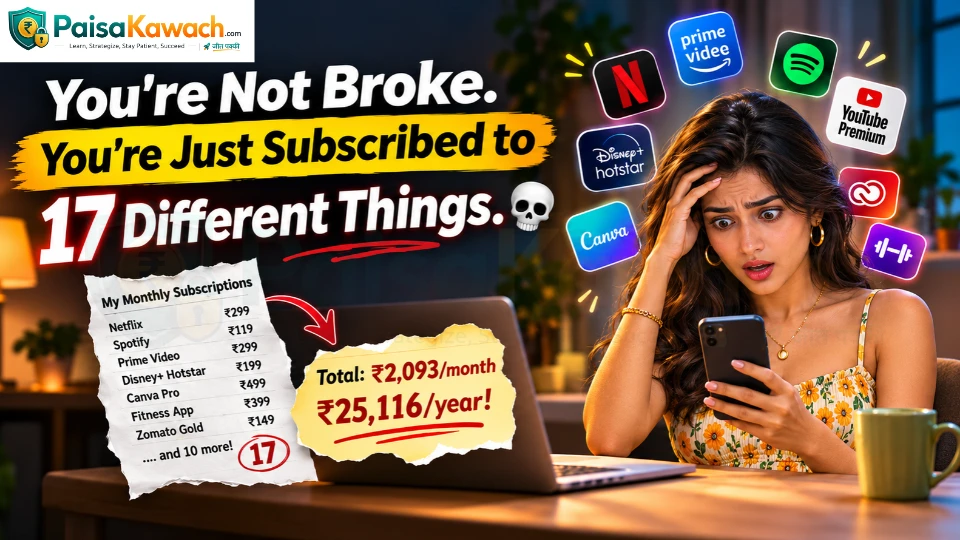
Be honest. How many subscriptions are you currently paying for?
Netflix? Spotify? YouTube Premium? A cloud storage plan? That fitness app you downloaded during your "new year, new me" era? Maybe an AI tool you used twice and then completely forgot existed?
And somewhere in your bank statement, there's probably a mysterious ₹199 charge that has been showing up every month like an unwanted guest.
Congratulations. Your bank account might be funding more memberships than you have actual hobbies. 💀
Here's the uncomfortable part: a subscription costing ₹149 doesn't feel expensive. Neither does ₹299. Or ₹499. But stack enough of them together and suddenly you're paying thousands every month for services you barely remember signing up for.
Welcome to the subscription trap — where convenience meets automatic payments, and your money quietly disappears on schedule.
This isn't about telling you to cancel everything fun. It's about finding the subscriptions you genuinely enjoy, removing the ones you don't need, and making sure you're in control of what renews.
You wouldn't casually hand someone ₹299 every month for doing nothing. But an unused app can effectively collect the same amount through auto-renewal.
The question isn't "Can I afford this subscription?" It's "Would I willingly buy this again today?"
1. The Subscription Trap: Why ₹199 Never Feels Like Real Money
Think about how you react to spending ₹3,000 at once. You might hesitate, compare prices, or question whether the purchase is worth it.
But ₹199 here, ₹299 there, and ₹499 somewhere else? Those purchases often feel harmless because the individual amounts are small.
That difference matters. Subscription services convert occasional purchase decisions into recurring payments. Once you sign up, you don't have to decide to buy the service again every month. The payment can continue until you cancel or the arrangement ends.
Three Reasons Subscriptions Are So Easy to Forget
- Small-price thinking: An affordable monthly charge may attract less attention than its annual total.
- Automatic renewal: Once a payment method is authorised, future charges can require less active effort, subject to applicable payment rules.
- Free-trial optimism: You believe you'll remember to cancel later, but life gets busy and the trial converts into a paid plan.
None of this automatically makes subscriptions bad. Plenty of people get genuine value from paid entertainment, software, education, and productivity tools. The problem begins when you're paying without regularly checking whether the value still exists.
2. Your "Tiny" Subscriptions Might Have a Big Annual Price Tag
Let's look at a fictional example. Meet Riya, a young professional earning ₹38,000 per month.
She doesn't consider herself a big spender. She rarely shops for expensive clothes and doesn't go on extravagant holidays. But her recurring digital expenses tell another story.
Riya's Monthly Subscription Stack
- Video streaming service: ₹299 per month
- Music subscription: ₹119 per month
- Second streaming platform: ₹199 per month
- Cloud storage: ₹130 per month
- Fitness app: ₹499 per month
- Productivity tool: ₹399 per month
- Gaming membership: ₹299 per month
- Another entertainment service: ₹149 per month
That's more than ₹25,000 per year in this illustrative scenario, assuming every listed price stays unchanged.
Now imagine she discovers that she rarely uses three of those services. Cancelling the ₹499 fitness app, ₹399 productivity tool, and ₹149 entertainment subscription would free up ₹1,047 every month — or ₹12,564 over twelve months.
That's money she could direct toward an emergency fund, a financial goal, or something she genuinely enjoys.

3. Calculate How Much Your Subscriptions Are Really Costing You
Enough about Riya's spending. What about yours?
Let's turn your monthly subscription list into an actual number. Include everything that renews automatically: entertainment, digital services, memberships, paid apps, subscriptions billed yearly, and other recurring digital charges.
Interactive Subscription Cost Calculator 🧮
Add your subscriptions and their prices. You can select monthly or yearly billing for each one.
Calculations are illustrative. Annual plans are divided by 12 to show an average monthly equivalent. Your entries stay in this browser session; this widget does not submit them to Paisa Kawach.
Now ask yourself: If you saw that annual amount as a single payment today, would you still choose to buy everything on your list?
If the answer is no, you've identified a useful opportunity to review your spending.
4. How to Find Hidden Subscriptions You Forgot About
Some subscriptions are obvious. Others are buried in app store settings, card statements, email receipts, or automatic payment mandates.
A proper subscription audit means checking more than your phone's home screen.
Your Subscription Detective Checklist 🔎
- Bank and card statements: Review the last three to six months for repeated merchant names or similar charges.
- Google Play: Check the subscriptions section under your account's payments and subscriptions settings.
- Apple account: On an iPhone, review subscriptions in Settings under your Apple account.
- UPI apps: Look for AutoPay or mandate management sections, where supported by the app.
- Email receipts: Search for terms such as "subscription", "renewal", "invoice", "payment successful", and "free trial".
- Service accounts: Check memberships and billing settings directly on websites where you signed up.
Uninstalling an app usually does not cancel its subscription. Cancelling a UPI mandate may also be different from ending your underlying service contract.
Always confirm cancellation with the service provider, check the billing end date, and retain the confirmation.
5. How to Cancel Unwanted Subscriptions in India
Found something you no longer use? Great. Now cancel it properly rather than simply deleting the app or ignoring the charges.
Follow These Steps
- Identify where you subscribed: Was it through the service's website, Google Play, Apple, a card, or another payment platform?
- Open the billing or subscription settings: Look for options such as Manage Subscription, Cancel Plan, Turn Off Auto-Renew, or Manage Mandate.
- Check the cancellation terms: Review any notice period, cancellation fee, remaining access, or refund conditions.
- Confirm cancellation: Save the confirmation message or email and note the next billing date.
- Verify future statements: Check whether another debit occurs after the cancellation should have taken effect.
For UPI, card, and other eligible recurring digital payments, India's e-mandate framework includes rules addressing authorisation, notifications, and revocation. The exact controls available depend on the provider and payment arrangement. Consult the RBI's Digital Payments – E-mandate Framework, 2026 for the regulatory details.
Never share your UPI PIN, OTP, or banking password with anyone claiming they need it to process your cancellation.
6. The Subscription Audit: Keep, Pause, or Cancel?
Before you aggressively cancel everything, remember that spending money isn't inherently bad. A ₹299 music service you use every day could deliver more value than a ₹99 app you haven't opened in six months.
The goal is to improve value, not chase the smallest possible bank statement.
Use the Three-Bucket Method
- KEEP: Services you use regularly, genuinely enjoy, and can comfortably afford.
- PAUSE OR DOWNGRADE: Services you use occasionally, could share under permitted plan rules, or could replace with a cheaper tier.
- CANCEL: Forgotten memberships, unnecessary duplicate services, or subscriptions that no longer justify their cost.
Before keeping a recurring payment, ask three questions:
1. Have I used this meaningfully in the past 30 days?
2. Would I willingly pay for it again today?
3. Does it fit within my current budget?
If you're answering "no" repeatedly, it's time to reconsider the subscription.
7. Take the 7-Day Subscription Detox Challenge
You don't have to fix every subscription problem today. Try this small challenge over the next week and track your progress as you go.
Can You Complete All Seven Tasks?
0 of 7 completed
The most useful result isn't necessarily cancelling lots of services. It's understanding which ones deserve a place in your monthly budget.
8. Why Your Brain Keeps Saying "It's Only ₹199"
Here's where subscription spending gets interesting. Many of our money decisions depend on how a price is presented.
₹199 per month feels smaller than ₹2,388 per year, even though those amounts represent the same spending over twelve months.
Subscriptions can also benefit from inertia. Once a service is running, cancelling requires a decision and some effort. That effort may be small, but it's easy to postpone.
Three Psychological Traps to Watch
- The small-payment effect: You focus on the monthly price and underestimate the annual total.
- The "just in case" excuse: You keep a service because you might need it someday.
- The free-trial trap: You accept a trial without planning how or when to cancel.
A simple solution is to mentally convert every monthly subscription into an annual cost before approving it.
Instead of saying "This app costs only ₹499 a month," say "This app costs ₹5,988 a year."
Same subscription. Different perspective.
9. Quick Quiz: Which Subscription Decision Makes More Sense?
You pay ₹399 a month for an app you haven't used in four months. There's no cancellation fee. What should you do?
The principle is simple: recurring expenses should earn their place in your budget. You can always reconsider a service when your needs change.
10. What Should You Do With the Money You Save?
Suppose you cancel three underused subscriptions and free up ₹800 per month. That's ₹9,600 across twelve months, assuming those savings continue.
Now comes an important decision. If that money quietly gets absorbed into other unnecessary expenses, your bank balance might look exactly the same.
Give Your Savings a Purpose
- Start an emergency fund: Build a cash buffer for unexpected essentials.
- Reduce expensive debt: Paying down high-interest balances may reduce future interest costs.
- Save toward a goal: Set the money aside for education, travel, equipment, or another meaningful priority.
When possible, automate a transfer of the amount saved into a dedicated savings account after cancelling the unwanted payment. This helps prevent the freed-up money from disappearing into miscellaneous spending.
For more practical techniques, read our related guide: If You Can't Earn More, Learn to Save Better.

11. The Ultimate Rule: Subscribe Intentionally, Not Automatically
Subscriptions aren't the enemy. Unnoticed spending is.
A music plan that helps you through your daily commute, a course that improves your skills, or a productivity tool that saves hours of work can be worth paying for.
But five overlapping entertainment platforms, three forgotten apps, and a membership you haven't touched since January? Those deserve another look.
Build These Three Subscription Habits
- Set a monthly subscription budget: Decide how much you're comfortable allocating to recurring services.
- Review every three months: Compare what you pay with what you actually use.
- Schedule renewal reminders: Put calendar alerts ahead of annual billing dates or trial expirations.
Instead of automatically agreeing to every attractive offer, ask whether the service solves a real problem or provides enjoyment that you value.
12. Frequently Asked Questions About Subscription Spending
How do I find all my active subscriptions?
Start with your bank and card statements. Then review Google Play, Apple account subscriptions, UPI AutoPay mandates, email invoices, and direct service-provider billing pages. No single dashboard necessarily shows every subscription you own.
Does deleting an app cancel its subscription?
Usually not. You generally need to cancel through the platform or service where you purchased the subscription. Always check for confirmation.
How can I stop recurring UPI AutoPay payments?
Look for AutoPay or mandate management in your UPI app or payment-provider interface. Follow the supported pause or revoke process, and confirm separately whether the underlying merchant subscription has ended.
How much should I spend on subscriptions every month?
There is no universal percentage. Set a spending limit after accounting for essential expenses, debt obligations, emergency savings, and personal priorities.
Are yearly subscriptions cheaper than monthly subscriptions?
Some annual plans offer a lower equivalent monthly price, but only if you use the service long enough to benefit. Compare the full annual price, refund terms, and cancellation conditions before committing.
Can unused subscriptions hurt my savings?
Yes. Recurring charges reduce the money available for other goals. Even relatively small charges can add up if multiple unused services continue renewing.
13. Final Reality Check: Your Money Deserves Better
You're not financially irresponsible just because you enjoy Netflix, music, gaming, or paid apps. Entertainment and convenience are legitimate things to spend money on.
But if you're stressed about your bank balance while funding services you don't use, that's worth changing.
The next time you notice a ₹199 renewal notification, don't simply swipe it away. Ask yourself whether you still want that service and whether the money could serve you better elsewhere.
"Your subscriptions should make your life better — not quietly make your savings smaller."
Keep what you love. Cancel what you don't use. Know where your money goes.
💬 Your Turn: What's the most ridiculous subscription you forgot you were paying for? Share your answer in the comments — no judgment, just financial character development. 💀
📢 Share this article with the friend who says they're broke but somehow has subscriptions to every streaming platform in existence.
Disclaimer: Financial examples are illustrative. Subscription prices, cancellation processes, and billing terms vary by service and provider. This article provides general financial education, not personalised advice.
Keep Reading: More Gen Z Finance Insights

Comments
No comments yet. Be the first to comment!