Nvidia Stock Crashes Over 8% After Hours: CEO Crisis Shakes Global AI Markets — Impact on India
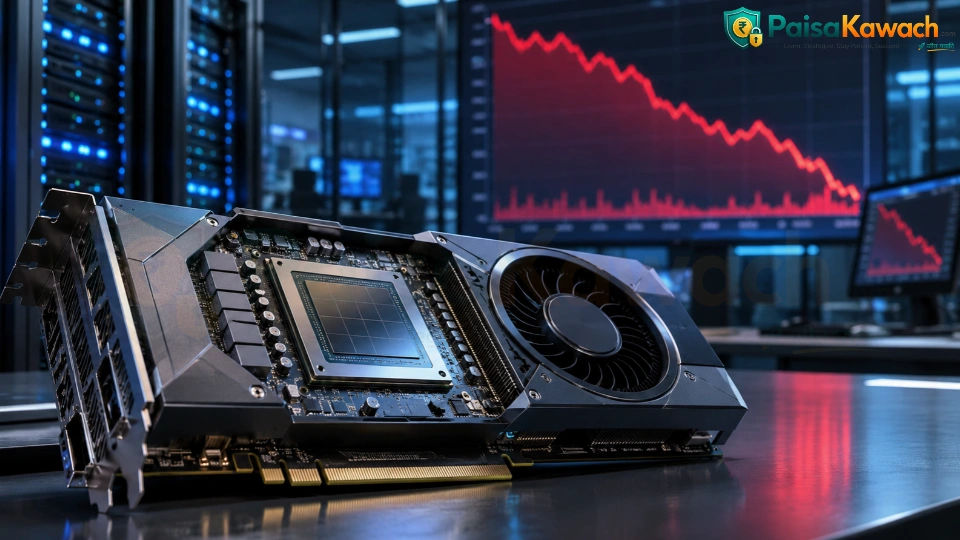
Nvidia Stock News Today, 12 November 2026: A fresh wave of uncertainty has hit the global artificial intelligence industry after Nvidia shares plunged more than 8% in extended US trading on Wednesday, following reports that the semiconductor giant's board was considering the future of its longtime chief executive, Jensen Huang.
The development has sent a warning signal through global technology markets because Nvidia is one of the most influential companies powering the artificial intelligence revolution. Its processors are widely used by technology companies, cloud computing providers, research organisations and businesses developing advanced AI systems.
According to Reuters, Nvidia's board was meeting late Wednesday to discuss whether Huang should continue leading the company amid an investigation related to reported personal relationships and potential security concerns. As of the latest reports reviewed for this article, a final decision on his position had not been confirmed.
The market reaction was immediate. Nvidia shares, which had gained nearly 2.9% during regular trading on 11 November, reversed direction sharply after the closing bell.
The controversy raises a much bigger question for financial markets: Could leadership uncertainty at one of the world's most important AI chip manufacturers affect the wider artificial intelligence investment boom?
Published: 12 November 2026 | Category: International Business and Technology News | Market Data: US trading session of 11 November 2026 | Reading Time: Approximately 9 minutes
Latest Nvidia News: Key Developments at a Glance
Before examining the wider implications, here are the most important developments investors should understand.
- Nvidia shares closed regular US trading on 11 November at $173.73, gaining approximately 2.87%.
- The stock subsequently declined to approximately $158.76 in extended trading, representing an after-hours fall of about 8.62%.
- Reuters reported that Nvidia's board was considering the future of CEO Jensen Huang following recent allegations and an internal investigation.
- Nvidia had previously announced an independent investigation on 8 November concerning reports of a foreign intelligence effort targeting its CEO.
- The company stated on 8 November that it had no reason at that time to believe national security or confidential company information had been compromised.
- Technology stocks and Nasdaq futures came under pressure following reports of the board meeting.
- Nvidia's next quarterly earnings announcement is scheduled for 17 November 2026, making the leadership uncertainty particularly significant for investors.
Important clarification: The reported leadership deliberations do not mean that Jensen Huang has been removed as CEO. The claims underlying the investigation remain subject to review, and no conclusion about wrongdoing should be drawn from the reports alone.
1. Why Did Nvidia Stock Crash After the Market Closed?
Nvidia shares experienced a dramatic reversal during the US trading session on Wednesday, 11 November 2026.
During regular trading, the stock gained approximately 2.87%, closing at $173.73. This recovery was partly supported by improving sentiment toward artificial intelligence companies following encouraging financial developments at AI infrastructure provider CoreWeave.
However, the situation changed after reports emerged that Nvidia's board was evaluating the future of its chief executive.
The Wall Street Journal initially reported that the company was preparing for a possible leadership change. Reuters subsequently reported that directors were meeting to consider whether Huang should remain CEO.
These developments triggered significant selling in Nvidia shares during extended trading.
Nvidia Share Price: 11 November 2026 Market Snapshot
- Regular trading closing price: $173.73 per share.
- Regular trading performance: Up approximately 2.87%.
- After-hours reported price: Approximately $158.76.
- After-hours movement: Down approximately 8.62% from the regular-session close.
- Immediate market concern: Uncertainty about Nvidia's leadership and corporate governance.
- Next major scheduled financial event: Quarterly earnings announcement on 17 November 2026.
The after-hours figures reflect extended trading on 11 November in the United States. Prices may change when the next regular US trading session begins on 12 November.
Why Did Investors React So Strongly?
Stock markets value companies not only through their profits and financial performance but also through expectations about future growth, business stability and management quality.
For Nvidia, the chief executive's role has been particularly important because Huang has led the company since its establishment in 1993 and played a central role in its transformation from a graphics processor manufacturer into a leading AI infrastructure company.
Investors are therefore concerned that an unexpected leadership change could create uncertainty around strategy, customer relationships, product execution and long-term business planning.
However, a sharp stock-price decline does not automatically mean that Nvidia's underlying chip demand or financial performance has deteriorated by the same amount.
2. What Is Happening With Nvidia CEO Jensen Huang?
The current controversy began with media reports concerning Huang's personal relationships and allegations involving a possible foreign intelligence effort.
On 8 November 2026, Nvidia formally announced that its board was initiating an independent investigation in response to reports suggesting that its founder and chief executive may have been targeted by foreign intelligence activity.
The company said a committee of independent directors, assisted by outside legal counsel, would oversee the investigation.
In its official statement, Nvidia also said that it had no reason to believe that national security or company secrets had been compromised. It expressed confidence in Huang and the leadership team at that time.
Subsequent reporting introduced additional allegations and increased pressure on the board to review the company's leadership situation.
Has Jensen Huang Been Removed as Nvidia CEO?
No confirmed removal had been announced in the latest reporting available for this article.
Reuters reported that the board was discussing Huang's future, but consideration of a possible leadership change is different from an official decision.
Under Nvidia's corporate bylaws, directors have the authority to remove the CEO through the required board voting process.
Any actual leadership change would require confirmation through an official company announcement or another reliable disclosure.
- Confirmed: Nvidia announced an independent investigation on 8 November 2026.
- Reported: Directors were considering Huang's future as CEO on 11 November.
- Not confirmed in the reports reviewed: A final decision to remove Huang.
- Unresolved: The conclusions of the independent investigation.
- Important for investors: Any official statement about the company's leadership and succession arrangements.
The distinction between confirmed facts, allegations and possible future decisions is particularly important because Nvidia's market value and influence make the company's leadership a major international business issue.
Source: Nvidia Investor Relations — Official Board Statement, 8 November 2026
3. Why Is Nvidia So Important to the Global Artificial Intelligence Industry?
Nvidia occupies a central position in the development of modern artificial intelligence infrastructure.
AI systems require enormous computing resources to train models, process information and deliver responses to users. Many of these workloads rely on specialised processors capable of performing large numbers of mathematical calculations efficiently.
Nvidia designs graphics processing units, accelerated computing platforms and networking technologies that are widely used in AI data centres.
The company is therefore connected to investment decisions across cloud computing, enterprise software, advanced research, robotics, autonomous systems and other technology industries.
Major Industries That Depend on Nvidia Technology
- Artificial intelligence: Nvidia processors support the training and operation of advanced AI models.
- Cloud computing: Major cloud providers use accelerated computing infrastructure to deliver AI services.
- Data centres: Businesses rely on powerful processors, networking systems and related infrastructure.
- Healthcare research: AI computing supports medical imaging, computational research and scientific applications.
- Automotive technology: Advanced computing systems are used in autonomous-driving development and vehicle software.
- Industrial automation: AI processors support robotics, simulations and intelligent manufacturing.
Because Nvidia's products are involved in so many industries, uncertainty surrounding the company can influence investment sentiment far beyond the semiconductor market.
How Strong Is Nvidia's Underlying Business?
Despite the leadership controversy, Nvidia's previously reported financial performance demonstrated substantial growth.
On 26 August 2026, the company reported second-quarter fiscal 2027 revenue of $96.2 billion, representing an increase of 106% compared with the corresponding quarter a year earlier.
Its data-centre business generated approximately $89 billion in revenue during the quarter, increasing 117% year-on-year.
These figures demonstrate the scale of demand for accelerated computing infrastructure before the latest leadership uncertainty.
However, past growth does not guarantee future performance. Investors are also monitoring whether AI infrastructure spending can remain sustainable and generate adequate returns for customers.
Source: Nvidia Investor Relations — Second Quarter Fiscal 2027 Results
4. Nvidia Selloff: How Are Global AI and Technology Stocks Reacting?
Nvidia's sharp decline in extended trading added pressure to an already volatile technology sector.
Artificial intelligence companies have attracted substantial investment as businesses expand their data-centre capacity and develop increasingly powerful computing systems.
However, the sector has recently faced questions about high valuations, infrastructure spending, financing costs and the profitability of AI-related investments.
The latest Nvidia leadership developments have added another layer of uncertainty.
How Did Other Technology Stocks Respond?
According to Reuters, US technology futures weakened following the reports about Nvidia's board meeting.
- Nasdaq futures declined approximately 1% during the reported reaction.
- Micron shares fell by nearly 2% in extended trading.
- CoreWeave shares dropped approximately 6% after hours.
- AMD shares advanced approximately 4% during the same reporting period.
- Broadcom shares gained approximately 3% as investors assessed potential competitive implications.
These movements show that the market reaction was not uniform. Some technology companies experienced selling pressure, while shares of certain Nvidia competitors strengthened.
Consequently, describing the event as a decline in Nvidia and selected AI-related stocks is more accurate than suggesting that every AI company experienced a crash.
Could Nvidia's Problems Benefit Its Competitors?
Potentially, but the long-term consequences remain uncertain.
Competing semiconductor companies could benefit if customers increasingly diversify their technology suppliers. However, large-scale AI systems depend on hardware performance, software compatibility, networking capabilities and established development ecosystems.
Changing infrastructure providers is not necessarily quick or inexpensive.
A leadership change at Nvidia would therefore not automatically translate into immediate business gains for competing chipmakers.
5. Is the Global AI Stock Market Boom in Danger?
Nvidia's leadership uncertainty comes at a sensitive time for the artificial intelligence investment cycle.
Technology companies are spending enormous amounts of money on AI infrastructure, including processors, servers, networking equipment, electricity supplies and data-centre construction.
Investors expect this spending to generate future revenue through AI-powered products and services.
However, financial markets are increasingly questioning how quickly these investments will deliver sustainable profits.
Three Major Risks Facing AI Stocks
- Valuation risk: High stock prices may already reflect optimistic expectations for future growth.
- Capital expenditure risk: Expensive infrastructure investment may take longer than expected to generate returns.
- Corporate governance risk: Leadership uncertainty and internal investigations can weaken investor confidence.
Does Nvidia's Selloff Mean the AI Bubble Has Burst?
No. A sharp decline in one company's shares does not establish that an entire investment cycle has ended.
AI adoption continues across many industries, and demand for computing infrastructure remains significant.
Nevertheless, investors must distinguish between the long-term usefulness of artificial intelligence and the prices they are willing to pay for businesses participating in the industry.
Even a fast-growing company can become a risky investment when its share price assumes exceptionally strong future performance.
The coming weeks may reveal whether the latest volatility represents a temporary reaction to leadership uncertainty or a broader reassessment of AI-sector valuations.
6. How Could the Nvidia Crisis Affect India?
Although Nvidia is headquartered in the United States, developments affecting the company can have consequences for India's technology industry, investment markets and digital infrastructure.
India has a large IT services sector, a growing data-centre industry and increasing demand for AI computing capabilities.
Indian companies are also investing in generative AI tools, enterprise automation, cloud computing and advanced technology services.
Potential Impact on India's IT Companies
- IT services: Global technology spending uncertainty could influence enterprise AI projects and customer budgets.
- Data-centre operators: Changes in AI hardware availability, financing or expansion plans could affect infrastructure investment.
- Cloud computing providers: Businesses using accelerated computing services may monitor changes in supplier strategy.
- AI startups: Companies developing AI products could be affected by changes in infrastructure pricing or availability.
- Technology investors: Indian investors with exposure to US semiconductor stocks and global technology funds may face greater volatility.
These are possible transmission channels rather than confirmed financial losses for Indian companies.
Will Indian IT Stocks Fall Because of Nvidia?
Not necessarily.
Companies such as TCS, Infosys, Wipro and HCLTech operate across numerous technology services, including enterprise software, cloud transformation, consulting and managed services.
Although the global AI investment outlook can influence technology-sector sentiment, the financial performance of each Indian company depends on its own client demand, business contracts, margins and strategic execution.
Investors should therefore avoid assuming that a decline in Nvidia shares will automatically cause equivalent losses across the Indian IT sector.
Could Nvidia's Problems Slow India's AI Development?
There is currently insufficient evidence to conclude that the company's leadership uncertainty will disrupt AI chip deliveries or ongoing Indian technology projects.
However, if corporate instability eventually affects Nvidia's product roadmap, supply relationships or investment strategy, AI infrastructure customers around the world could reassess their procurement plans.
India's longer-term AI development will also depend on domestic computing infrastructure, skilled professionals, electricity availability, data policies and investment.
PaisaKawach Takeaway: Nvidia's market volatility may affect global technology sentiment, but its immediate impact on Indian IT businesses should not be overstated without company-specific evidence.
7. What Should Indian Investors Do After Nvidia's Stock Crash?
The sudden decline in Nvidia shares highlights an important investment lesson: Even highly profitable and globally influential companies can experience substantial stock-market volatility.
For Indian investors, the appropriate response depends on their investment exposure, financial goals and risk tolerance.
Practical Points for Retail Investors
- Review international exposure: Identify whether your mutual funds, ETFs or direct investments hold Nvidia or other major semiconductor companies.
- Avoid panic selling: Short-term headlines should not automatically determine long-term investment decisions.
- Check concentration risk: A portfolio heavily dependent on a single company or technology sector may be vulnerable to sudden declines.
- Understand valuations: Strong revenue growth does not guarantee that a stock is attractively priced.
- Monitor official disclosures: Company announcements and financial filings are more reliable than unverified social media claims.
- Maintain diversification: Exposure across sectors and asset classes can reduce dependence on a single investment theme.
Is Nvidia Stock a Buying Opportunity After the Fall?
A declining share price does not automatically make a company undervalued.
Before considering any investment, investors should review earnings expectations, competitive advantages, future growth, valuation, corporate governance and potential leadership changes.
Nvidia's upcoming earnings announcement may also provide additional information about demand for AI infrastructure and the company's business outlook.
Investors should not interpret this article as a recommendation to buy, sell or hold Nvidia shares.
8. Nvidia Earnings on 17 November: Why the Next Few Days Matter
Nvidia's next scheduled quarterly earnings announcement on 17 November 2026 is likely to receive substantial investor attention.
Beyond the usual financial results, investors will be watching for any official communication concerning corporate governance and management continuity.
Five Key Developments to Watch
- Official board announcement: Whether Nvidia confirms any leadership decision or provides an update on its investigation.
- Quarterly earnings: Revenue, profitability and data-centre growth reported for the latest financial period.
- Future guidance: Management's outlook for AI hardware demand and upcoming business performance.
- Customer spending: Whether large technology companies continue expanding AI infrastructure investment.
- Semiconductor-sector reaction: Movements in Nvidia's competitors, suppliers and major technology customers.
Investors should also distinguish between Nvidia's extended-hours share price and its performance during the next regular trading session.
Extended trading can experience reduced liquidity, wider bid-ask spreads and sharper price movements than normal market hours.
9. Frequently Asked Questions About the Nvidia Crisis
Why Did Nvidia Shares Crash on 11 November 2026?
Nvidia shares fell more than 8% in after-hours trading following reports that its board was considering the future of CEO Jensen Huang. The decline reflected concerns about leadership uncertainty and corporate governance.
Has Nvidia CEO Jensen Huang Resigned or Been Fired?
As of the reports reviewed for this article on the morning of 12 November 2026, no final decision removing Huang had been confirmed.
How Much Did Nvidia Stock Fall?
Nvidia closed regular trading on 11 November at $173.73, up approximately 2.87%, before declining about 8.62% to approximately $158.76 in extended trading.
Will Nvidia's Stock Decline Affect the Entire AI Industry?
The event could influence sentiment across semiconductor, cloud computing and AI infrastructure companies. However, the effects will differ by company, and it does not establish that demand for AI technology has collapsed.
Could Indian IT Companies Be Affected?
Indian technology companies may experience indirect effects through global technology spending, AI infrastructure investment and investor sentiment. Direct financial impacts have not been established solely by Nvidia's stock decline.
Is Nvidia Still a Major AI Chip Company?
Yes. Nvidia remains a leading supplier of accelerated computing infrastructure. Its previously reported quarterly financial results showed substantial revenue growth, particularly in its data-centre business.
When Is Nvidia's Next Earnings Announcement?
Nvidia's next earnings announcement is scheduled for 17 November 2026.
Does Nvidia's Share Price Decline Mean Artificial Intelligence Is Failing?
No. Stock prices are influenced by earnings expectations, valuations, interest rates and company-specific risks. A decline in a major technology stock does not mean the underlying technology has stopped developing.
10. Final Analysis: Nvidia's Leadership Crisis Tests Confidence in the Global AI Boom
Nvidia's sharp after-hours stock decline on 11 November 2026 has become one of the most significant technology-business developments heading into Thursday's global trading sessions.
The reported board deliberations have created uncertainty around the future of a chief executive closely associated with the company's rise to prominence in artificial intelligence.
At the same time, the company's recent financial results demonstrate that the underlying demand for AI computing infrastructure has been substantial.
This creates an important distinction between business fundamentals and market confidence.
Investors are not only evaluating whether Nvidia can continue selling advanced chips. They are also assessing the stability of its management, future growth expectations, competitive position and the sustainability of global AI infrastructure spending.
For India, the developments are relevant because the country's technology sector is increasingly connected to international AI investment, cloud computing and digital transformation.
However, the impact on Indian companies will depend on actual changes in technology demand, customer spending and business operations rather than on headlines alone.
The immediate focus now shifts to any official statement from Nvidia's board, the company's next regular trading session and its scheduled earnings announcement on 17 November.
PaisaKawach Final Takeaway: Nvidia's crisis is a reminder that even market-leading technology companies face leadership and valuation risks. For investors, understanding the difference between temporary market volatility and long-term business performance is essential.
Sources and Further Reading
- Reuters — Nvidia Board Considers CEO's Future, 11 November 2026
- Nvidia Investor Relations — Official Board Statement, 8 November 2026
- Nvidia Investor Relations — Second Quarter Fiscal 2027 Financial Results
- The Indian Express / Reuters — Nvidia Falls in After-Hours Trading
Stay informed with PaisaKawach for the latest international financial news, global technology developments, stock market analysis and practical insights for Indian investors.
Disclaimer: This article is provided for educational, informational and news-reporting purposes only. It is not a recommendation to buy, sell or hold any security. Reported allegations remain unproven unless established through an appropriate investigation or legal process. Stock prices and market conditions are subject to change. Readers should verify current information and consult a qualified financial adviser where appropriate.
Keep Reading: More Insights You Might Like

Comments
No comments yet. Be the first to comment!