Global Briefing September 14, 2026: Hormuz Talks Postponed, BRICS Declaration Adopted, Sweden Election Too Close to Call
September 14, 2026, opened with three international developments that carry direct consequences for India: the collapse of high-stakes diplomatic talks over the Strait of Hormuz, a missing Indian seafarer following an attack on a commercial tanker off Oman, and a deadlocked Swedish election that could reshape Europe's political landscape and affect India's strategic partnerships in Northern Europe.
Iran-Gulf Strait of Hormuz Meeting Postponed After Regional Divisions Surface
A critical diplomatic meeting between Iran and Gulf countries to negotiate safe shipping arrangements through the Strait of Hormuz was abruptly postponed late Sunday, hours before it was set to begin in Salalah, Oman. The postponement came after Bahrain refused to participate and Saudi Arabia raised concerns about the proposed framework, exposing deep divisions among Gulf states over how to engage with Tehran on the world's most strategically vital waterway.
Oman's Foreign Minister Badr Albusaidi announced the postponement on X, stating the meeting was delayed "in the interests of consensus" and that Oman "remains committed to fostering dialogue that supports stability and lasting cooperation in our region". The Omani Foreign Ministry added that the decision was made "to help create appropriate conditions for constructive dialogue".
Why the Talks Collapsed
Bahrain's Foreign Ministry declared Saturday that Manama would not participate in any collective ministerial meeting with Iran before diplomatic relations between the two countries were restored. Saudi Arabia also submitted amendments to the proposed agreement, with Riyadh concerned that the language could effectively establish a new status quo that would be unacceptable to GCC states.
Iranian Foreign Minister Abbas Araghchi had earlier told Al-Araby Al-Jadeed that "the main, and indeed the only, agenda of this meeting is the new maritime route in the Strait of Hormuz". He stressed that the agreement with Oman "by no means" signifies the reopening of the Strait of Hormuz. Iran and Oman had reportedly finalized an agreement setting out the new route, along with maps and a joint statement detailing the arrangements.
The timing of the postponement was particularly significant, coming just a day after an Iranian commercial vessel was hit near Qeshm Island, further escalating tensions in the already volatile region. More than six months into the Middle East war, the Hormuz blockade continues to drive up oil prices, which soared past US$100 a barrel last week.
- Diplomatic setback: The postponement undermines efforts to stabilize shipping routes amid escalating regional conflict, with no new date announced
- Regional divisions: Bahrain's refusal to attend and Saudi Arabia's concerns reflect deep fractures among Gulf states over engagement with Iran
- Iran's conditions: Tehran has outlined seven conditions for reopening the waterway and has expressed interest in charging transit fees
Indian Seafarer Missing After Tanker Attack Off Oman Coast
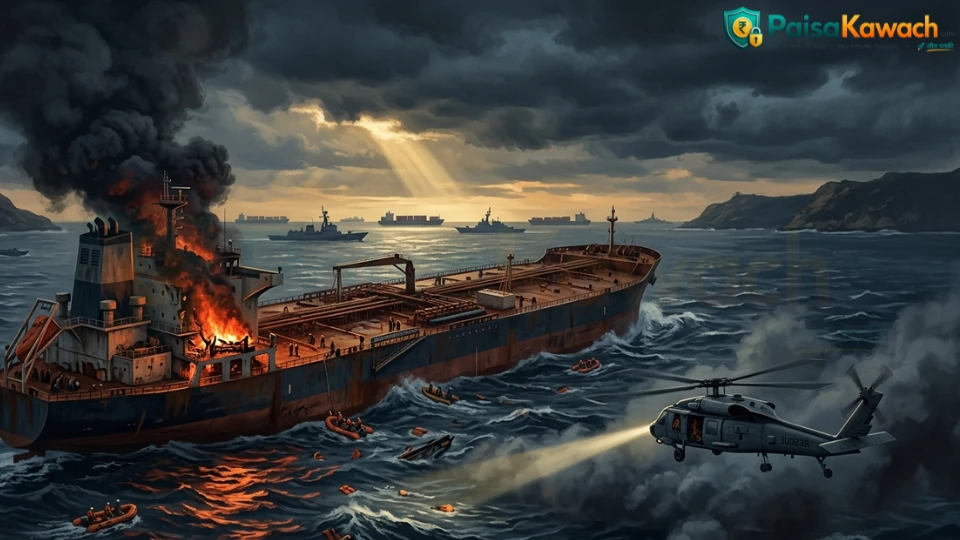
India's Ministry of External Affairs confirmed that one Indian seafarer remains missing after an unknown projectile struck the Panama-flagged oil tanker MT El Gaia while it was transiting off the coast of Oman. Thirteen other Indian crew members were rescued, but the vessel's engine room was completely destroyed by fire.
"We condemn the attack on the commercial vessel MT El Gaia off the coast of Oman earlier today. Of the 14 Indian crew onboard, 13 Indians have been rescued so far," the MEA said in a statement. "Search and rescue operations for the missing Indian national are continuing. Our embassy in Oman is closely monitoring the situation and proactively coordinating with the Omani authorities in the ongoing search and rescue operation".
The Human Cost of Regional Conflict
The attack brings the total number of Indian seafarers killed in the West Asia conflict to ten, while another five Indian seafarers have died in strikes on merchant vessels in the Black Sea. The MT El Gaia carried 25 crew members in total, including 14 Indian nationals and 11 Pakistanis, with one Pakistani engineer also reported missing.
Speaking at the BRICS Summit just a day earlier, Prime Minister Narendra Modi had proposed the creation of a "Seafarers' Emergency Support Network" to safeguard maritime workers from security risks due to regional conflicts. The MEA reiterated its call for "immediate de-escalation of tensions and pursuance of dialogue and diplomacy to bring peace to the region," adding that "the targeting of commercial shipping, seafarers, civilians, and civilian infrastructure in the region is unacceptable".
New Delhi has been increasingly concerned over attacks on commercial shipping, as most vessels in the region typically carry Indian seafarers. The Indian government also urged that "free and safe navigation and flow of commerce through the international waterways in the region be restored at the earliest".
- Rescue operation ongoing: India's embassy in Oman is coordinating with Omani authorities in the search for the missing seafarer
- Crew composition: MT El Gaia carried 14 Indian nationals; 13 were rescued, and search continues for the missing Indian crew member
- Modi's initiative: The Seafarers' Emergency Support Network proposal at BRICS reflects India's growing concern for maritime worker safety
Sweden Election Deadlocked as Centre-Left Holds One-Seat Lead
Sweden's parliamentary election remained too close to call Monday, with the opposition centre-left bloc holding a razor-thin one-seat majority (175 seats) over the right-wing governing coalition (174 seats) in the 349-seat Riksdag. According to preliminary results from the Swedish Election Authority, the opposition left-wing bloc received 49.4% of the vote, while the ruling right-wing bloc received 49.1%, with voter turnout at 80.4%.
Final results are not expected until Wednesday after overseas ballots are counted. The election, while unlikely to change Sweden's pro-Western and pro-Ukraine stance, will decide whether Prime Minister Ulf Kristersson's push toward a hard-right clampdown on migration continues.
Implications for India and Europe
While geographically distant, Sweden's political direction affects EU trade policy, climate cooperation, and relations with India. In May 2026, Prime Minister Narendra Modi visited Gothenburg, where India and Sweden elevated their relationship to a Strategic Partnership, setting an objective of doubling bilateral trade and investment within five years.
The India-Sweden partnership identifies cooperation in green steel, cement, transport, energy storage, smart grids, and sustainable mining. India's industrial future will increasingly be shaped by decarbonisation pressures, EU carbon regulation, green supply chains, and technological standards. The new partnership includes defence dialogue, cyber policy, counterterrorism cooperation, and defence innovation.
A centre-left victory under Social Democrat leader Magdalena Andersson would likely reinforce Sweden's commitment to multilateral trade frameworks and green technology partnerships — areas where Indian-Swedish cooperation has deepened in recent years. Conversely, a right-wing win would bring the far-right Sweden Democrats into government for the first time, potentially shifting EU migration and trade debates.
The far-right Sweden Democrats, a party with roots in the Nazi fringe, have already helped move Swedish politics from welfare universalism towards welfare conditionality, migration restriction, and cultural belonging. Since June, the general residence requirement for citizenship has risen from five to eight years, alongside new self-sufficiency and knowledge requirements.
- Historic closeness: The one-seat margin echoes Sweden's 2018 and 2022 elections, both of which took days to resolve
- Far-right breakthrough: PM Kristersson has pledged to include the Sweden Democrats in government if his bloc wins
- EU policy impact: Sweden's stance on trade agreements, climate targets, and multilateralism affects India-EU relations and the India-Sweden Strategic Partnership
These three developments — a collapsing diplomatic framework in the Gulf, a direct attack on Indian maritime personnel, and a European political deadlock — collectively illustrate how regional instability and democratic fragility are converging to shape India's foreign policy and economic security in September 2026.
Keep Reading: More Insights You Might Like
Comments
No comments yet. Be the first to comment!