Fed Decision Day: Why a Certain Rate Pause Still Holds India's Rupee and Bonds Hostage
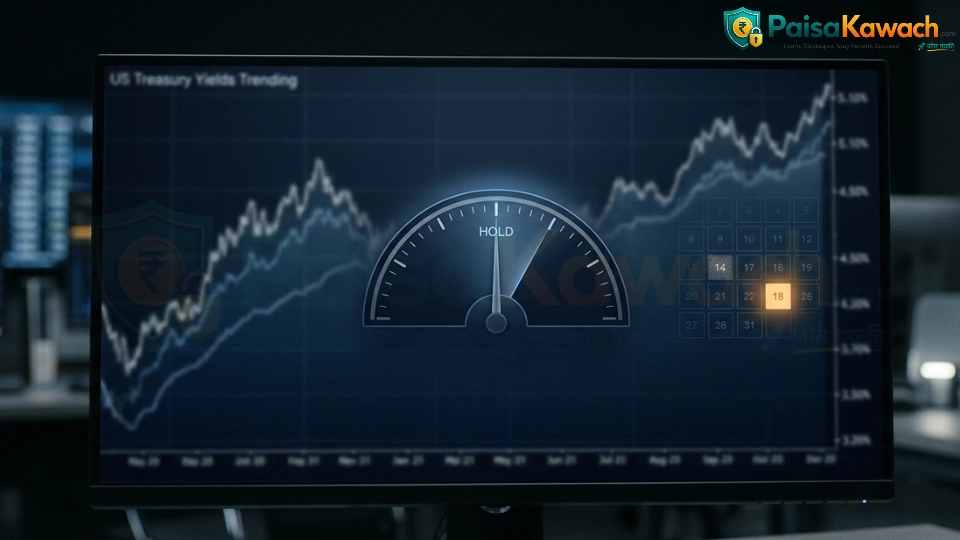
The Federal Reserve concludes its two-day policy meeting tonight, and the decision itself carries almost no suspense. Markets have priced a 90% probability of a hold, and a Reuters poll of 100 economists found 94 expecting no change to the 3.75%–4.00% target range. The consensus range for the decision is uniformly 0 basis points.
For Indian markets, that certainty is precisely the problem. The October pause has been fully absorbed into prices. What has not been absorbed is the December signal — and that signal, delivered through the Fed's statement language and Chair Kevin Warsh's press conference, will determine whether the rupee stabilises near 95 or slides toward 96, whether the 10-year bond yield breaks the 7.50% ceiling, and whether foreign portfolio investors continue their record withdrawal from Indian equities.
The October Hold: Priced, Explained, and Almost Irrelevant
The case for a pause tonight is straightforward. The Fed raised rates in September for the first time since 2023, and policymakers have signalled they want to observe the effects before moving again. Weak September jobs data and the proximity of the November 3 midterm elections further argue for waiting.
Why the data actually supported a hike
The uncomfortable truth for the Fed is that the economic data did not argue for a pause. Inflation picked up last month and broadened beyond fuel prices. US economic growth accelerated last quarter, powered by solid consumer spending and surging business investment driven by AI demand. The unemployment rate held at 4.2%, and weekly jobless claims are running lower than at any point in Warsh's lifetime.
Nationwide Chief Economist Kathy Bostjancic put it bluntly: "The data, in my opinion, do support a rate hike." What stopped the Fed was not the economy but the bond market. The 10-year Treasury yield had risen to near-quarter-century highs in the weeks after September's hike, threatening to slow the economy more than intended. Officials including New York Fed President John Williams and Vice Chair Philip Jefferson signalled a willingness to wait for more data — and markets responded by slashing hike bets.
- Hold probability: 90% priced by futures, with 94 of 100 Reuters-polled economists expecting no change.
- The data paradox: Growth accelerated, inflation broadened, and unemployment held at 4.2% — yet the Fed is pausing because Treasury yields did the tightening for it.
- The political dimension: With midterms on November 3, Warsh must dispel any impression that the decision was politically motivated, whichever way it goes.
December: The Only Number That Matters for India
The shift in the December consensus over the past month has been dramatic. In the previous Reuters poll, fewer than half of economists expected a December hike. In the latest survey, all 100 expect one. CME futures assign a 72.6% probability to a December move.
Why Warsh's words carry more weight than the rate decision
Warsh has consistently refused to provide forward guidance, and he is unlikely to start tonight. That creates a communication trap. If he says nothing about December, markets may interpret it as a signal that the Fed is not credible on inflation — which could actually spike yields more than a hike would. If he explicitly validates the December consensus, he locks in expectations but removes the Fed's flexibility.
EY-Parthenon Chief Economist Gregory Daco framed the dilemma precisely: "If Chairman Warsh does not provide any clue or essentially says that the Fed is waiting for more evidence, that would be a signal that the Fed is not credible, and that would likely lead to spiking yields that would actually be more dramatic for the economy" than an actual rate hike.
Goldman Sachs' US economics team expects the Fed to follow an "every other meeting" pattern: skip October, hike in December, and end the tightening cycle there. The bank argues that the current inflation impulse comes from tariffs, energy, and AI-driven supply shocks, which should fade without requiring sustained tightening.
- December consensus: 100 of 100 economists expect a hike at the December 8–9 meeting, up from fewer than half a month ago.
- Market pricing: Futures assign a 72.6% probability to a December move.
- The communication risk: Warsh's refusal to guide markets means any implicit signal will be read as deliberate — and the absence of one could be read as weakness.
Rupee: A Stronger Dollar Is the Default Outcome
The rupee's vulnerability to the Fed's tone is direct and well-documented. A stronger dollar, driven by higher US yields, encourages foreign investors to shift capital toward US assets, pressuring emerging-market currencies and equity flows. The rupee has already been testing the 95.30 threshold, with the RBI's intervention appearing to thin.
Why Indian policymakers have limited room to respond
The RBI raised rates to 5.50% in early October and shifted to a "calibrated tightening" stance. But it cannot match US tightening indefinitely without choking domestic growth, and its currency-defense measures have been described by some portfolio managers as insufficient to foster long-term confidence. A hawkish Fed signal tonight would narrow the interest-rate differential that supports the rupee, increasing the likelihood of a test toward 96.
Higher US Treasury yields also make crude oil more expensive in dollar terms, compounding India's import bill at a time when Brent is already near $115 per barrel. That combination — a weaker rupee and elevated crude — feeds directly into imported inflation, constraining the RBI's room to support growth.
- Rupee pressure point: A stronger dollar and higher US yields encourage capital outflows from emerging markets, with the rupee already near the 95.30 line.
- RBI constraint: At 5.50%, the RBI has limited room to defend the currency without harming domestic growth.
- Crude compounding: Dollar-denominated oil becomes more expensive in rupee terms as the currency weakens, feeding imported inflation.
Bonds and Equities: The Transmission Channels
For Indian government bonds, the Fed's signal matters through the yield differential. The 10-year benchmark yield closed at 7.4740% last week, its 10th consecutive weekly rise and the longest streak in data going back to 1998. A hawkish Fed that pushes US yields higher would narrow the spread that supports Indian bonds, increasing the likelihood of the benchmark testing or breaking 7.50%.
For equities, the channel is foreign portfolio flows. FPIs have withdrawn ₹52,100 crore from Indian equities in October, following a ₹35,861 crore outflow in September. The cumulative 2026 outflow stands at ₹3.12 lakh crore, far exceeding the full-year 2025 figure. Hariselvan Radhakrishnan of HST Wealth noted that "a continued focus on inflation could push US yields and the dollar higher, keeping foreign flows into emerging markets under pressure, while balanced guidance could support a temporary recovery."
There is a mitigating scenario. If Warsh emphasises data dependence without explicitly endorsing the December consensus — preserving optionality while maintaining credibility — US yields could stabilise, giving Indian equities room for a relief rally. But that outcome requires a communication balancing act that Warsh has shown little appetite for.
- Bond yield risk: The 10-year at 7.4740% faces a test of 7.50% if US yields rise on a hawkish Fed signal.
- FPI outflow backdrop: ₹52,100 crore pulled from Indian equities in October alone, with the 2026 total at a record ₹3.12 lakh crore.
- The relief scenario: Balanced guidance without explicit December validation could stabilise yields and support a short-term equity rebound.
What to Watch Tonight
The Fed's statement is released at 2:00 PM ET (11:30 PM IST), with Warsh's press conference following at 2:30 PM ET. Three specific elements will determine the India impact:
First, whether the statement acknowledges the broadening of inflation beyond energy in language that implies December action is imminent. Second, whether Warsh repeats his refusal to guide markets or inadvertently validates the 100% December consensus. Third, whether any dissents emerge — Cleveland Fed President Beth Hammack is expected to favour an immediate hike, and additional dissents would signal a more hawkish committee than the pause suggests.
For Indian investors, the practical takeaway is that tonight's decision is not the event. The event is what Warsh says about the next one. The rupee, bonds, and FPI flows will all respond to how convincingly the Fed telegraphs December — or how carefully it avoids doing so.
Keep Reading: More Insights You Might Like
Comments
No comments yet. Be the first to comment!