Three Global Forces Driving Markets Today: IMF Debt Warning, Saudi Oil Risk and the U.S. CPI Countdown

Global markets are being driven by three powerful forces on October 14, 2026: a growing debt warning from the International Monetary Fund, renewed oil-market anxiety linked to attacks on Saudi targets, and a crucial U.S. inflation report that could determine the next move in global interest rates.
Each of these stories matters on its own. Together, they form a single macroeconomic picture: governments are carrying heavy debt, energy prices remain elevated because of geopolitical risk, and investors are waiting to see whether inflation is cooling enough to reduce pressure on central banks. If inflation remains stubborn while debt and oil stay high, the world could face another round of tighter financial conditions.
This is why today’s global market narrative is not just about stocks moving up or down. It is about the cost of money, the cost of energy, and the ability of governments to manage both at the same time.
Quick Read: What Is Moving the World Today?
These are the three biggest global stories shaping markets right now.
- The IMF says public debt is nearing 100% of global GDP and warns governments to act quickly as bond yields stay elevated.
- Oil is back above $106 a barrel as traders assess the risk that Saudi-related attacks could eventually affect supply more directly.
- Markets are waiting for U.S. CPI data, with investors expecting headline inflation of around 3.6% year-on-year.
1) IMF Warns the World’s Debt Problem Is Becoming Urgent
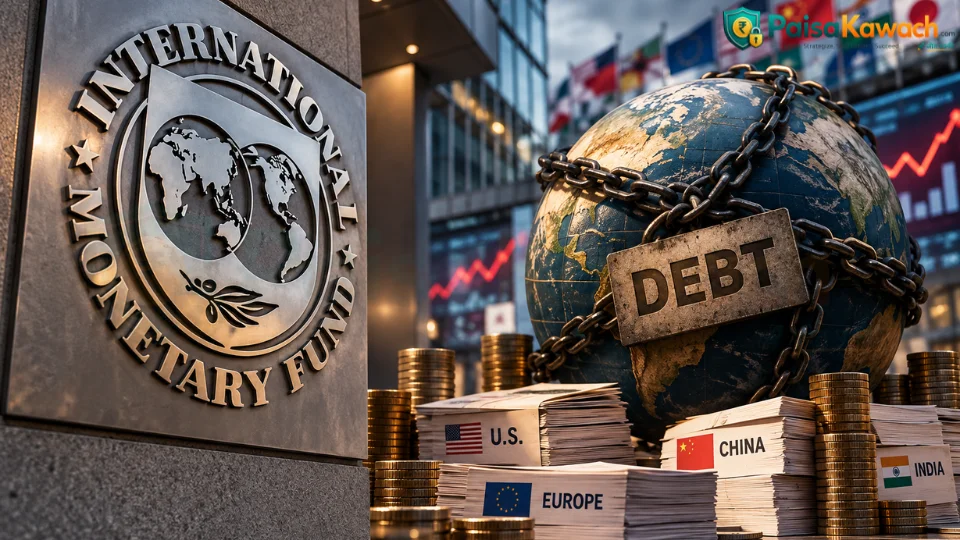
The first major global story today is the International Monetary Fund’s warning that the world’s public debt burden is becoming increasingly difficult to manage. According to the IMF, public debt is approaching 100% of global gross domestic product, putting it near the highest levels seen since the Second World War.
The concern is not just the size of the debt itself. The bigger issue is that governments now have to refinance that debt at much higher interest rates than they did during the low-rate era that followed the global financial crisis and the pandemic years. In other words, countries are carrying very large debt piles at the same time that borrowing money has become far more expensive.
Why Higher Bond Yields Make Debt More Dangerous
When bond yields rise, governments pay more interest when they issue new debt or refinance old debt. That can squeeze public finances, reduce room for welfare or infrastructure spending, and make fiscal policy much harder to manage. The IMF says delays in reducing deficits and stabilizing debt will only make the adjustment more painful later.
- Global public debt is nearing 100% of GDP.
- Higher bond yields are raising the cost of refinancing sovereign debt.
- Countries that delay fiscal adjustment risk even larger future borrowing costs.
Why This Matters Beyond Government Budgets
Sovereign debt is not an isolated market. Government bond yields influence the entire financial system, including bank lending rates, corporate borrowing costs, mortgages, and capital flows into emerging markets. If governments have to pay more to borrow, the rest of the economy usually has to pay more as well.
That is why the IMF’s warning matters globally. This is not simply a story about fiscal discipline in one country. It is a warning that the world could face structurally higher interest costs at a time when growth is still uneven and geopolitical risks remain elevated.
The U.S. Example Shows How Serious This Has Become
Reuters reported that U.S. interest costs are projected to rise to around 5.3% of GDP, a level comparable to one of the federal government’s biggest spending categories. That illustrates how interest expense itself is becoming a macroeconomic force.
- Higher sovereign yields affect banks, businesses, households, and emerging markets.
- Debt-servicing costs are starting to crowd out other government priorities.
- The longer high yields persist, the more pressure they place on the global economy.
2) Saudi Supply Risk Keeps Oil Above $106

The second major force moving global markets today is oil. Brent crude is trading around $106.58 a barrel, while U.S. crude is near $94.94, keeping energy firmly in the inflation-risk zone. Markets remain sensitive to developments involving Saudi Arabia because any threat to Saudi infrastructure or regional stability can affect energy sentiment worldwide.
The latest concern comes from continued fighting involving Yemen’s Iran-aligned Houthis and Saudi Arabia. Reuters reported that traders are weighing supply risk after attacks on Saudi targets, including airports and an administrative building linked to Saudi Aramco. Even when actual oil production is not immediately disrupted, these incidents increase perceived supply risk and keep a geopolitical premium embedded in crude prices.
Why Oil Prices Stay High Even Without a Direct Supply Collapse
Oil markets do not need a full shutdown in exports to react. In many cases, the threat of disruption is enough. Traders price in the possibility that further escalation could damage infrastructure, tighten shipping routes, increase insurance costs, or force precautionary supply adjustments.
- Brent crude is holding above $106 a barrel.
- Saudi-linked security risks are keeping a geopolitical premium in oil prices.
- Higher oil prices continue to threaten inflation and transport costs globally.
The Contradiction: Russian Diesel Could Ease Pressure, But Risk Remains
There is, however, one balancing factor. Traders also expect increased Russian diesel exports to ease some of the tightness in fuel markets. That could limit how sharply prices rise in the short term. But it does not remove the core risk. Saudi Arabia remains one of the world’s most important energy suppliers, and any major escalation affecting its energy system would have global consequences.
This is why oil remains one of the world’s most important macro variables. It affects headline inflation, shipping costs, airline economics, industrial margins, consumer spending, and central-bank policy.
Why Oil Still Shapes the Inflation Story
Higher crude prices feed into a wide range of prices across the economy. Energy affects transport, logistics, aviation, manufacturing, agriculture, and household fuel bills. So even when core inflation appears more stable, high oil can quickly complicate the broader inflation outlook.
- Russian diesel expectations may prevent an extreme oil spike.
- Saudi supply risk still keeps markets nervous.
- Elevated oil prices can quickly feed into broader inflation pressures.
3) U.S. CPI Could Reset Global Interest-Rate Expectations Today

The third major story is today’s U.S. consumer price index report, which is the most important scheduled market event of the day. Investors expect headline inflation to come in around 3.6% year-on-year. That number may look moderate compared with the peak inflation years, but in the current environment it carries enormous significance.
The reason is simple: if inflation comes in hotter than expected, markets may start pricing a stronger chance of another Federal Reserve rate hike or a longer period of high interest rates. If inflation is softer, yields could ease, the dollar could weaken, and global equities may get some relief.
Why One U.S. Inflation Print Affects the Whole World
U.S. monetary policy still sits at the center of global financial conditions. Treasury yields influence global capital flows, currency markets, corporate debt pricing, and foreign borrowing costs. That means a U.S. inflation surprise can quickly affect emerging-market currencies, European bond markets, commodity prices, and stock markets across Asia.
- Markets expect U.S. headline CPI around 3.6%.
- A hotter reading could push Treasury yields and the dollar higher.
- A softer reading could reduce rate-hike fears and ease pressure on global markets.
Why Today’s CPI Matters More in a High-Debt, High-Oil World
Normally, an inflation print is already important. But today it matters even more because it arrives against two difficult background conditions: very high public debt and elevated oil prices. If inflation remains sticky, central banks may have to keep rates high even as governments struggle with debt servicing and businesses face higher energy costs.
That is the real macro risk. The world may not be dealing with just one problem, but three reinforcing pressures at once: expensive money, expensive energy, and fragile fiscal positions.
This Is the Market Chain Investors Are Watching
Higher CPI can lead to higher Fed expectations. Higher Fed expectations can lift Treasury yields. Higher yields can strengthen the dollar and tighten financial conditions. If oil is also high at the same time, inflation becomes harder to cool and the pressure intensifies further.
- Sticky inflation can force central banks to keep policy tighter for longer.
- That increases pressure on indebted governments and leveraged companies.
- High oil makes the inflation fight more difficult and less predictable.
How These Three Global Stories Connect
At first glance, public debt, Saudi-related oil risk, and U.S. CPI may seem like separate stories. In reality, they are part of the same global macro equation.
High debt makes economies more sensitive to interest rates. High oil makes inflation harder to control. Sticky inflation forces central banks to keep rates elevated. Elevated rates then increase the burden of debt and reduce economic flexibility. This loop is exactly why markets are so sensitive right now.
The World Is Fighting on Three Fronts at Once
Governments are trying to preserve fiscal credibility. Central banks are trying to control inflation. Markets are trying to judge whether economic growth can withstand both high borrowing costs and expensive energy.
- Debt amplifies the damage from higher interest rates.
- Oil amplifies the risk of persistent inflation.
- Inflation data determines how aggressively central banks may respond.
What This Means for India
India is directly exposed to all three developments. Higher global bond yields can put pressure on capital flows and domestic borrowing costs. Higher oil prices can worsen the import bill and increase inflation. And a strong U.S. CPI print can push up the dollar, which can place renewed pressure on the rupee and imported inflation.
On the other hand, if U.S. inflation comes in softer and oil stabilizes, India could benefit through a calmer rupee, easier imported inflation, and more stable global risk appetite.
Why Indian Investors Should Care
- India is a major oil importer and is sensitive to crude price moves.
- U.S. yields strongly influence FII flows and global risk appetite.
- Higher global borrowing costs can eventually affect Indian bonds, banks, and rate-sensitive sectors.
What Should Investors Watch Next?
The next few hours and days could be crucial. Investors should focus on whether the U.S. CPI report confirms cooling inflation, whether oil remains above $106 or rises further, and whether more policymakers echo the IMF’s debt warning with specific fiscal actions.
Three Immediate Signals Matter Most
- Watch the U.S. CPI release and the market reaction in Treasury yields and the dollar.
- Watch Brent crude and headlines related to Saudi infrastructure or regional escalation.
- Watch sovereign-bond markets for signs that investors are becoming more worried about fiscal sustainability.
Conclusion
The three biggest global stories on October 14, 2026 are deeply connected. The IMF is warning that governments are running out of room to ignore rising debt costs. Oil remains high because Saudi-related supply risk has not disappeared. And the U.S. inflation report could determine whether markets face relief or another round of tighter financial conditions.
Together, these stories define the current global economic challenge. The world is trying to manage high debt, persistent energy risk, and uncertain inflation at the same time. If one of those pressures worsens, markets may be able to cope. If all three remain elevated together, the result could be a tougher and more volatile environment for governments, businesses, and investors around the world.
Keep Reading: More Insights You Might Like

Comments
No comments yet. Be the first to comment!