China’s AI Chip Push Reshapes Global Markets as Nvidia Loses Share, Tencent Raises $4.5 Billion and Asian Tech Stocks Slide
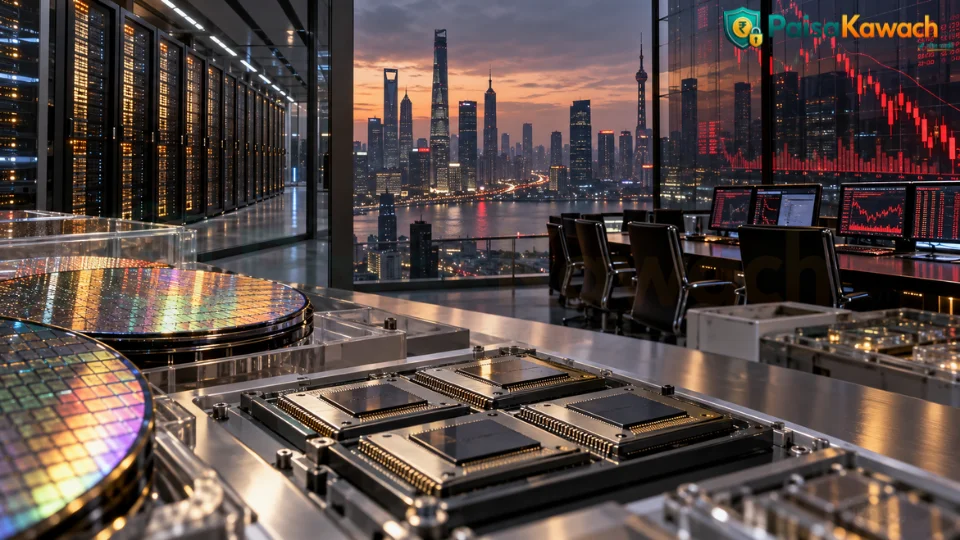
A major shift is taking place inside the global artificial-intelligence industry on October 13, 2026.
China is no longer simply trying to replace restricted U.S. artificial-intelligence chips with weaker domestic alternatives. Its home-grown accelerator ecosystem is expanding rapidly, major Chinese technology companies are raising billions of dollars to finance new AI infrastructure, and investors across Asia are beginning to reconsider how much profit established semiconductor leaders can earn if Chinese competitors continue improving.
Three developments today illustrate how quickly this transition is accelerating. New IDC data shows Nvidia’s share of China’s data-centre AI accelerator market has fallen to 34% while Huawei has climbed to 28%. Tencent is simultaneously tapping international and offshore Chinese bond markets for at least $4.5 billion as its AI-related capital expenditure surges. And across Asian markets, semiconductor stocks are falling sharply, with South Korea’s KOSPI dropping around 6% amid broader concerns about AI valuations, Chinese competition and future chip-industry margins.
Taken together, these developments point to a much bigger story than one bad day for technology stocks. The global AI race is increasingly becoming a battle over domestic chip ecosystems, access to capital, data-centre infrastructure and the ability to produce complete computing systems rather than individual processors.
Quick Read: What Is Happening Today?
Three developments are driving the AI and semiconductor story on October 13, 2026.
- Nvidia’s share of China’s data-centre AI accelerator market fell to 34% in the first half of 2026, while Huawei reached 28%, according to IDC data reported by Reuters.
- Tencent is selling U.S. dollar and offshore-yuan bonds in a transaction expected to raise at least $4.5 billion as its AI-related investment increases sharply.
- Asian technology markets are falling heavily, with South Korea’s KOSPI down around 6% as investors reassess AI valuations and the competitive threat from Chinese semiconductor companies.
Story 1: Nvidia’s China AI Chip Share Falls to 34%
The most significant structural development today comes from China’s artificial-intelligence semiconductor market.
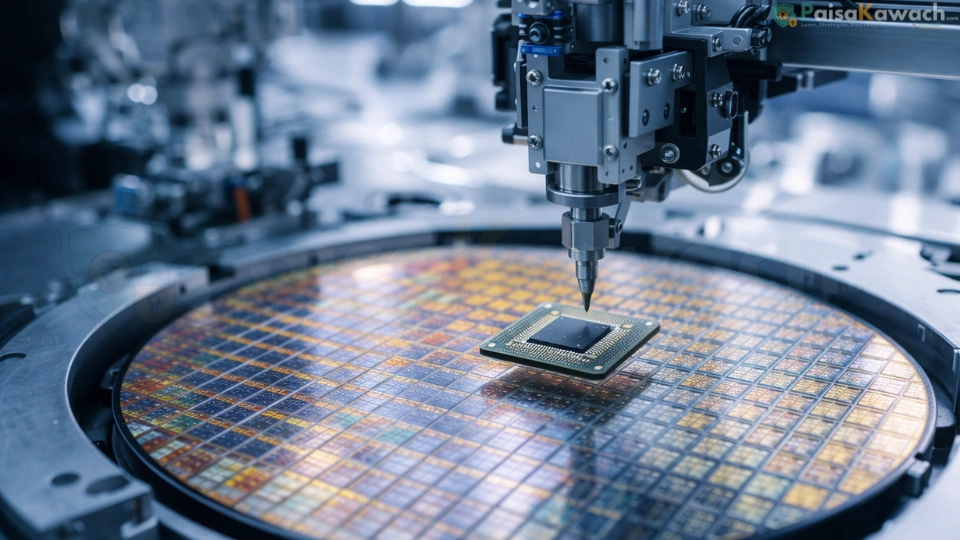
According to IDC data reviewed by Reuters, Nvidia controlled approximately 34% of China’s data-centre AI accelerator market during the first half of 2026.
Huawei reached approximately 28%, putting the Chinese technology group much closer to Nvidia than many investors would have expected only a few years ago.
Nvidia Shipments Fell 44%
Nvidia shipped around 678,000 AI accelerators in China between January and June 2026, representing a decline of approximately 44% from a year earlier.
U.S. export restrictions have limited Nvidia’s ability to sell its most advanced processors into China, creating an opening for domestic suppliers.
- Nvidia shipped approximately 678,000 AI accelerators in China during the first half of 2026.
- Shipments were down around 44% year-on-year.
- U.S. export controls continue to restrict the availability of Nvidia’s most advanced products in the Chinese market.
Huawei Is Rapidly Closing the Gap
Huawei shipped approximately 572,000 AI accelerators during the same period, giving it about 28% of the Chinese market.
That compares with slightly more than 300,000 units during the corresponding period a year earlier.
The Competitive Gap Has Narrowed Dramatically
The difference between Nvidia and Huawei in China is therefore no longer enormous.
Nvidia remains the largest supplier by market share, but Huawei’s growth shows that Chinese cloud providers, government organisations and technology companies are increasingly willing to deploy domestically designed alternatives.
- Huawei shipped approximately 572,000 AI accelerators in the first half of 2026.
- Its market share reached roughly 28%.
- Domestic Chinese demand is increasingly shifting toward locally designed AI computing systems.
This Is Bigger Than Huawei Versus Nvidia
The Chinese market is not developing around one domestic competitor alone.
Companies including Alibaba’s T-Head, Cambricon, Baidu’s Kunlunxin and Hygon are also expanding their presence.
IDC data showed that nine of the 11 domestic Chinese accelerator suppliers increased shipments during the first half of 2026.
China Is Building an Entire AI Chip Ecosystem
This matters because semiconductor independence does not require one Chinese company to completely replace Nvidia.
China can reduce dependence on foreign technology if multiple suppliers collectively provide sufficient computing capacity for different workloads.
- Huawei is only one part of China’s expanding domestic AI semiconductor ecosystem.
- Alibaba, Baidu, Cambricon, Hygon and other suppliers are increasing shipments.
- A diversified local supply base reduces dependence on any single foreign semiconductor company.
Non-GPU Accelerators Are Overtaking GPUs in China
One particularly important detail in the IDC data is the changing architecture of China’s AI computing market.
Total AI accelerator shipments in China reached approximately 2.008 million units during the first half of 2026.
Traditional GPU shipments fell around 26% to approximately 991,000 units.
Other types of AI accelerators, however, increased nearly 80% to approximately 1.016 million units.
This Could Change How Investors Think About AI Hardware
For years, GPUs have been treated as almost synonymous with AI computing.
China’s market suggests that alternative architectures could become increasingly important where access to advanced GPUs is restricted or where specialised workloads can run efficiently on different accelerator designs.
- Total Chinese AI accelerator shipments reached approximately 2.008 million units.
- GPU shipments fell to around 991,000 units.
- Non-GPU accelerator shipments rose to approximately 1.016 million units, overtaking GPUs.
Why U.S. Export Controls May Be Producing an Unexpected Result
Washington introduced semiconductor export restrictions partly to limit China’s access to the most advanced computing technologies.
The restrictions have clearly made it harder for Chinese companies to obtain Nvidia’s leading processors.
But they have also created an enormous commercial incentive for domestic Chinese companies to develop alternatives.
Restrictions Can Accelerate Local Substitution
When companies know that access to imported technology may remain uncertain, they have a strong reason to redesign software, hardware and data-centre infrastructure around products they can reliably obtain.
- Export restrictions reduce access to advanced U.S. chips.
- Scarcity creates stronger incentives for Chinese companies to adopt domestic alternatives.
- Long-term substitution could permanently reduce Nvidia’s addressable market inside China.
The Competition Is Moving From Individual Chips to Full Systems
The next stage of AI semiconductor competition may not be determined by which company produces the fastest individual processor.
IDC says competition in China is increasingly shifting toward system-level integration.
That includes processors, networking, memory, software frameworks, servers, cooling and data-centre architecture working together.
System Performance Can Matter More Than Chip Performance
A slightly slower processor can remain commercially useful if thousands of units can be integrated efficiently and supported by reliable software.
This is one reason Huawei’s broader technology ecosystem may matter almost as much as the technical specifications of individual accelerators.
- AI systems depend on networking, memory, software and power efficiency as well as processors.
- Chinese companies are increasingly building complete domestic computing stacks.
- Future competition may focus on data-centre-level performance rather than chip benchmarks alone.
Story 2: Tencent Is Raising at Least $4.5 Billion for Its AI Expansion
The second major development today shows how much capital the AI race now requires.
Tencent is selling U.S. dollar and offshore Chinese yuan bonds in a transaction that could raise at least $4.5 billion.
The company is offering long-duration debt across four tranches, including 10-year and 20-year U.S. dollar notes and 10-year and 30-year offshore yuan bonds.
Tencent Is Locking In Long-Term Funding
The maturity structure is notable because Tencent is not simply borrowing for a short-term working-capital need.
Issuing bonds with maturities extending as long as 30 years suggests the company is securing financing for a prolonged investment cycle.
- Tencent is offering both U.S. dollar and offshore-yuan bonds.
- The transaction could raise at least $4.5 billion.
- Some bonds have maturities of 20 or 30 years, highlighting the long-term nature of the investment cycle.
Tencent’s Capital Spending Has More Than Doubled
The financing comes after Tencent dramatically increased capital expenditure.
Capital spending reached approximately 96.3 billion yuan, or around $14.4 billion, during the first half of 2026.
That was more than twice the level recorded a year earlier.
Where Is the Money Going?
The spending includes computing hardware, software and data-centre infrastructure needed to support AI services.
- Tencent spent approximately 96.3 billion yuan on capital expenditure during the first half of 2026.
- Spending more than doubled year-on-year.
- AI computing equipment, software and data centres are major investment priorities.
AI Is Turning Technology Companies Into Major Bond Issuers
This represents an important change in the technology sector.
Many large technology companies historically financed expansion primarily from internal cash generation.
The extraordinary cost of building AI infrastructure is now encouraging even highly profitable technology companies to make greater use of debt markets.
The AI Boom Is Becoming a Credit-Market Story
As more technology companies issue debt to finance AI infrastructure, artificial intelligence increasingly affects not only equity valuations but also corporate bond supply and long-term interest rates.
- AI infrastructure requires unusually large amounts of upfront capital.
- Technology companies are increasingly turning to debt markets to finance expansion.
- AI therefore has growing implications for corporate credit markets as well as stock markets.
Investors Still Want Tencent’s Debt
Despite rising concerns about AI valuations, investor demand for Tencent’s bond transaction has been substantial.
Reuters reported that orders exceeded $2 billion for the dollar-denominated bonds and approximately 35 billion yuan, equivalent to about $5.2 billion, for the offshore-yuan securities.
Credit Investors and Equity Investors Are Sending Different Signals
Tencent shares fell around 1.3% amid the broader technology-market decline, and the stock is down substantially in 2026.
Bond investors, however, continue to show strong interest in lending to the company.
- Demand for Tencent’s offshore yuan bonds exceeded the expected transaction size.
- The company retains investment-grade credit ratings.
- Equity investors are questioning growth valuations while credit investors remain willing to provide long-term financing.
Story 3: Asian Technology Stocks Are Being Repriced
The third major development is happening directly in financial markets.
Asian equities sold off sharply on October 13, led by semiconductor and technology stocks.
South Korea’s KOSPI dropped approximately 6%, triggering a temporary restriction on program selling.
Japan and Taiwan Also Fell
Japan’s Nikkei declined about 2.6%, while Taiwan’s market fell roughly 2%.
The broader MSCI Asia-Pacific index excluding Japan dropped around 2.4% to a two-month low.
- South Korea’s KOSPI fell around 6%.
- Japan’s Nikkei dropped approximately 2.6%.
- MSCI’s Asia-Pacific index excluding Japan lost about 2.4%.
Why South Korea Is Especially Vulnerable
South Korea sits at the centre of the global semiconductor supply chain.
Companies such as Samsung Electronics and SK Hynix are major suppliers of memory chips used in AI servers and advanced computing systems.
That means changes in AI spending expectations or Chinese competition can have an outsized effect on Korean markets.
Memory Chips Are Becoming the Next Competitive Battlefield
A major source of concern is progress by Chinese memory-chip producer ChangXin Memory Technologies.
Investors fear that improved Chinese memory technology could eventually increase competition for established suppliers and pressure industry margins.
- South Korea has heavy stock-market exposure to semiconductor companies.
- Chinese progress in memory technology could increase industry supply and competition.
- Higher competition could eventually weaken pricing power for established chipmakers.
The AI Trade Is Becoming Less One-Sided
The market reaction shows an important shift in investor psychology.
For several years, strong AI demand generally meant higher valuations for semiconductor companies.
Now investors are beginning to distinguish between rising AI demand and the profits that individual suppliers can actually retain.
More AI Demand Does Not Automatically Mean More Profit
If more companies enter the market, chip supply can increase even while demand remains strong.
Competition can therefore reduce selling prices and profit margins.
- AI demand can remain strong while semiconductor profit margins decline.
- More suppliers create additional price competition.
- Investors are increasingly focusing on market share and profitability rather than AI demand alone.
China’s AI Strategy Is Starting to Affect Global Valuations
The connection between today’s Nvidia market-share data and the Asian semiconductor selloff is important.
China’s technology independence was previously viewed primarily as a geopolitical objective.
It is increasingly becoming a financial-market variable.
Chinese Self-Reliance Can Change Earnings Expectations
If domestic Chinese companies capture more of their home market, foreign semiconductor suppliers may lose revenue opportunities.
If Chinese companies eventually become competitive exporters, pressure could extend beyond China.
- Domestic substitution can reduce foreign semiconductor sales inside China.
- Increasing Chinese production can add more supply to technology markets.
- Future competition could affect global chip pricing and profit margins.
The Bigger Story: China Is Building an AI Supply Chain That Can Finance Itself
Taken together, Nvidia’s falling market share and Tencent’s bond issuance reveal two sides of the same transformation.
China needs both technology and capital to develop an independent AI ecosystem.
Domestic semiconductor suppliers are expanding production, while large technology companies are securing long-term financing to buy computing equipment and build data centres.
This Is Becoming a Self-Reinforcing Cycle
More domestic chips create more available computing capacity. More computing capacity allows Chinese technology companies to build more AI services. Greater AI investment creates more demand for domestic chips.
- Domestic chip production increases available AI computing capacity.
- Technology companies invest more heavily in data centres and AI services.
- Additional infrastructure investment creates further demand for Chinese semiconductors.
Could China Eventually Reduce Nvidia’s Global Dominance?
Nvidia remains the dominant supplier of advanced AI processors globally and continues to possess major advantages in software, networking and developer adoption.
China’s progress therefore does not mean Nvidia’s global leadership is disappearing.
But the Chinese market shows that technology restrictions can create regional semiconductor ecosystems that operate differently from the U.S.-led market.
The World Could Move Toward Two AI Computing Ecosystems
One possibility is a more fragmented global technology system.
The United States and allied markets could continue relying heavily on Nvidia and other Western semiconductor suppliers, while China builds increasingly independent processors, software frameworks and data-centre architecture.
- Nvidia remains significantly stronger globally than its Chinese competitors.
- China is nevertheless reducing reliance on foreign AI hardware.
- The global semiconductor market could become more geographically fragmented.
Why This Matters for Nvidia Investors
The immediate risk is not that Huawei suddenly replaces Nvidia everywhere.
The more realistic concern is that Nvidia’s long-term revenue opportunity in China becomes smaller.
China Is Too Large a Market to Ignore
China remains one of the world’s largest technology markets.
A permanent reduction in Nvidia’s accessible Chinese market could affect future revenue assumptions even if demand elsewhere remains strong.
- Nvidia’s China market share has fallen significantly.
- Domestic alternatives are gaining customer acceptance.
- Investors may need to reassess long-term Chinese revenue assumptions.
Why This Matters for Huawei
Huawei’s growth in AI accelerators reinforces its transformation from a telecommunications-equipment company into a major computing-platform provider.
The company is increasingly competing across processors, cloud infrastructure, networking and AI systems.
Huawei’s Advantage Is Integration
Because Huawei develops multiple parts of the technology stack, it can potentially optimise hardware, networking and software together.
- Huawei is expanding beyond telecommunications into AI computing.
- Its broader technology ecosystem supports system-level integration.
- Strong domestic demand gives the company a large market in which to improve its products.
Why Tencent’s Bond Sale Matters Beyond China
Tencent’s financing highlights a global issue: the AI buildout requires enormous amounts of capital.
If technology companies continue borrowing heavily, they will increasingly compete with governments and other corporations for investor money.
AI Could Influence Global Interest Rates
Large-scale corporate debt issuance increases the supply of bonds investors must absorb.
When that occurs alongside heavy government borrowing, yields may need to remain higher to attract sufficient capital.
- AI companies increasingly require external financing.
- Technology debt is entering the same capital markets used by governments and traditional industries.
- Heavy issuance could contribute to structurally higher borrowing costs.
Why Today’s Asian Selloff Matters Globally
The October 13 decline is important because Asia dominates much of the physical semiconductor supply chain.
Memory chips, foundry capacity, packaging, electronics assembly and advanced manufacturing are heavily concentrated across South Korea, Taiwan, Japan and China.
A Semiconductor Repricing Can Spread Worldwide
If investors reduce valuations across Asian chipmakers, the impact can quickly reach U.S. technology stocks, semiconductor equipment manufacturers and global index funds.
- Asia remains the centre of global semiconductor manufacturing.
- Technology-market weakness can spread rapidly across international equity markets.
- Semiconductor valuations increasingly reflect geopolitical competition as well as earnings.
Interactive View: Follow the Chain
China Chip Chain
U.S. export restrictions → fewer advanced Nvidia chips available → Chinese firms accelerate domestic alternatives → Huawei and other suppliers gain market share → Nvidia’s China opportunity shrinks.
AI Financing Chain
AI demand increases → Tencent expands data centres and computing infrastructure → capital expenditure doubles → company raises billions in bonds → AI becomes a major credit-market theme.
Market Chain
Chinese semiconductor progress → investors expect greater competition → future chip margins are questioned → Korean, Japanese and Taiwanese tech stocks fall → global AI valuations face pressure.
What Could Happen Next?
The next phase of this story will depend on whether Chinese suppliers can continue increasing performance and production volumes.
Watch Nvidia’s China Market Share
A continued decline would suggest domestic substitution is becoming structural rather than temporary.
Watch Huawei Accelerator Shipments
Further rapid growth would indicate that customers are becoming increasingly comfortable deploying Huawei-based systems at scale.
Watch Chinese AI Bond Issuance
Tencent may not be the last major Chinese technology company to raise substantial capital for AI infrastructure.
- Monitor accelerator shipment growth inside China.
- Monitor capital expenditure at Tencent, Alibaba and other major technology companies.
- Monitor profit margins at global semiconductor and memory-chip producers.
What Does This Mean for India?
India is not currently a major producer of advanced AI accelerators, but the transformation has important implications for the country.
A more fragmented global semiconductor industry could create opportunities for India in chip packaging, electronics manufacturing, data centres, software and supply-chain diversification.
India Could Benefit From Global Diversification
- International companies may continue diversifying electronics supply chains outside China.
- India could attract more semiconductor packaging, assembly and data-centre investment.
- Greater competition among AI hardware suppliers could eventually reduce computing costs for Indian companies.
Frequently Asked Questions
Has Huawei overtaken Nvidia in China?
No. Nvidia still held the largest share of China’s data-centre AI accelerator market in the first half of 2026 at approximately 34%, compared with Huawei at around 28%. However, the gap has narrowed substantially.
Why did Nvidia’s China shipments fall?
U.S. export restrictions have limited the company’s ability to supply its most advanced processors to Chinese customers, while domestic competitors have increased production.
How much is Tencent raising?
Tencent’s current U.S. dollar and offshore-yuan bond transaction could raise at least $4.5 billion, depending on final market demand and pricing.
Why is Tencent borrowing money if it is profitable?
AI infrastructure is extremely capital intensive. Long-term bond financing allows Tencent to preserve cash while spreading infrastructure costs across many years.
Why did South Korea’s stock market fall so sharply?
Semiconductor shares were hit by concerns about AI valuations, rising Chinese competition and broader geopolitical and energy risks. South Korea’s market is particularly sensitive because large chipmakers represent a substantial share of the index.
Does China already have chips as advanced as Nvidia’s best products?
China still faces disadvantages in several cutting-edge semiconductor technologies, and Nvidia remains the global leader in high-end AI computing. The important change is that Chinese suppliers are becoming capable enough to meet a growing share of domestic demand.
Conclusion: The Global AI Race Has Entered a New Phase
The biggest technology story on October 13, 2026 is not simply that Nvidia has lost market share or that Asian stocks are falling.
The deeper change is that China is building a more independent artificial-intelligence ecosystem while simultaneously mobilising the capital required to expand it.
Nvidia’s Chinese market share has fallen to 34% as Huawei approaches 28%. Domestic accelerator suppliers are increasing shipments across multiple architectures. Tencent is raising at least $4.5 billion as its capital spending more than doubles. And investors across Asia are beginning to reconsider whether strong AI demand automatically guarantees strong profits for existing semiconductor leaders.
This changes the global AI investment story.
The first phase was dominated by scarcity: there were too few advanced processors to meet exploding demand.
The next phase may increasingly be about competition.
If China successfully develops multiple domestic accelerator platforms, memory suppliers, networking systems and software stacks, the global AI market could become more fragmented and more competitive.
That could be positive for customers because greater competition can reduce prices and increase supply.
But for semiconductor investors, it introduces a harder question: as the AI market becomes much larger, how much of the resulting profit will established leaders actually be able to keep?
Keep Reading: More Insights You Might Like

Comments
No comments yet. Be the first to comment!