India’s Electric Dream: Modi Unveils Global EV Export Push with ₹70,000 Crore Investment
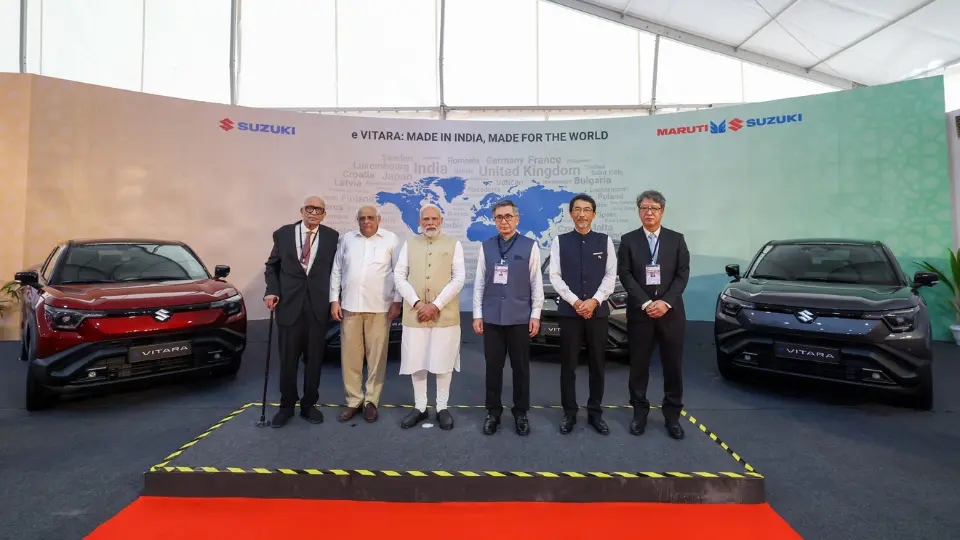
Image Credit: PIB
Prime Minister Narendra Modi has set the stage for India to become a global powerhouse in electric vehicle (EV) manufacturing and exports. Speaking at the launch of Suzuki’s eVITARA BEV in Gujarat, Modi emphasized that India is no longer content with being just a domestic market—it is preparing to send EVs “Made in India” to the world.
The announcement comes with a ₹70,000 crore investment plan spread over the next 5–6 years, targeted at building robust supply chains, scaling up manufacturing capacity, and positioning India as a competitive force in the global EV arena.
A Push Beyond Domestic Demand
India’s EV industry has so far focused on domestic adoption, supported by incentives like FAME-II and state-level subsidies. Modi’s announcement marks a significant shift—from an inward-focused strategy to an outward-looking ambition of transforming India into an export-driven EV hub.
- Global exports of Indian-made EVs, beginning with passenger cars.
- Development of large-scale gigafactories for EV batteries.
- Priority focus on securing critical minerals to ensure raw material availability.
The Role of Suzuki’s eVITARA BEV
The unveiling of Suzuki’s eVITARA BEV in Gujarat symbolises India’s readiness to compete in the global EV race. As one of the first India-made EVs designed with export markets in mind, the model will act as a benchmark for affordability, performance, and reliability.
Strengthening the Supply Chain
One of the biggest hurdles for EV expansion worldwide is the availability of batteries and raw materials. Modi’s strategy directly addresses this by prioritizing:
- Battery domestication: Establishing domestic battery production facilities to cut dependence on imports.
- Critical mineral mission: A government-backed initiative to secure lithium, cobalt, and rare earths through global partnerships.
- Value-added manufacturing: Encouraging tier-1 and tier-2 suppliers to localize components like motors, power electronics, and charging systems.
Economic Impact of the EV Export Push
According to industry experts, the move could transform India’s auto sector over the next decade. Export-led growth is expected to create hundreds of thousands of new jobs, attract foreign direct investment, and elevate India’s position in the global automotive supply chain.
Indian manufacturers are expected to compete with Chinese, South Korean, and European automakers by offering a unique blend of cost-efficiency and scale. Analysts believe that India’s EV exports could exceed $50 billion annually by 2035 if the plan is executed effectively.
Challenges Ahead
Despite the optimism, challenges remain. Charging infrastructure, logistics, global competition, and technology adoption rates will all play decisive roles. Experts also caution that India will need to maintain policy stability and attract significant private investment to sustain the export momentum.
Bottom Line
Modi’s announcement signals a bold leap for India’s electric vehicle sector. With Suzuki’s eVITARA BEV paving the way, and a ₹70,000 crore roadmap in place, India is making it clear that its EVs are not just for Indian roads—they are built to compete on highways across the world.
Keep Reading: More Insights You Might Like
 Trump’s Attempt to Fire Fed Governor Sparks Global Market Fears
Next →
Trump’s Attempt to Fire Fed Governor Sparks Global Market Fears
Next →
 Nifty 50 Opening Forecast for August 28, 2025: Weak Sentiment May Drive Flat-to-Lower Start
Comments
No comments yet. Be the first to comment!