India–US Trade Deal: How Agriculture and Dairy Safeguards Protect Indian Farmers and What It Means for Both Economies
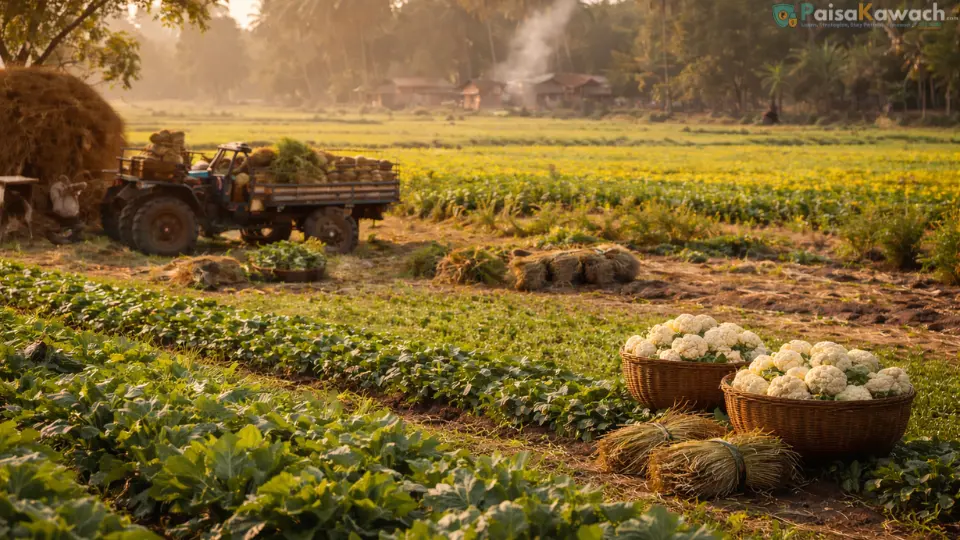
India’s recent trade understanding with the United States has drawn significant attention, not just for tariff relief on Indian exports, but for what it deliberately leaves untouched. Indian ministers have repeatedly underlined that agriculture and dairy—two politically and economically sensitive sectors—remain safeguarded, with no adverse impact on Indian farmers. This assurance sits at the heart of the agreement and explains why New Delhi views the deal as strategically balanced rather than concessionary.
Why agriculture and dairy are sensitive for India
Agriculture supports nearly half of India’s population, directly or indirectly, while the dairy sector is one of the largest sources of rural income, driven largely by small and marginal farmers. Unlike capital-intensive farming systems in developed economies, Indian agriculture is fragmented, price-sensitive, and deeply linked to social stability.
Any sudden opening of these sectors to heavily subsidised foreign produce—especially from the United States—could distort domestic prices, weaken farmer incomes, and create long-term dependence on imports. This backdrop explains why India has historically resisted sweeping agricultural liberalisation in trade negotiations.
What exactly has been safeguarded in the deal
Under the current India–US trade understanding, there is no blanket reduction in tariffs for sensitive farm and dairy products. Staples such as rice, wheat, sugar, milk powder, and dairy-based products remain outside full market-opening commitments.
Limited access may be explored for select, non-sensitive agricultural items, but only through calibrated quotas or phased mechanisms. Crucially, these do not undermine minimum support prices (MSP), domestic procurement systems, or cooperative-led dairy models that dominate India’s rural economy.
- Sensitive sectors protected: Dairy, cereals, sugar, and key farm produce remain shielded.
- No tariff shock: Existing duties on critical farm imports stay largely intact.
- Farmer income stability: MSP and cooperative dairy structures remain unaffected.
- Trade focus elsewhere: Gains concentrated in manufacturing, energy, and services.
What this means for Indian farmers
For Indian farmers, the safeguards reduce uncertainty. There is no immediate threat of cheaper, subsidised U.S. farm goods flooding domestic markets. This stability is vital at a time when input costs, climate variability, and price volatility are already challenging farm incomes.
By ring-fencing agriculture and dairy, policymakers aim to ensure that trade-led growth does not come at the cost of rural distress. In practical terms, it preserves India’s ability to pursue internal reforms—such as productivity improvements and supply-chain upgrades—at its own pace.
What the deal means for the United States
From the U.S. perspective, the agreement represents a pragmatic compromise. While American farm lobbies have long sought deeper access to India’s vast food market, Washington gains instead through expanded opportunities in energy exports, defence equipment, aircraft, and high-value manufactured goods.
The deal also strengthens strategic and economic alignment with India, which carries long-term geopolitical value that outweighs near-term agricultural access constraints.
Market and investor impact
Financial markets have interpreted the agricultural safeguards as a sign of policy stability rather than protectionism. By avoiding politically disruptive concessions, the deal reduces the risk of domestic backlash and policy reversals—factors investors closely monitor.
Export-oriented sectors such as textiles, engineering goods, chemicals, and select manufacturing segments stand to benefit from improved U.S. market access, while agri-linked stocks remain insulated from competitive shocks.
How this compares with other trade agreements
India’s stance mirrors its approach in other negotiations, including talks with the European Union and regional partners, where agriculture and dairy are treated as special cases. Unlike some developing economies that have opened farm markets rapidly, India continues to favour gradualism.
This contrasts with U.S. trade agreements in Latin America, where agriculture is often fully liberalised—highlighting how India’s demographic and political realities shape its trade strategy.
Future outlook: what to watch next
Looking ahead, the real test will lie in implementation and follow-up talks. Incremental access for niche agricultural products could still be negotiated, but sweeping liberalisation remains unlikely. Instead, cooperation may shift toward agri-technology, storage, logistics, and climate-resilient farming practices.
Bottom line
By safeguarding agriculture and dairy, India has signalled that trade expansion will not come at the expense of farmer livelihoods. For the United States, the deal offers strategic depth and industrial gains, even without full farm access. For investors and markets, the message is one of balance—growth-oriented, yet politically and socially grounded.
Keep Reading: More Insights You Might Like
 Apple Faces Near-Term Margin Pressure as On-Device AI Push Raises Hardware Costs
Next →
Apple Faces Near-Term Margin Pressure as On-Device AI Push Raises Hardware Costs
Next →
 Gold Prices Surge as Safe-Haven Demand Rises Amid Global Market Volatility
Comments
No comments yet. Be the first to comment!