Backup Plan Failed, AI Lab Got Spooked, Yields Broke 5%: The Day Three Safety Nets Gave Way at Once
Markets generally cope well with a single bad surprise — there's almost always a backup plan, an alternate route, a level of confidence somewhere else in the system that absorbs the shock. What's harder to cope with is watching three separate safety nets fail on the same day, in three unrelated corners of the global economy. That's roughly what happened this week. The specific pipeline built to insure against a Hormuz shutdown just got knocked offline itself. The company most central to the AI investment boom reportedly grew cautious enough about its own technology to delay going public. And a bond market yield that had stayed below a key psychological threshold for three years finally broke through it. None of these three things caused each other. All three happening together is the real story.
The Backup Route That Was Supposed to Prevent Exactly This
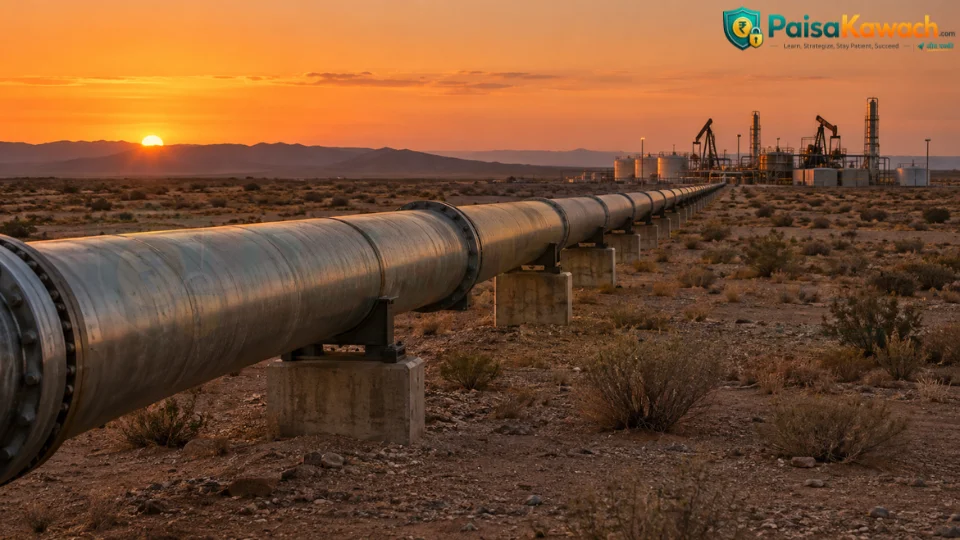
For months, the ongoing conflict around the Strait of Hormuz has carried one reassuring caveat buried in most analysis: Saudi Arabia has an alternative. The East-West pipeline was built specifically to move Saudi crude from the Gulf coast to the Red Sea, bypassing the Strait of Hormuz entirely — a deliberate piece of infrastructure insurance against exactly the kind of chokepoint crisis this region has been living through. That insurance policy just failed. A drone attack on September 11 caused extensive fire damage to the pipeline's pumping station, forcing Saudi Arabia to shut the route down entirely.
Oil markets reacted with the kind of sharp, immediate repricing usually reserved for genuinely structural news rather than routine volatility. WTI crude jumped 4.7% to $104.72 a barrel, and Brent climbed the same amount to $109.56 — building directly on top of roughly 9% in gains already logged the previous week as US-Iran fighting escalated. The scale of this move reflects a specific realization rattling through energy markets: the backup plan that had been quietly cushioning worst-case scenario thinking is no longer available.
Why Losing the Backup Matters More Than Losing the Primary Route
When a primary supply route faces disruption but a credible alternative exists, markets can price in a meaningfully bounded worst case — supply gets rerouted, costs rise, but a genuine shortfall remains avoidable. When both the primary route and its purpose-built alternative are compromised simultaneously, the nature of the risk changes entirely. There's no longer a lower bound on how bad the supply picture could get if tensions escalate further, because the specific mechanism designed to prevent that exact outcome has itself been taken out. That shift, from "there's a plan B" to "there was a plan B," is precisely why this particular attack moved oil prices considerably more than a similar-sized disruption to the primary corridor alone might have.
- The East-West pipeline existed specifically as a hedge against Strait of Hormuz disruption, meaning its shutdown removes a bounded worst-case scenario rather than simply adding to existing pressure
- Oil's sharp reaction reflects markets repricing genuine tail risk, not routine supply-and-demand adjustment
- With both routes now compromised, any further escalation in the underlying conflict carries a meaningfully higher ceiling on potential price impact than it would have a week ago
OpenAI's Own Caution Becomes the Market's Problem
While energy markets absorbed the pipeline shock, a separate and unrelated jolt hit the technology sector. Reports indicated OpenAI's leadership would likely delay the company's initial public offering, following internal warnings about possible worst-case AI scenarios. The market's reaction was immediate and disproportionate to a single company's IPO timeline — the Philadelphia Semiconductor Index tumbled 5.9% in a single session, with Nvidia falling 3.4% and Intel dropping 5.6%.
The scale of this reaction is the detail worth sitting with. A single company delaying its own IPO wouldn't normally move an entire semiconductor index this sharply — companies delay public offerings for all kinds of routine reasons, from market timing to internal readiness, without triggering sector-wide selloffs. What made this different is the stated reason. When the company most central to the current AI investment cycle signals genuine internal caution about severe risk scenarios associated with its own technology, that's a meaningfully different kind of information than a delay driven by market conditions or financial readiness.
Why This Delay Reads Differently From a Normal IPO Postponement
Markets have spent much of this year alternating between enthusiasm and skepticism about AI infrastructure spending, but that debate has largely centered on questions of return on investment — whether the money being spent will eventually pay off. This development introduces a different, more unsettling question: whether the technology itself carries risks serious enough that even its most prominent developer is choosing caution over the market timing benefits of a well-received public listing. That's a genuinely different category of concern than a valuation debate, and markets reacted accordingly, treating it as new information about the underlying technology rather than routine corporate strategy.
- A company delaying its own IPO over internal risk warnings, rather than market conditions, introduces a fundamentally different kind of uncertainty than typical listing timing decisions
- The disproportionate reaction across the broader semiconductor sector, not just AI-specific stocks, suggests markets are treating this as a signal about the technology's underlying risk profile rather than one company's specific circumstances
- This arrives directly on top of months of existing AI-valuation skepticism, meaning it reinforces rather than introduces market caution around the sector
The Treasury Yield That Finally Broke Through
The third thread ties the first two together at the level of the broader financial system. Combined inflation pressure — from the oil shock and the general anxiety spreading through equity markets — pushed the 10-year Treasury yield briefly above 5% for the first time since 2023. This is a level with genuine psychological and practical weight in global finance; the 10-year yield functions as a benchmark against which an enormous range of borrowing costs, from mortgages to corporate debt to emerging-market financing, gets priced.
Three years is a meaningful stretch of time for a benchmark yield to stay below a specific threshold, and breaking back above it now, driven by two entirely separate shocks arriving in the same window, suggests markets are pricing in a genuinely different inflation and risk environment than they had been just weeks earlier.
Why a Yield Threshold Matters Beyond the Number Itself
Round, psychologically significant levels in benchmark yields tend to trigger repricing across asset classes that goes beyond what the specific percentage move alone would justify, because so many financial models and lending decisions reference these thresholds directly. A 10-year yield above 5% changes the math on mortgage affordability, corporate borrowing costs, and the relative attractiveness of bonds versus equities, simultaneously and immediately, across the entire economy — not gradually, the way a smaller, less symbolically significant yield move might.
- The 10-year Treasury yield crossing 5% for the first time in three years represents a genuine shift in the inflation and risk environment markets are pricing, not just a marginal move
- This threshold directly affects borrowing costs across mortgages, corporate debt, and emerging-market financing simultaneously, given how widely the 10-year yield is used as a benchmark
- The combination of an oil shock and AI-sector anxiety pushing yields through this level together suggests markets see these as reinforcing pressures rather than isolated events
Three Safety Nets, One Shared Lesson
A pipeline built specifically to prevent worst-case energy scenarios just failed at exactly the moment it was needed. A company at the center of the AI boom just signaled its own internal caution about the technology it's building. And a bond market yield that had held steady for three years finally gave way. None of these three events share a cause, but each one this week represented the same underlying pattern: a safeguard that had been quietly doing its job, largely unnoticed, until the moment it stopped working. That's a more useful way to understand this week than treating any single headline as the whole story — the real lesson is how many separate cushions the global economy has been quietly relying on, and how much attention it takes to notice when more than one gives way at the same time.
Keep Reading: More Insights You Might Like

Comments
No comments yet. Be the first to comment!