The World Waits for an Iran Deal — Oil, Markets and the American Consumer Under Pressure — May 22, 2026

PaisaKawach · Global Market Intelligence · 22 May 2026
The World Waits for an Iran Deal — Oil, Markets and the American Consumer Under Pressure
Today in 30 Seconds
- → Trump says US-Iran talks in "final stages" — oil crashed 5% then bounced back above $106; no formal deal yet
- → Walmart warns: US consumers filling gas tanks under 10 gallons for first time since 2022 — "an indication of stress"
- → Nvidia posted its best quarter in semiconductor history — stock still fell 4%; AI valuation bubble showing cracks
- → Japan's Nikkei surged 3.14%; SoftBank soared 20% on OpenAI IPO news; Asia outperforming US this week
- → SpaceX Starship test live ahead of $2 trillion IPO; OpenAI confidential filing expected this week
Story 01 · Oil & Geopolitics
Iran Deal or No Deal — Oil's $20 Swing Has Every Economy on Edge
Trump said "final stages." Oil crashed 5%. Then it bounced back. Nobody knows which direction is real — and that uncertainty is the defining story of global markets right now.
Brent Crude
$106.82
+1.71% this morning
WTI Crude
$97.66
bounced from $98.26 low
If Deal: Brent Target
~$80
Wood Mackenzie forecast
Oil Rise Since Conflict
+40%
since Iran war began
"With aggressor's threats neutralized and new protocols in place, safe, stable passage through the Strait of Hormuz will be ensured."
— Iran's Navy, posted on X, May 21, 2026On Wednesday, President Trump told reporters the administration is in the "final stages" of negotiations with Iran — one of the most significant statements of the entire conflict. West Texas Intermediate crude fell more than 5% to close at $98.26 per barrel. Brent settled at $105.02. Markets had been pricing the risk of a prolonged Hormuz blockade for months; any diplomatic signal reprices that risk immediately and sharply.
But here is the complication: Iran has not confirmed any deal. According to Axios, the two sides are working on a one-page memorandum of understanding — a framework document, not a final agreement. Iran's Foreign Ministry said a US proposal was under review and that Tehran would communicate its response through Pakistan, which is mediating. Iran's navy posted that "safe, stable passage through the Strait of Hormuz will be ensured" — significant language, but not a legally binding commitment.
Trump has made optimistic Iran statements before, only for tensions to re-escalate within days. Markets remember this. That is precisely why Brent crude bounced back above $106 this morning despite yesterday's 5% drop — the market wants to believe a deal is near, but will not fully price it in until something is formally signed and the Strait is physically open.
If a deal is finalised over the weekend: Wood Mackenzie estimates spot Brent prices could ease to around $80 per barrel by end-2026. That is the equivalent of a massive global stimulus package — lower fuel costs, lower CPI, lower pressure on central banks to raise rates, and a boom in import-dependent economies including India, Japan, South Korea, and most of Southeast Asia.
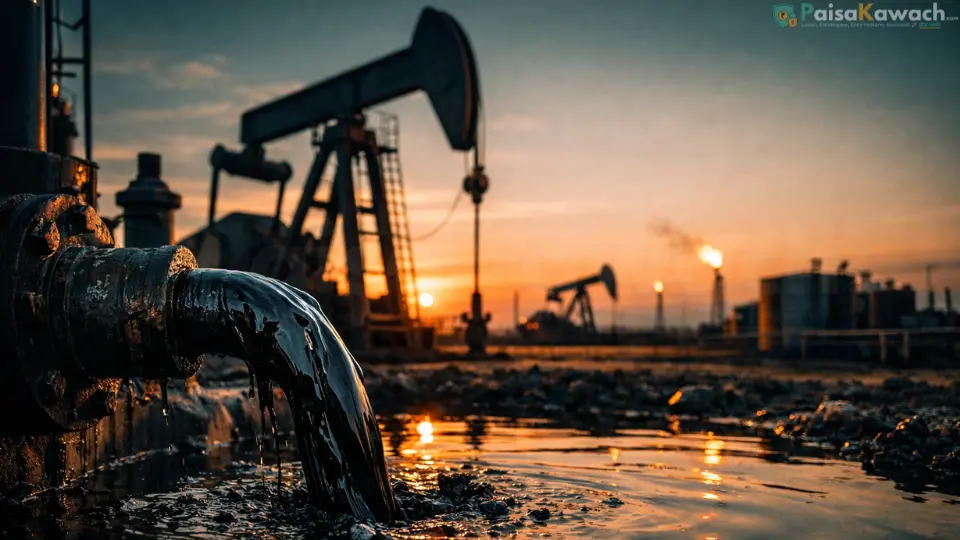
The environmental dimension is also escalating. Bloomberg reports increasing oil slicks across the Persian Gulf — a direct consequence of tanker route disruptions caused by the conflict. Environmental experts warn the Middle East war risks a long-term ecological disaster in one of the world's most critical shipping corridors. This damage will not be undone even if a peace deal is reached tomorrow.
What This Means For You
An Iran deal = oil down 20–25% = fuel prices fall worldwide = inflation eases = central banks pause rate hikes = stocks and bonds both rally. No deal = oil stays above $100 = inflation stays sticky = rate hikes possible = every market under pressure. This one geopolitical event controls the direction of virtually every other financial variable right now. Check Pakistan and Iran's foreign ministry statements this weekend — they will break the news first.
Story 02 · Consumer Economy
Walmart's Warning: The American Consumer Is Running on Empty
People are filling their gas tanks with less than 10 gallons for the first time since 2022. Walmart's CFO called it "an indication of stress." The world's largest retailer is returning its tariff refunds directly to shoppers just to keep them in the door.
Walmart US Sales Growth
+4.1%
Feb–Apr 2026
Gas Fill Signal
<10 gal
first time since 2022
Tariff Refunds Going To
Price Cuts
not shareholder returns
"The high-income customer is spending with confidence, while the lower-income consumer is more budget-conscious and perhaps navigating financial distress."
— John David Rainey, CFO, Walmart — May 21, 2026 Earnings CallWalmart's Q1 2026 earnings call contained a number that every economist should note: gas station visitors are filling up with fewer than 10 gallons at a time — a behaviour last seen in 2022 when fuel prices surged post-Russia's invasion of Ukraine. CFO John David Rainey was direct: "That's an indication of stress."
The income divide is growing stark. High-income shoppers are trading down to Walmart for value. Lower-income shoppers are being pushed there by necessity. Both are showing up in the store, which is why sales grew 4.1% from February through April — but the underlying pressure on lower-income households is a warning signal for consumer-dependent sectors globally.
On the tariff refund front: the US Supreme Court struck down most of Trump's tariff package, and the government has begun refunding customs payments to importers. Walmart said it will use those refunds to cut prices for shoppers — not to boost shareholder returns. Home Depot said the same. CFO Rainey stated: "We think that the single best return on a dollar of capital right now is to invest in the customer, invest in price."
This is an important deflationary signal. If Walmart, Home Depot, Costco, and Amazon all use tariff refunds to cut prices, Q2 CPI could surprise to the downside — partially offsetting energy-driven inflation. That would give the Federal Reserve a narrow path to pause rather than hike, even with oil above $100. Watch the June CPI print closely.
Walmart also reported a notable hit to its income from higher fuel expenses — its own logistics and transportation costs have surged due to elevated diesel prices. The company is absorbing these costs rather than passing them on, betting that keeping prices low now is the right long-term strategy in a stressed consumer environment.
What This Means For You
US consumer spending is the world's largest single economic engine. When lower-income Americans cut back — even on a $50 fill-up — the ripple effects reach manufacturers in Asia, exporters in Europe, and commodity producers in the Gulf and Africa. The Walmart data is not just a retail story; it is an early warning on global demand. If June and July data confirm the stress is deepening, expect export-oriented economies to revise their 2026 growth forecasts downward.
Story 03 · AI & Markets
The AI Trade Is Hitting a Wall: Nvidia Beat History, Markets Shrugged
$81.6 billion in revenue. 210% profit growth. The best semiconductor quarter ever recorded. Nvidia's stock fell 4%. This is what peak expectations look like — and it has implications for every AI-linked stock on earth.
Nvidia Revenue Q1
$81.6B
+85.2% YoY
Net Income Growth
+210%
$58.3 billion
Stock Reaction
−4%
after-hours drop
S&P 500 Fwd P/E
20.9×
vs 10yr avg 18.9×
"Agentic AI has arrived. Demand has gone parabolic. Nvidia is the only platform that runs every frontier AI model."
— Jensen Huang, CEO Nvidia — Q1 FY2027 Earnings Call, May 20, 2026Nvidia's Q1 FY2027 results were, by every conventional measure, the greatest quarter in the history of the semiconductor industry. Revenue of $81.6 billion beat the $80.4 billion estimate. EPS of $1.87 beat the $1.76 consensus. Data center revenue hit $75.25 billion — up 92% year-over-year. Q2 guidance of $89.1–$92.8 billion exceeded Wall Street's $87.3 billion expectation.
And yet the stock fell 4% after hours, and dragged the entire Nasdaq down 0.7% on Thursday. The reason is a concept called expectation saturation. Nvidia has beaten estimates in 18 of its last 20 quarters. The market has stopped being impressed and has started looking for the first cracks — specifically in China revenue, supply chain constraints, and the sustainability of hyperscaler capex.
The broader AI valuation tension is becoming impossible to ignore. Crestwood Advisors notes the S&P 500's forward P/E of 20.9× is above both the 5-year average of 19.9× and the 10-year average of 18.9×. Alphabet rose 34% in April on results; Meta fell 9% despite a beat because it raised 2026 capex to $125–$145 billion. Microsoft fell 4%. Markets are now demanding evidence of AI returns, not just AI spending.
The China wildcard: Jensen Huang estimates the Chinese AI chip market is worth $50 billion annually. US-cleared H200 chip sales to 10 Chinese companies including Lenovo have been approved — but no deliveries have been made. Beijing has told its companies to wait. If that logjam breaks, it is the next major Nvidia catalyst. If it persists, that is a $50 billion gap in the revenue story that will be increasingly difficult to ignore as 2026 progresses.
Sovereign AI — government-backed AI programs — crossed $30 billion in FY2026 revenues for Nvidia, more than triple the prior year, now representing roughly 14% of total revenue. This is the fastest-growing segment and the least discussed. Countries from India to Saudi Arabia to France are building national AI infrastructure, and Nvidia is the primary beneficiary.
What This Means For You
The AI trade is not over — but it is maturing. The easy money from simply owning AI-adjacent stocks is fading. The market now asks: which companies are converting AI investment into profits? For global investors, AI infrastructure plays — power generation, data center cooling, fibre networking — may now offer better risk-reward than chip leaders trading at historic premiums. In India specifically, watch Tata Power, Adani Green, and listed data centre operators as the AI power demand story globalises.
🚀 IPO Watch
SpaceX Starship Test Underway — Critical for $2T IPO
SpaceX is conducting a live Starship test ahead of its Nasdaq SPCX listing targeting $2 trillion+. OpenAI confidential IPO filing expected this week with Goldman Sachs and Morgan Stanley.
🇯🇵 Asia Markets
Nikkei +3.14% — SoftBank Surges 20% on OpenAI IPO
Japan's benchmark rebounded strongly on Iran optimism and AI IPO pipeline. SoftBank's $60B OpenAI bet is suddenly looking vindicated. Kospi +1.43%; Hang Seng +1.57%.
🌱 ESG
Big Tech Shareholders Push Back on AI Energy Use
Investors at Amazon, Microsoft, and Google are pressing boards over AI's surging electricity footprint. The NextEra-Dominion power merger is the sector's structural response.
🏦 Bond Market
30-Year Yield at 5.19% — Near 19-Year High
US long-bond yields remain elevated as Fed rate-hike signals compete with Iran deal hopes. Mortgage rates at 6.68%. Dollar strength is squeezing EM currencies including the Indian rupee.
Weekend Outlook · What To Watch
One Phone Call Between Washington and Tehran Could Change Everything on Monday
Markets are entering the weekend in a state of suspended animation. Three of the most consequential stories in recent memory — the Iran deal, the AI valuation reckoning, and the US consumer spending slowdown — are all unresolved and pointing in different directions simultaneously.
The single biggest variable is oil. If a formal US-Iran memorandum of understanding is announced over Saturday or Sunday, Monday's open will see oil collapse toward $80–$85, inflation expectations reprice sharply lower, and the probability of Fed rate hikes fall dramatically. That would be the equivalent of three rate cuts in a single news cycle. Asian markets — especially India, Japan, and South Korea — would surge.
If the deal stalls or collapses as before, Brent crude retests $110+, the Fed's calculus stays hawkish, and AI valuations face renewed pressure as risk-free rates stay high. Watch for statements from Pakistan's Foreign Ministry and Iran's ISNA news agency over the weekend — those are the two sources most likely to break the news before official announcements.
Sources: CNBC · NPR · Bloomberg · Trading Economics · Nikkei Asia · Wood Mackenzie · Crestwood Advisors · May 22, 2026
Keep Reading: More Insights You Might Like
 Nvidia's $81.6B Blowout, the IPO Summer of 2026, and a World on the Edge of Higher Rates — May 21, 2026
Next →
Nvidia's $81.6B Blowout, the IPO Summer of 2026, and a World on the Edge of Higher Rates — May 21, 2026
Next →
 New Fed Chair, Iran Talks Stall Again, and India Bleeds $22 Billion — Weekend Global & India Briefing, May 23, 2026
Comments
🛢 Brent: $106.82 ▲
📉 S&P 500: 7,405 ▼
🇯🇵 Nikkei: 61,684 ▲ 3.14%
₿ Bitcoin: $77,143
💛 Gold: $4,519
Which story surprises you most today? Drop it below 👇
Iran Deal 🕊️ | Walmart stress 🛒 | Nvidia falling despite record profits 🤖