Iran War Deadline, RBI MPC Decision & Air India CEO Exit — India Business News April 7, 2026
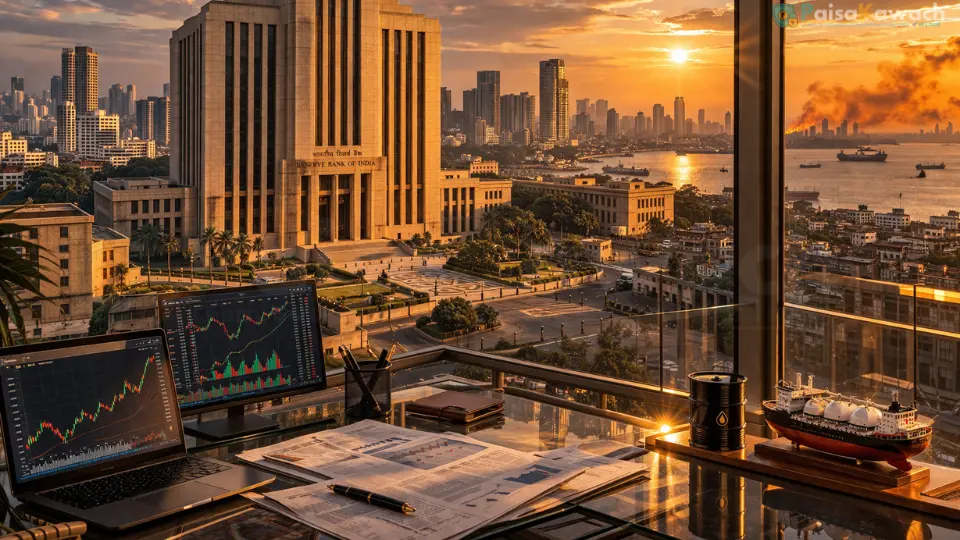
The Day That Could Change Global Energy Markets — April 7, 2026
Tuesday, April 7, 2026 is shaping up to be one of the most consequential days for India's economy and financial markets in recent memory. Three major stories are converging simultaneously: U.S. President Donald Trump's hard deadline for Iran to reopen the Strait of Hormuz expires at 8 PM ET tonight (6:30 AM IST Wednesday), the RBI Monetary Policy Committee concludes its deliberations today ahead of a rate announcement tomorrow, and Air India CEO Campbell Wilson has submitted his resignation — creating a leadership vacuum at India's flagship carrier mid-transformation.
For India, a nation that imports approximately 85% of its crude oil and over 40% of its LPG from West Asian countries, the outcome of tonight's Iran deadline is not merely a geopolitical headline — it is a direct determinant of retail inflation, fuel prices, the rupee's direction, and the RBI's ability to hold rates steady going into FY2026–27.
Snapshot: India Market Levels — April 7, 2026 Opening
- Gift Nifty: Down ~167 pts indicating cautious opening for Nifty 50
- Nifty 50 (Monday close): 22,968 (+255 pts) | Sensex: 74,106 (+787 pts)
- Nifty resistance: 22,900–23,000 | Support: 21,750
- Brent Crude: ~$111–115/barrel (approaching fresh highs)
- Gold: ~$4,694/oz (intraday spike Monday) | Rupee: ~₹93.6–94.4/USD
- India VIX: Elevated — sharp intraday moves expected
Story #1 — Trump's Iran Ultimatum: Tonight's Deadline Is the Biggest Market Catalyst of 2026
The U.S.-Israeli war on Iran, which began on February 28, 2026, has already triggered what the International Energy Agency (IEA) has described as the largest oil supply disruption in the history of global energy markets. The near-total closure of the Strait of Hormuz — through which 20% of the world's oil normally flows — has cut Gulf crude output by at least 10 million barrels per day and sent Brent crude surging well past $100/barrel.
Now, President Trump has set an ultimatum: Iran must reopen the Strait by 8 PM ET Tuesday (tonight), or face immediate and devastating strikes on its power plants, bridges, and civilian infrastructure. Trump described the strikes as ready to execute, calling them "Power Plant Day and Bridge Day all wrapped up in one" on his Truth Social platform.
As of Tuesday morning IST, Iran has rejected the proposed 45-day ceasefire put forward through Pakistani mediation. Tehran instead conveyed a 10-point response demanding a permanent end to all hostilities — including safe passage protocol for the Strait of Hormuz, lifting of sanctions, and reconstruction commitments. Trump acknowledged the response as "a significant step" but said it is "not good enough."
According to CBS News, Pakistan's army chief Field Marshal Asim Munir has been in contact through the night with U.S. VP JD Vance, special envoy Steve Witkoff, and Iranian Foreign Minister Abbas Araqchi — with talks also being conducted through direct text messages — as a last-ditch diplomatic push continues even as the deadline draws near.
Meanwhile, Iran has intensified its regional strikes. Kuwait, the UAE, and Saudi Arabia all activated air defense systems overnight to intercept Iranian missiles and drones. Israel struck a key petrochemical plant at Asaluyeh linked to the South Pars gasfield, and at least 19 people were killed in U.S. and Israeli airstrikes near Tehran. Iran's military warned of "much more devastating and widespread" retaliation if civilian infrastructure is targeted.
Snapshot: Two Market Scenarios for Tonight's Deadline
- Scenario A — Deal / Ceasefire: Brent crude could drop $15–25/barrel instantly; Nifty likely to gap up 300–500 pts; rupee to strengthen; RBI gains room to stay neutral
- Scenario B — Escalation / Strikes: Brent crude could spike toward $120–130/barrel; Nifty likely to gap down sharply; rupee could breach ₹95+; RBI faces a near-impossible policy bind
- Oil industry analysts warn: even a ceasefire will take 2+ months for shipping to normalize
- Mid-April is the critical "cliff" — strategic reserves and exempted oil run dry around April 19
Why This Matters Directly for India
India's exposure to the Iran war energy shock is among the deepest of any major economy. As the world's third-largest oil importer, India relies on West Asia for the bulk of its crude needs. Economists have warned that sustained crude prices at current levels could shave 50–70 basis points off India's GDP growth in FY27 and push headline CPI inflation higher by 55–60 basis points for every $10 per barrel increase in crude.
The rupee has already touched record lows near ₹93.6–94.4 against the U.S. dollar, and Moody's has cut India's FY27 GDP growth forecast to 6%. The current account deficit is projected to widen from 1% of GDP in FY26 to approximately 1.7% in FY27 — a meaningful deterioration that will pressure both the currency and India's external financing needs.
India has also quietly resumed buying Iranian oil and gas after a 7-year hiatus, a significant diplomatic signal of the practical limits to New Delhi's alignment with Washington's foreign policy posture on the conflict.
Story #2 — RBI MPC: Decision Day Tomorrow — Rate Hold Expected But Guidance Will Be Everything
Today is the final day of the Reserve Bank of India's three-day Monetary Policy Committee meeting. Governor Sanjay Malhotra will announce the rate decision tomorrow, April 8, 2026 — the first MPC outcome of the new financial year FY2026–27.
The near-unanimous market expectation is a repo rate hold at 5.25%. A Reuters poll of 71 economists found 69 forecasting no change. The RBI cut rates by a cumulative 125 basis points through 2025 and paused in February 2026. Another pause is widely expected now — but the tone and forward guidance from Governor Malhotra will be far more important than the rate decision itself.
According to Outlook Business, IDFC First Bank's chief economist Gaura Sengupta noted: "Monetary policy will need to ensure that the flow of credit is maintained in the economy, especially to at-risk sectors such as exporters and MSMEs. The tone of the policy will need to remain neutral to prevent further tightening of domestic financial conditions."
However, financial markets have already begun pricing in a more hawkish scenario. Since the Iran conflict began, overnight indexed swap (OIS) contracts have increasingly factored in the possibility of rate hikes — with some contracts pricing in more than five hikes over the coming months. Neeraj Gambhir of Axis Bank noted that swap market pricing implies investors believe the RBI may need to tighten monetary policy to defend the currency. Bank of Baroda's chief economist Madan Sabnavis went further, saying one rate hike is possible to tame the risk of imported inflation.
Snapshot: What to Expect from RBI MPC — April 8 Decision
- Repo rate: Expected to stay at 5.25% (unchanged)
- Policy stance: Neutral — but language may shift to acknowledge inflation risk
- FY27 CPI inflation forecast: Likely revised upward from earlier estimates
- FY27 GDP growth forecast: Expected to be revised downward (from 7.4% guidance)
- Key watch: Will RBI signal a pause-with-tightening-bias or reassure markets of dovishness?
- OIS market pricing: More than 5 rate hikes priced in — a hawkish disconnect
ICRA noted that even in a scenario of rapid geopolitical de-escalation, energy prices are unlikely to revert to pre-war February 2026 levels in the near term. HSBC's chief India economist Pranjul Bhandari added that if the energy shock persists, the resulting growth slowdown could outweigh inflation pressures — resembling conditions seen during COVID-19 — arguing for a continued neutral stance rather than any hike.
For India's borrowers, the good news is that home loan EMIs are unlikely to change immediately. But the forward path of interest rates has become significantly more uncertain than it was just six weeks ago.
Story #3 — Air India CEO Campbell Wilson Resigns
In a major corporate development, Air India CEO Campbell Wilson has submitted his resignation, creating a leadership transition challenge for India's flagship airline mid-way through its most ambitious transformation in decades under Tata Group ownership.
Wilson's tenure was originally contracted through September 2027, but he had previously signalled his unwillingness to extend beyond that period. Air India began quietly searching for a successor as early as January 2026, but the process has now been fast-tracked following the formal resignation. The company has requested Wilson remain in his role until a new CEO is appointed to ensure a smooth handover. A key board-level meeting is expected next week to advance the appointment process.
According to Business Standard, Wilson joined Air India in 2022 following Tata Group's landmark acquisition of the airline from the government — overseeing a sweeping fleet expansion, the merger of Air Asia India and Vistara into the Air India family, and a massive cabin and product overhaul. His departure comes at a time when Air India is still integrating these mergers and executing a multi-billion dollar aircraft order.
The timing of the CEO transition is sensitive. Air India is in the middle of taking delivery of new wide-body aircraft, launching new long-haul routes, and competing aggressively with IndiGo for domestic market share. Investors and airline watchers will be closely monitoring whether Tata Group can secure a credible successor quickly — and whether Wilson's exit signals any deeper strategic concerns within the group's aviation vertical.
India's LPG Crisis: ₹40,000 Crore Problem and Growing
India's domestic cooking gas situation has become one of the more politically sensitive consequences of the Iran war. The price of a 19-kg commercial LPG cylinder in Delhi has surged by ₹195.50 to ₹2,078.50, following a 44% jump in the Saudi Contract Price — from $542/tonne in March to $780/tonne in April. The domestic 14.2-kg cooking gas cylinder, however, has been kept unchanged at ₹913 in Delhi, with the government shielding households from the global price shock.
The cost of that protection is steep. Oil marketing companies are absorbing an under-recovery of ₹380 per domestic LPG cylinder. Cumulative losses from this subsidy burden are projected to reach approximately ₹40,484 crore by end of May 2026. The government has directed state-run refiners to defer scheduled maintenance and ramp up LPG production. Distribution monitoring has been tightened, and 12,226 inspections were conducted between March 1 and April 5 to curb hoarding and black marketing.
Snapshot: India Fuel Prices — April 7, 2026
- Petrol Delhi: ₹94.77/litre | Diesel Delhi: ₹87.67/litre (unchanged)
- Petrol Mumbai: ₹103.54/litre | Diesel Mumbai: ~₹90.03/litre
- Domestic LPG (14.2 kg, Delhi): ₹913 (unchanged — govt holding price)
- Commercial LPG (19 kg, Delhi): ₹2,078.50 (up ₹195.50 from prior month)
- Under-recovery per domestic cylinder: ₹380 | Projected total loss by May-end: ₹40,484 crore
- Saudi LPG Contract Price: $780/tonne (up 44% from $542/tonne in March)
India's Nuclear Milestone: PFBR Achieves Criticality at Kalpakkam
Amid the geopolitical noise, an important long-term development went relatively under-reported: Prime Minister Narendra Modi hailed the achievement of Prototype Fast Breeder Reactor (PFBR) criticality at Kalpakkam, Tamil Nadu as India's next step toward self-reliant nuclear energy — or aatmanirbhar nuclear independence. The PFBR, developed by Bhartiya Nabhikiya Vidyut Nigam Limited (BHAVINI), marks a transformational advance in India's three-stage nuclear programme and reduces long-term dependence on imported uranium fuel.
This milestone is especially strategically significant in the current energy crisis environment — underscoring India's push to diversify its energy sources and reduce the vulnerability that imported crude oil dependence creates.
What to Watch on April 8, 2026
Tomorrow is set to be an even more pivotal day. The RBI's rate decision at 10 AM IST will set the monetary policy tone for FY27. Crucially, the market will be watching not just the rate outcome but Governor Malhotra's press conference for signals on inflation tolerance, currency management, and whether the neutral stance is genuinely neutral or quietly tilting hawkish.
Simultaneously, India and the world will be assessing the aftermath of tonight's Trump-Iran deadline. Whether the Strait of Hormuz sees movement — diplomatically or militarily — will define crude oil prices, bond yields, the rupee, and risk appetite for the foreseeable future. Indian markets open at 9:15 AM IST on Wednesday and will immediately price in whatever happened overnight with Iran.
For investors, the message is clear: this is a moment for positioning, not panic. Defensive sectors — FMCG, pharma, IT (which earns in dollars) — offer relative shelter. Energy stocks may benefit if crude stays elevated. Banking stocks will keenly track the RBI tone. And the rupee will remain the most sensitive real-time indicator of India's geopolitical and macro exposure over the days ahead.
Keep Reading: More Insights You Might Like
 Markets Reopen Amid Iran War Oil Shock — RBI MPC Begins Key April 2026 Meeting
Next →
Markets Reopen Amid Iran War Oil Shock — RBI MPC Begins Key April 2026 Meeting
Next →
 Global Markets Rally as RBI Policy, Oil Price Crash, and Geopolitical Relief Drive Investor Sentiment
Comments
No comments yet. Be the first to comment!