The New Global Infrastructure Battle: Russia Seizes Assets, Europe Funds Power Grids and AI Reshapes U.S. Utilities
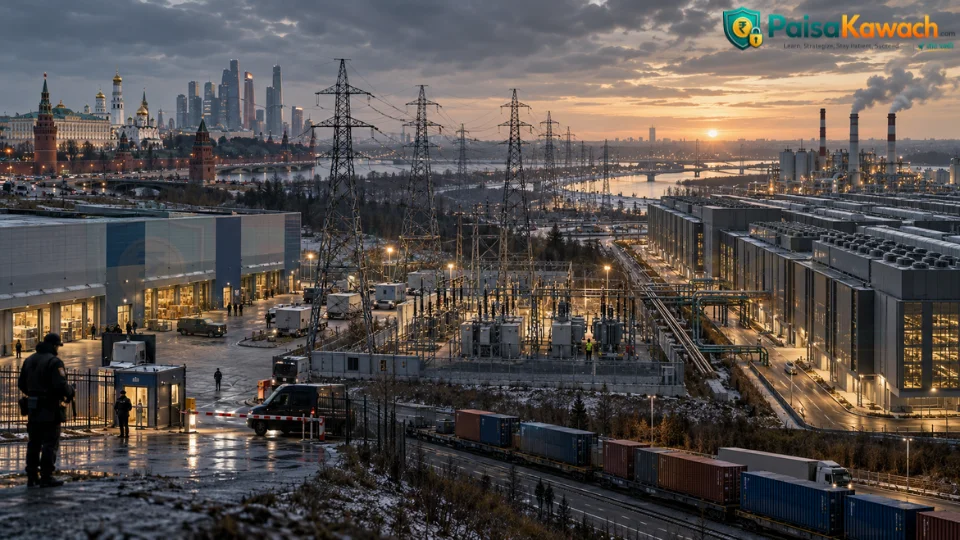
A major shift is taking place beneath the surface of global financial markets. Governments, banks, infrastructure investors and technology companies are increasingly competing for control over something more fundamental than stocks or currencies: the physical assets that keep modern economies running.
Three developments unfolding across Russia, Europe and the United States illustrate this transformation. Russia has placed the local operations of several major European companies under temporary administration. In Europe, the European Investment Bank and BNP Paribas have launched a financing programme designed to unlock billions of euros for electricity-grid equipment. In the United States, lawmakers are challenging a $33.4 billion acquisition of power company AES amid concerns that booming artificial-intelligence data centres could reshape electricity investment and customer costs.
These stories may appear unrelated. Together, however, they reveal an emerging global investment theme: strategic infrastructure is becoming increasingly intertwined with geopolitics, artificial intelligence, national security and private capital.
Russia Expands Control Over European Corporate Assets
Russia has intensified pressure on foreign companies operating within its borders by placing the Russian assets of Swiss food group Nestlé, German wholesaler Metro AG and French retailer Auchan under temporary administration.
The measure removes or limits the foreign owners' ability to control their Russian businesses while placing management under authorities or administrators designated within Russia.
Why Russia Is Targeting European Companies
The Kremlin says the actions are connected to what it describes as the increasing involvement of European countries in the war in Ukraine. European governments, meanwhile, say their military and financial support is intended to help Ukraine defend itself against Russia's invasion.
Moscow has also repeatedly criticised European countries for freezing Russian sovereign assets and imposing sanctions on Russian businesses and individuals.
- Russia has placed the local assets of Nestlé, Metro AG and Auchan under temporary administration.
- Russian officials describe the measures as a response to European sanctions and support for Ukraine.
- The Kremlin has suggested that the measures could technically be reversed if geopolitical circumstances change.
Foreign Businesses Face a New Kind of Political Risk
The latest measures demonstrate how geopolitical disputes can directly affect corporate ownership rights. Traditionally, multinational companies evaluated overseas investments primarily through factors such as consumer demand, taxes, labour costs and regulation. Increasingly, geopolitical alignment has become equally important.
Companies operating in countries involved in major geopolitical disputes may now face restrictions on dividends, asset sales, management rights or ownership itself.
More Than 100 Foreign-Affiliated Firms Have Been Affected
According to data cited by Reuters from Russian news agency TASS, temporary administration has been introduced at approximately 135 companies affiliated with foreign businesses since the war began, with most connected to European Union countries.
Earlier cases have included companies such as Danone and Carlsberg. The number of European companies maintaining operations in Russia has also declined substantially.
- Approximately 135 foreign-affiliated businesses have reportedly faced temporary administration measures.
- European business presence in Russia has been shrinking as sanctions and political tensions intensify.
- Companies increasingly need to evaluate geopolitical exposure alongside traditional financial risk.
Could European Banks Be the Next Major Flashpoint?
The latest development has drawn particular attention because major European banks continue to maintain substantial operations in Russia.
A Russian government source questioned by Reuters about whether the local businesses of Italy's UniCredit or Austria's Raiffeisen Bank International could eventually face similar treatment declined to provide a specific forecast but indicated that European companies should remain concerned.
Why Banks Are Especially Sensitive
Banks differ from retailers or manufacturers because they sit directly inside a country's financial system. Their local businesses can include customer deposits, corporate loans, payment infrastructure and other financial assets.
Any future intervention involving a major foreign bank would therefore have implications beyond the bank's shareholders. It could affect cross-border payments, capital flows and confidence among other foreign investors.
- European banks remain among the most closely watched foreign businesses operating in Russia.
- Banking assets are strategically important because they connect companies, customers and cross-border capital flows.
- Geopolitical escalation could raise the cost of operating or exiting from politically sensitive markets.
Europe Is Fighting a Different Infrastructure Problem: Electricity
While Russia is tightening control over foreign corporate assets, Europe is confronting another strategic challenge: its electricity grid may not be expanding quickly enough to support electrification, renewable energy and future computing demand.
The European Investment Bank and BNP Paribas have signed an agreement to mobilise €700 million in guarantees for manufacturers supplying electricity-grid equipment.
A €700 Million Guarantee Could Unlock €2.8 Billion
The structure includes €350 million in counter-guarantees from each institution and is backed by the European Union's InvestEU programme.
The guarantee portfolio is expected to support as much as €2.8 billion in investment across the real economy by increasing financing capacity for companies that manufacture components required for electricity networks.
- EIB and BNP Paribas are mobilising €700 million in grid-related guarantees.
- The programme could support as much as €2.8 billion in investment.
- Funding will help manufacturers supplying equipment used to strengthen and modernise European electricity networks.
The Hidden Bottleneck Behind Europe's Energy Transition
Europe has invested heavily in renewable electricity generation, but adding wind farms and solar projects is only part of the challenge. Electricity must still travel from where it is generated to homes, factories, charging stations and data centres.
That requires transmission lines, transformers, substations, high-voltage equipment, cables, power electronics and storage systems.
Generating Electricity Is Not Enough
When grid infrastructure becomes congested, new power generation can struggle to connect even if the electricity itself is relatively inexpensive to produce. Grid delays can therefore become one of the biggest obstacles to energy investment.
The EIB's initiative is part of a broader €1.5 billion Pan-EU Power Grid package designed to strengthen and modernise European electricity infrastructure.
- Electricity generation and electricity transmission are separate investment challenges.
- Grid congestion can delay renewable-energy projects and industrial electrification.
- Equipment manufacturers are becoming strategically important as governments accelerate grid investment.
AI Is Turning Electricity Infrastructure Into a Technology Story
The electricity-grid issue is becoming even more important because artificial intelligence is dramatically increasing demand for computing power.
AI models require enormous data centres filled with specialised chips. Those facilities need electricity not only to run computing equipment but also to support cooling systems, networking infrastructure and backup power.
The AI Boom Is Moving Beyond Semiconductor Chips
For several years, the most visible beneficiaries of artificial intelligence investment were semiconductor companies and cloud-computing providers. Increasingly, investors are also focusing on power producers, transmission companies, electrical-equipment manufacturers, cooling systems, natural-gas infrastructure and renewable-energy developers.
- AI data centres require large and reliable electricity supplies.
- Grid infrastructure can become a limiting factor even when computing chips are available.
- Electrical equipment and power generation are emerging as important parts of the AI investment ecosystem.
The United States Is Facing Its Own AI Electricity Battle
The same issue is developing rapidly in the United States, where electricity consumption is reaching record levels partly because of the expansion of large data centres.
A group of U.S. lawmakers has asked the Federal Energy Regulatory Commission to reject the planned acquisition of AES by a consortium involving BlackRock's Global Infrastructure Partners, Swedish private-equity group EQT and other investors.
The transaction values AES at approximately $33.4 billion including debt and would rank among the largest power-sector transactions in recent years.
Why the AES Deal Is Becoming Politically Important
AES operates major electricity businesses and regulated utilities. Under the proposed transaction, AES would become privately held while AES Indiana and AES Ohio would remain regulated utility subsidiaries.
The lawmakers argue that growing private-capital ownership of electricity infrastructure deserves additional scrutiny at a time when electricity demand from data centres is increasing rapidly.
- The proposed AES acquisition is valued at approximately $33.4 billion including debt.
- BlackRock's Global Infrastructure Partners and EQT are among the investors involved.
- Federal regulators still need to determine whether the transaction meets the required public-interest standard.
Could AI Data Centres Change Household Electricity Bills?
One of the most important questions raised by the AES debate is who should pay for new electricity infrastructure required by large data centres.
Technology companies can require enormous new power connections. Utilities may need to construct substations, transmission lines, generating capacity or other infrastructure to support those facilities.
The Cross-Subsidisation Debate
The lawmakers challenging the AES acquisition argue that ordinary customers could potentially end up paying part of the cost of infrastructure built primarily to serve large technology companies.
They have also raised concerns about possible conflicts when large investment firms simultaneously own interests in utilities, energy infrastructure and data centres.
AES disputes the concern that its acquisition would raise regulated customer rates. The company says acquisition-related costs and premiums would not be passed through to utility customers and argues that additional access to capital could support infrastructure investment.
- Lawmakers are questioning whether data-centre infrastructure costs could indirectly affect ordinary utility customers.
- AES says transaction costs will not be borne by customers of its regulated utilities.
- The broader policy question is how electricity networks should allocate the enormous cost of accommodating AI-driven demand.
Private Equity Is Moving Deeper Into Essential Infrastructure
The AES dispute also reflects a much larger financial trend. Infrastructure assets have become increasingly attractive to private-equity firms, pension funds, sovereign wealth funds and insurance-backed investment groups.
Electric utilities, pipelines, LNG terminals and data-centre power assets can produce long-term cash flows that are particularly attractive to investors seeking stable returns.
Energy Infrastructure Is Becoming a Major Alternative-Asset Class
Reuters reported separately that firms including Apollo Global Management, Blackstone and KKR are increasingly using capital from insurance businesses to finance U.S. LNG terminals, pipelines and other large energy projects.
These investments demonstrate how energy infrastructure is moving closer to the centre of global asset-management strategies.
- Private-capital firms increasingly view electricity and energy infrastructure as long-duration financial assets.
- Insurance capital is becoming an important source of financing for infrastructure projects.
- AI electricity demand is making generation, pipelines and grid assets more strategically valuable.
The Next AI Bottleneck May Be Electricity, Not Chips
One of the most important conclusions from these developments is that the global AI boom may increasingly be constrained by physical infrastructure rather than computing technology.
A company can purchase advanced chips and build data centres, but those facilities cannot operate without enough electricity, transmission capacity and grid connections.
Power Availability Is Becoming a Competitive Advantage
Developers are increasingly competing for locations where projects can connect to electricity networks quickly. Grid connection queues in several markets can take years, making existing or advanced-stage power projects particularly valuable.
This explains why energy assets located near fast-growing data-centre markets are attracting increasing investor attention.
- AI infrastructure requires both computing capacity and physical electricity infrastructure.
- Grid-connection availability may become as important as access to advanced chips.
- Regions capable of providing reliable power quickly could gain an advantage in attracting data-centre investment.
A New Investment Chain Is Emerging Around Artificial Intelligence
The first phase of the AI investment cycle focused heavily on semiconductor companies. The next phase is spreading throughout the physical economy.
The emerging investment chain includes semiconductor fabrication, cloud infrastructure, data-centre construction, electricity generation, transmission networks, natural-gas pipelines, nuclear power, renewable energy, battery storage, cooling equipment and electrical components.
AI Is Becoming an Infrastructure Supercycle
This expansion means that the economic impact of artificial intelligence increasingly reaches sectors that historically had little connection to the technology industry.
- Chip manufacturers represent only one part of the AI infrastructure chain.
- Utilities, energy developers and electrical-equipment manufacturers are becoming increasingly important.
- Financing the AI buildout may require trillions of dollars across multiple infrastructure categories.
Why These Three Stories Are Connected
Russia's intervention in European corporate assets, Europe's electricity-grid financing programme and the regulatory battle over AES all point toward the same broader transformation.
Governments increasingly view infrastructure and corporate ownership through the lens of national strategy. Investors are simultaneously directing enormous amounts of capital toward assets that provide energy, computing capacity and financial security.
Control of Physical Assets Is Becoming Strategic
The defining economic competition of the coming decade may not only be about who develops the most powerful artificial-intelligence models or produces the most advanced semiconductor chips. It may also depend on who controls electricity networks, energy resources, infrastructure financing and strategically important companies.
- Russia demonstrates how geopolitical conflict can directly affect corporate ownership.
- Europe demonstrates how governments and banks are mobilising capital to strengthen critical infrastructure.
- The United States demonstrates how AI electricity demand is creating new regulatory and ownership questions.
What Investors and Businesses Should Watch Next
Several developments could determine how quickly these trends accelerate.
In Russia, foreign companies will closely watch whether temporary administration expands to additional European businesses or financial institutions. In Europe, investors will monitor whether grid financing successfully increases manufacturing capacity for transformers, cables and other equipment. In the United States, FERC's decision on the AES transaction could become an important signal for future private-capital investments in regulated utilities.
Five Emerging Indicators Matter
- Whether Russia places additional European companies or banks under temporary administration.
- How quickly Europe expands electricity transmission and grid-equipment manufacturing capacity.
- Whether AI data centres begin signing more direct long-term power agreements.
- How regulators allocate infrastructure costs between data centres and ordinary electricity customers.
- Whether private-equity and infrastructure funds continue acquiring utilities and power assets.
Conclusion
A new global economic competition is developing around infrastructure ownership, electricity and capital. Russia is demonstrating the geopolitical risks associated with corporate assets located inside strategically hostile jurisdictions. Europe is trying to remove electricity-grid bottlenecks that could limit electrification and future technology investment. The United States is debating how much control private capital should have over utilities as artificial intelligence pushes electricity demand to unprecedented levels.
Together, these developments suggest that the next phase of global economic competition will increasingly take place in the physical world. Data centres need power. Power requires grids. Grids require enormous amounts of capital. And the companies controlling these assets are becoming strategically important to governments and investors alike.
For businesses and investors, this means infrastructure can no longer be treated simply as a slow-moving utility sector. Electricity networks, energy assets and strategic corporate holdings are rapidly becoming central to artificial intelligence, geopolitics and global capital allocation.
Keep Reading: More Insights You Might Like

Comments
No comments yet. Be the first to comment!