
The Capacity Question: How a Cloud Contract, a Mediterranean Drone Strike, and an Empty Missile Stockpile Are Deciding This Week's Outcomes
Headlines like to talk about confidence, resolve, and sentiment, because those words make for cleaner sentences than the truth usually allows. But this week, three completely separate stories quietly pointed at the same less flattering explanation for how things actually get decided: not confidence, not resolve, but capacity — the unglamorous, physical, countable question of how much of something actually exists and where. A cloud computing division's real infrastructure. A port's exposed shipping lanes. A country's dwindling stockpile of a very specific kind of missile. None of these three stories were about sentiment shifting. They were about capacity being tested, and in each case, the test revealed something the headlines alone wouldn't have shown.
Microsoft's $450 Billion Day Was Never About Sentiment
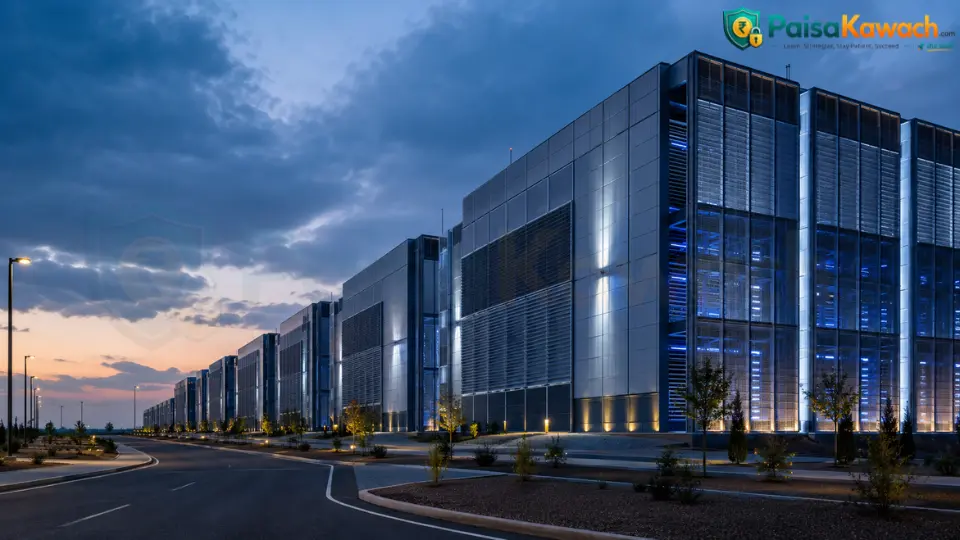
When Microsoft's stock jumped 16% in a single session, adding roughly $450 billion in value — the largest one-day gain recorded by any publicly traded company — the easy read is that investors simply regained confidence in artificial intelligence as a theme. That read isn't wrong, exactly, but it skips the more useful explanation underneath it. Microsoft didn't rally because analysts felt better about AI in the abstract. It rallied because its Azure cloud division reported growth numbers that functioned as hard, physical proof that the company's enormous infrastructure buildout — the data centers, the server capacity, the actual physical plant behind the AI narrative — is being used at a rate that justifies its cost.
This distinction matters enormously for how the rest of the week should be read. Confidence can evaporate overnight, the way it very nearly did earlier this week when a Fed dissent and a hawkish bond-market reaction wiped out days of gains in a single session. Capacity doesn't evaporate that quickly. A cloud division either has customers actively running workloads on its infrastructure at scale, generating revenue that grows quarter over quarter, or it doesn't — and Microsoft's numbers said, unambiguously, that it does. That's a different, more durable kind of good news than a mood shift, and it's why the rebound carried enough weight to snap a six-day Nasdaq losing streak and lift Asian markets into Friday's session before the sun had even properly risen over Seoul or Tokyo.
Why Infrastructure Numbers Outlast Sentiment Numbers
Markets frequently confuse the two, treating a stock's daily move as evidence of how investors feel rather than evidence of what a business actually did. The distinction is worth holding onto precisely because it explains why this particular rally has more staying power than the panic that preceded it. A sentiment-driven selloff, like the one following this week's Fed dissent, can reverse just as fast as it arrived, because nothing physical actually changed — only the market's read of a data point did. A capacity-driven rally, built on demonstrated infrastructure usage translating into revenue, reflects something that took months or years to build and doesn't unwind on the next uncertain headline.
- Microsoft's cloud growth reflects actual infrastructure utilization, not merely improved sentiment about the AI theme in the abstract
- A capacity-driven rally, built on demonstrated revenue from real usage, tends to be more durable than a sentiment-driven move that can reverse on the next uncertain data point
- The rally's spillover into Asian markets before their own session even opened shows how quickly global capital reprices around a genuine capacity signal once it appears
A Drone at an Egyptian Port Exposes a Different Kind of Capacity Problem
While one story tested infrastructure capacity in the cloud, a second tested it at sea level, literally. Egyptian authorities confirmed that a drone struck two ships at the Mediterranean port of Damietta, sparking a fire onboard, as attacks on energy infrastructure continue widening across the broader Middle East conflict. On its own, an isolated incident at one port might be treated as a contained, regional story. What makes it genuinely significant is the pattern it completes — this is now the third distinct geography, alongside the Gulf shipping lanes and targets inside Iraq, where this conflict has produced serious infrastructure-level incidents within a matter of weeks.
The capacity question here isn't about AI infrastructure, but it rhymes with it in an important way: global energy and shipping systems were built assuming a certain baseline level of security across a specific, historically stable set of chokepoints. Every additional geography that gets pulled into this conflict — the Strait of Hormuz, Iraqi border regions, and now a Mediterranean port with Suez Canal-adjacent significance — represents a reduction in the total amount of "safe capacity" the global shipping and energy system can rely on. It's not that global trade capacity disappears overnight. It's that the buffer of assumed safety around it keeps shrinking, incident by incident, in a way that's much harder to reverse than it was to erode.
Why Widening Geography Matters More Than Any Single Incident's Severity
Security and insurance markets don't primarily price conflicts by counting casualties or measuring the size of any single attack — they price them by mapping how much of the globally interconnected shipping and energy network has become genuinely unpredictable. A single incident, however serious, is something insurers and traders can model and price around. A conflict that has now demonstrated the ability to produce serious incidents across three separate, previously distinct geographies is a fundamentally different underwriting problem, because it suggests no single region can be treated as a safely contained exception anymore.
- The Damietta strike extends this conflict's demonstrated reach into a third distinct geography within weeks, following the Gulf and Iraq
- Each additional affected region reduces the global shipping and energy network's assumed baseline of safe capacity, a reduction that tends to be far slower to rebuild than it was to erode
- Insurance and freight markets price geographic breadth of risk more heavily than the severity of any single incident, since breadth signals systemic rather than contained exposure
Ukraine's Real Vulnerability Isn't Willpower — It's a Specific Kind of Missile
The third story completes the pattern most starkly. Russia launched a major air attack on Lviv, expanding its near-daily bombardment of Ukrainian cities, and the strategic logic behind the timing is the part that deserves closer attention than the attack itself. This escalation is being read as a calculated exploitation of a specific, narrow gap: Kyiv's critical shortage of Western-supplied anti-ballistic missile defense systems. This is not a story about Ukraine's resolve weakening, or about Russia suddenly gaining broader momentum across the conflict. It's a story about one specific category of physical capacity — interceptor missiles capable of stopping incoming ballistic threats — running low at a moment when the attacking side has both the awareness and the willingness to exploit exactly that gap.
This is, in its own grim way, the same lesson as the other two stories, just with immeasurably higher stakes. Willpower and resolve, on both the Ukrainian and Western-supporter side of this conflict, may remain entirely intact. But willpower doesn't intercept a ballistic missile. A physical, finite stockpile of specific defensive hardware does, and when that stockpile runs thin, the strategic picture changes regardless of how much political commitment remains on paper. It's the clearest possible illustration of why capacity, not sentiment or stated commitment, is often the variable that actually determines what happens next.
Why a Narrow Supply Gap Can Reshape a Broad Strategic Picture
Modern military logistics rarely fail across the board all at once — they fail at specific, narrow chokepoints, the way a supply chain doesn't collapse entirely but instead gets stuck at whichever single component is hardest to replace quickly. Anti-ballistic interceptor systems are exactly this kind of chokepoint: complex, expensive, slow to manufacture, and not easily substituted by other categories of military aid, however generously those other categories might be supplied. An adversary that identifies and exploits this specific gap doesn't need to overwhelm an opponent's entire war effort — it only needs to press against the one point where physical capacity, rather than resolve, has actually run short.
- This escalation reflects a calculated exploitation of a specific missile-defense supply gap, not a broader shift in resolve on either side of the conflict
- Highly specialized military hardware like anti-ballistic interceptors is difficult to substitute quickly with other forms of aid, making this kind of narrow shortage disproportionately consequential
- Adversaries increasingly target the specific chokepoint in an opponent's supply capacity rather than attempting to overwhelm the broader effort, since narrow gaps are often easier to exploit decisively
What Connects a Cloud Contract, a Port Strike, and a Missile Shortage
None of these three stories share a cause, a geography, or even a comparable scale of consequence — one measures in market capitalization, one in shipping insurance, one in human lives. But each one, this week, demonstrated the same underlying principle: outcomes are increasingly being decided by specific, countable, physical capacity rather than by the broader narratives of confidence, risk, or resolve that headlines tend to lead with. Microsoft's rally held because real infrastructure usage backed it up. The Mediterranean incident matters because it reflects a genuine erosion of safe shipping capacity, not just another data point in an ongoing conflict. And Ukraine's newest vulnerability traces back to a specific, finite category of hardware running short, not to any broader failure of will. Reading all three together is a reminder that behind almost every headline this week, the real story wasn't sentiment — it was capacity, and whoever has enough of it, in the specific place it's actually needed, is the one setting the terms.
Keep Reading: More Insights You Might Like
 The Dissent, The Front Line, and the 250-Fold Answer: Three Signals From the Week the Old Rules Stopped Working
Next →
The Dissent, The Front Line, and the 250-Fold Answer: Three Signals From the Week the Old Rules Stopped Working
Next →
 The Week Big Tech Answered Back: Meta, Amazon, and Apple's Earnings Verdict, China's Slowdown, and How Indian Markets Actually Traded All Five Days
Comments
No comments yet. Be the first to comment!