World & India News Today, 20 November 2026: JPMorgan, Visa, Mastercard Cyber Incidents, RBI Warning & India's ₹7,280 Crore Manufacturing Push
World and India Financial News Today, 20 November 2026: What if your bank's systems are secure, but a company handling your personal information gets hacked? What if a financial product recommended at your bank is not actually suitable for you?
These questions have become especially relevant as three major developments attract attention from the global financial industry and Indian consumers.
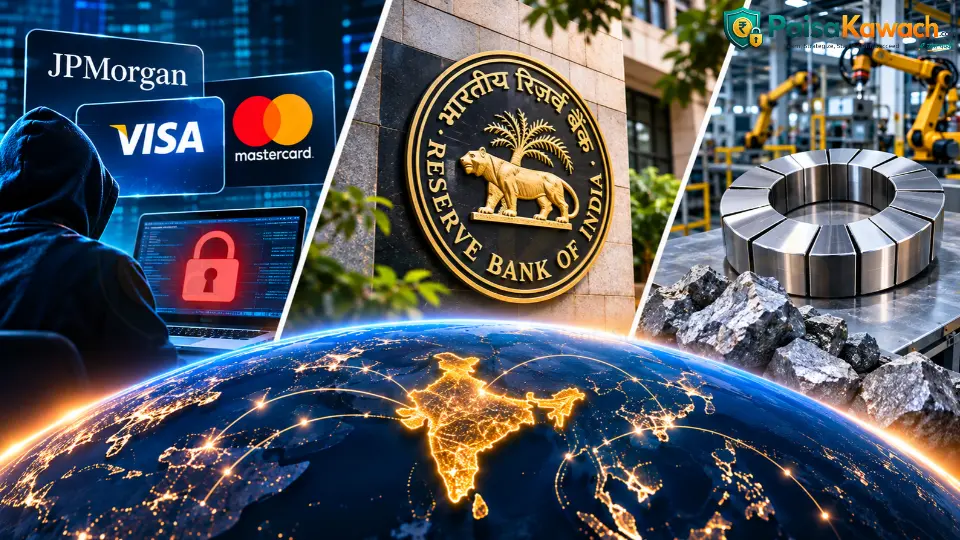
JPMorgan Chase, Visa and Mastercard have disclosed cybersecurity incidents involving outside service providers. Meanwhile, the Reserve Bank of India has raised concerns about financial-product mis-selling. In another important development, India has moved forward with its ₹7,280-crore rare-earth magnet manufacturing initiative.
Although these stories involve different industries, they share an important theme: financial security, consumer protection and India's long-term economic resilience.
Let's understand what happened, why it matters and what Indian consumers, businesses and investors should watch next.
Today's Top 3 Financial and Business News Stories
Here are the major developments covered in today's PaisaKawach report.
- 1. Global Banking Cyber Incidents: JPMorgan, Visa and Mastercard report customer-information exposure involving third-party vendors.
- 2. RBI Warning on Financial Mis-Selling: The central bank highlights how sales targets and incentives may encourage unsuitable financial-product recommendations.
- 3. India's ₹7,280 Crore Manufacturing Initiative: Four companies receive initial approvals under the rare-earth permanent magnet manufacturing programme.
- 4. What It Means for India: Understand the implications for banking customers, financial institutions, manufacturing and investment.
- 5. Join the Discussion: Tell us which development concerns you most.
1. JPMorgan, Visa and Mastercard Report Cyber Incidents: Is Your Financial Information Safe?
A significant cybersecurity development has raised concerns about how major financial institutions protect customer information.
On 19 November 2026, JPMorgan Chase, Visa and Mastercard disclosed incidents involving external vendors that provide services to their organisations.
According to Reuters, leaked material reviewed during reporting contained more than 16,000 customer email addresses, along with some other personal information.
The incident is particularly important because it highlights a potential weakness in the financial industry: customer information can be exposed through an outside company even when a bank's primary systems are not directly compromised.
What Actually Happened?
Major financial companies frequently work with external service providers for customer communications, marketing, loyalty programmes, payment-related services and technology operations.
These providers may handle limited customer information to perform their services.
If their systems are compromised, information belonging to financial institutions' customers may be exposed.
- JPMorgan disclosed a cybersecurity incident involving external vendors and certain customer information.
- Visa reported a vendor-related security incident involving limited information.
- Mastercard disclosed an incident involving information connected to a cardholder benefits programme.
- Reuters examined leaked material containing more than 16,000 customer email addresses and some additional contact details.
- The companies are investigating the circumstances and scope of the incidents.
Were Customer Bank Accounts and Credit Card Details Hacked?
This is the most important distinction for consumers.
The available reporting does not establish that JPMorgan's core banking systems or the main Visa and Mastercard payment networks were compromised.
The incidents involved information handled by external service providers.
There is also no confirmed evidence from these reports that India's UPI system was breached or that customers' bank balances were stolen.
However, even limited personal information can create risks when used by criminals for impersonation and phishing.
Why Can Leaked Email Addresses Be Dangerous?
Imagine receiving a message that appears to come from your bank.
It includes your name, mentions a familiar financial service and asks you to verify your account.
Because some details are accurate, you might be more likely to trust the message.
This is how stolen contact information may help criminals create more convincing fraudulent communications.
- Phishing emails may imitate legitimate banking messages.
- Fraudsters may send links to fake account-verification websites.
- Attackers may attempt to obtain passwords, OTPs or other sensitive details.
- Scammers may impersonate bank customer-support representatives.
- Personal information can be used to make fraudulent messages appear more credible.
How Could This Affect Indian Banking Customers?
India has one of the world's largest digital payments ecosystems, with widespread use of UPI, mobile banking, credit cards and online financial services.
Indian financial institutions also rely on technology vendors and external service providers.
The international incident highlights the importance of securing customer information throughout the entire service-provider network.
However, the reported incidents should not be interpreted as evidence of a nationwide banking or digital payments failure in India.
Five Ways to Protect Your Financial Information
- Never share your OTP, UPI PIN, banking password or card PIN with anyone.
- Do not open suspicious links claiming that your bank account needs immediate verification.
- Access banking services through official applications and verified websites.
- Enable available transaction alerts and regularly review account activity.
- Report suspected financial cyber fraud promptly through India's 1930 helpline or the official National Cyber Crime Reporting Portal.
PaisaKawach Takeaway: Financial security is not limited to protecting a bank's main systems. External vendors also handle sensitive customer information, making strong data protection and consumer awareness essential.
Source: Reuters — JPMorgan and Third-Party Vendor Cybersecurity Incidents
2. RBI Warns About Financial Product Mis-Selling: Are Banks Always Recommending the Right Products?
India's second major financial development raises an important question about banking services and consumer protection.
Reserve Bank of India Deputy Governor S. C. Murmu has highlighted concerns about the mis-selling of financial products and the incentives that may encourage employees to recommend unsuitable products.
His remarks, reported on 19 November, remain significant for Indian financial consumers on 20 November.
The underlying concern is straightforward: when banks place excessive emphasis on sales targets, customers' interests may receive insufficient attention.
What Is Financial Product Mis-Selling?
Financial mis-selling occurs when a product is sold through misleading information, unsuitable recommendations or practices that fail to adequately consider customer needs.
Consider a simple example.
You visit a bank to invest your savings in a fixed deposit.
Instead, an employee recommends an insurance-linked investment plan and describes it as similar to a deposit, without clearly explaining its risks, charges or lock-in period.
If you purchase the product based on misleading information, you may later discover that it does not meet your financial needs.
What Did the RBI Deputy Governor Say?
The RBI Deputy Governor highlighted the responsibility of bank management and boards to evaluate how employee incentives can influence the selling of financial products.
He indicated that inappropriate sales behaviour may originate from targets and compensation structures rather than only from individual decisions made at bank branches.
- Banks should examine whether sales incentives encourage unsuitable recommendations.
- Customer protection should remain an important consideration in financial-product distribution.
- Senior management and boards should strengthen oversight of sales practices.
- Financial institutions should maintain transparent governance and accountability.
- Regulatory coordination remains important where banking, insurance and investment products overlap.
Why Should Ordinary Bank Customers Care?
Many customers assume that products sold inside a bank branch have the same safety and liquidity features as ordinary bank deposits.
That assumption is not always correct.
Fixed deposits, insurance policies, mutual funds and market-linked products have different risks, charges and withdrawal conditions.
Understanding those differences is essential before making financial commitments.
Questions to Ask Before Buying Any Financial Product
- What type of financial product am I purchasing?
- Is my principal guaranteed, or can I lose money?
- What fees, commissions or surrender charges apply?
- Can I withdraw my money before maturity?
- What happens if I discontinue payments?
- Is this product suitable for my financial goals and risk tolerance?
What If You Believe a Financial Product Was Mis-Sold?
Start by collecting your product documents, payment records, sales illustrations and any written communications related to the purchase.
Submit a complaint through the financial institution's official grievance mechanism.
If the complaint concerns an RBI-regulated entity and remains unresolved under the applicable rules and timelines, you may be eligible to use the RBI's complaint mechanism.
For insurance and securities-related products, different regulatory grievance mechanisms may apply.
Visit the official RBI Complaint Management System for information about eligible complaints.
PaisaKawach Takeaway: Never purchase a financial product solely because a bank employee recommends it. Understand the product, read the official documents and verify whether it matches your needs.
Source: Business Standard — RBI Deputy Governor Warns About Financial Mis-Selling
3. India's ₹7,280 Crore Rare-Earth Magnet Manufacturing Push: Four Companies Selected
India's third major business development concerns the country's long-term manufacturing and technology supply chains.
The government has selected four companies to participate in its ₹7,280-crore initiative to develop domestic rare-earth permanent magnet manufacturing capacity.
The selected companies include Coal India, ReNew, Prozeal Green Energy and Midwest Energy.
The development is important because high-performance permanent magnets are used in several advanced technologies, including certain electric vehicles, wind turbines and industrial machinery.
What Are Rare-Earth Permanent Magnets?
Rare-earth permanent magnets are specialised components made using materials that can produce powerful magnetic fields.
These magnets are useful in compact and efficient motors, generators and other advanced equipment.
Although the term may sound unfamiliar, technologies that use these components are increasingly important in modern manufacturing.
- Electric vehicles: Certain electric motors use rare-earth permanent magnets.
- Renewable energy: Some wind turbine generators rely on specialised magnets.
- Industrial automation: Magnets are used in motors and manufacturing equipment.
- Electronics: Various devices use permanent-magnet components.
- Advanced engineering: Applications include robotics and specialised industrial systems.
What Has the Indian Government Announced?
India's rare-earth permanent magnet scheme has a total financial outlay of ₹7,280 crore and aims to develop an integrated domestic manufacturing ecosystem.
The programme targets a national annual production capacity of 6,000 metric tonnes.
Four companies have received initial approvals or letters of intent under the programme.
Coal India has disclosed that a consortium led by the company received a letter of intent for a proposed facility with annual capacity of 1,200 tonnes.
These figures relate to planned manufacturing capacity rather than production already achieved.
Why Is India Investing in Domestic Magnet Production?
Rare-earth materials and specialised magnet manufacturing are concentrated within international supply chains.
This can create risks when trade restrictions, geopolitical developments or shipping problems disrupt supplies.
By developing domestic manufacturing capacity, India aims to strengthen its industrial ecosystem and reduce dependence on certain imported components over time.
How Could This Benefit India's Economy?
- Manufacturing growth: New facilities could support investment in industrial infrastructure.
- Electric vehicles: Domestic components could benefit parts of India's EV supply chain.
- Renewable energy: Local magnet production may support certain wind-energy applications.
- Employment: Facility construction and operations could create demand for specialist skills.
- Supply-chain resilience: More domestic production could reduce exposure to selected international supply disruptions.
Why Is Coal India Entering This Industry?
Coal India is primarily known for coal production, but participation in rare-earth magnet manufacturing may represent an opportunity to diversify into another industrial activity.
Such projects require technology, financing, raw materials and commercial customers.
Receiving a letter of intent does not mean that a facility has already been completed or that it is generating revenue.
Should Investors Buy Shares Because of This Announcement?
A government manufacturing initiative may influence long-term business opportunities, but investors should not assume that participating companies will immediately generate profits.
Before considering any investment, review the company's financial position, project economics, execution risks and market valuation.
PaisaKawach Takeaway: India's rare-earth magnet initiative is an important step toward strengthening manufacturing capabilities, but its economic success will depend on project execution and commercially competitive production.
Sources: Economic Times — Four Companies Selected for Rare-Earth Magnet Production | Government of India — Rare-Earth Magnet Scheme
4. How Today's Three Stories Are Connected to India's Financial Future
The international banking incident, RBI warning and manufacturing initiative may appear unrelated, but they highlight different aspects of economic security.
The banking incident demonstrates the risks of sharing customer information with external service providers.
The RBI warning highlights the importance of protecting consumers from unsuitable financial products.
India's magnet manufacturing initiative reflects efforts to strengthen domestic industrial capabilities and reduce exposure to concentrated international supply chains.
Three Important Lessons for India
- Digital security: Financial institutions need strong data protection across their internal systems and external vendors.
- Consumer protection: Banks must prioritise transparent financial-product distribution and suitable recommendations.
- Industrial resilience: Domestic manufacturing capabilities can help reduce dependence on selected imported technologies.
For ordinary consumers, the immediate priority is protecting personal information and understanding financial products.
For businesses and policymakers, the long-term priority is building reliable institutions, technology infrastructure and manufacturing capacity.
5. What Should Indian Readers Do After Today's News?
- Be alert to unexpected emails, phone calls and messages claiming to come from banks.
- Never share sensitive banking credentials or OTPs.
- Review financial-product documents before making payments or investments.
- Use official complaint channels if you suspect mis-selling or fraudulent activity.
- Understand that industrial investment announcements involve long-term projects, not guaranteed short-term investment returns.
6. Frequently Asked Questions
Were JPMorgan, Visa and Mastercard Directly Hacked?
The reported incidents involved outside vendors. Available reporting does not establish that the companies' main payment or banking networks were directly breached.
Were Indian UPI Users Affected?
There is no confirmed evidence in the cited reports that India's UPI system was compromised by these incidents.
Can Leaked Email Addresses Lead to Financial Fraud?
They may increase the risk of phishing and impersonation because attackers can use genuine contact information to make fraudulent messages appear more convincing.
What Does Financial Mis-Selling Mean?
Financial mis-selling involves misleading or unsuitable product recommendations and sales practices that do not adequately consider customer needs or relevant disclosures.
Why Is India Investing in Rare-Earth Magnets?
India aims to strengthen domestic production of components used in electric vehicles, renewable-energy systems and advanced manufacturing while reducing certain import dependencies.
Has India Already Started Producing 6,000 Tonnes of Rare-Earth Magnets Annually?
No. The figure represents the programme's targeted annual manufacturing capacity, not existing production under the initiative.
7. Your Opinion Matters: Which Issue Concerns You the Most?
Every major financial development affects people differently, and we want to hear your perspective.
Which of today's three stories do you believe deserves the greatest attention in India?
- Option A — Banking Data Security: Protecting customer information and preventing financial scams.
- Option B — Financial Mis-Selling: Protecting consumers from unsuitable insurance and investment products.
- Option C — Manufacturing Independence: Strengthening India's ability to produce important industrial components.
- Option D — All Three: Financial safety, customer rights and manufacturing development are equally important.
Comment A, B, C or D below and explain your choice in one sentence.
Have you ever received a suspicious message pretending to come from your bank? Or have you been pressured to purchase a financial product you did not fully understand?
Share your experience in the comment section without revealing personal banking details, account numbers, phone numbers or passwords.
Your opinion can help other PaisaKawach readers understand real financial challenges faced by consumers.
8. Final Analysis: Protecting Money, Consumers and India's Economic Future
November 20, 2026, highlights three important aspects of financial and economic security.
The vendor cybersecurity incidents involving major international financial companies demonstrate how customer information can face risks beyond a bank's primary systems.
The RBI's warning about financial mis-selling reminds consumers that financial products should be purchased based on suitability, transparency and informed decisions rather than sales pressure.
Meanwhile, India's ₹7,280-crore rare-earth magnet manufacturing initiative shows how the country is attempting to strengthen its industrial capabilities and build more resilient technology supply chains.
For Indian readers, the overall message is clear: protecting your financial future involves more than watching stock prices or interest rates.
It also means understanding cybersecurity risks, recognising unsuitable financial products and following economic developments that could shape business opportunities and jobs over time.
PaisaKawach Final Takeaway: Financial security requires trustworthy institutions, informed consumers and strong economic systems. Stay alert, ask questions and make financial decisions based on reliable information.
Which issue matters most to you? Join the discussion below.
Sources and Further Reading
- Reuters — Financial Companies Report Vendor Cyber Incidents
- Associated Press — Customer Information Exposure
- Business Standard — RBI Warning on Financial Mis-Selling
- Economic Times — Rare-Earth Magnet Manufacturing Approvals
- Government of India — Rare-Earth Magnet Manufacturing Scheme
- National Cyber Crime Reporting Portal
Stay informed with PaisaKawach for global financial news, important Indian business developments, banking safety information and easy-to-understand financial education.
Disclaimer: This article is published for educational, informational and news-reporting purposes only. The cyber incidents remain under investigation, and the reported manufacturing capacity is planned rather than already operational. This article does not constitute personalised financial or investment advice.
Keep Reading: More Insights You Might Like

Comments
No comments yet. Be the first to comment!