"Father Time Always Wins" — Warren Buffett Steps Down as Berkshire Chairman After 56 Years
The Oracle of Omaha Passes the Gavel
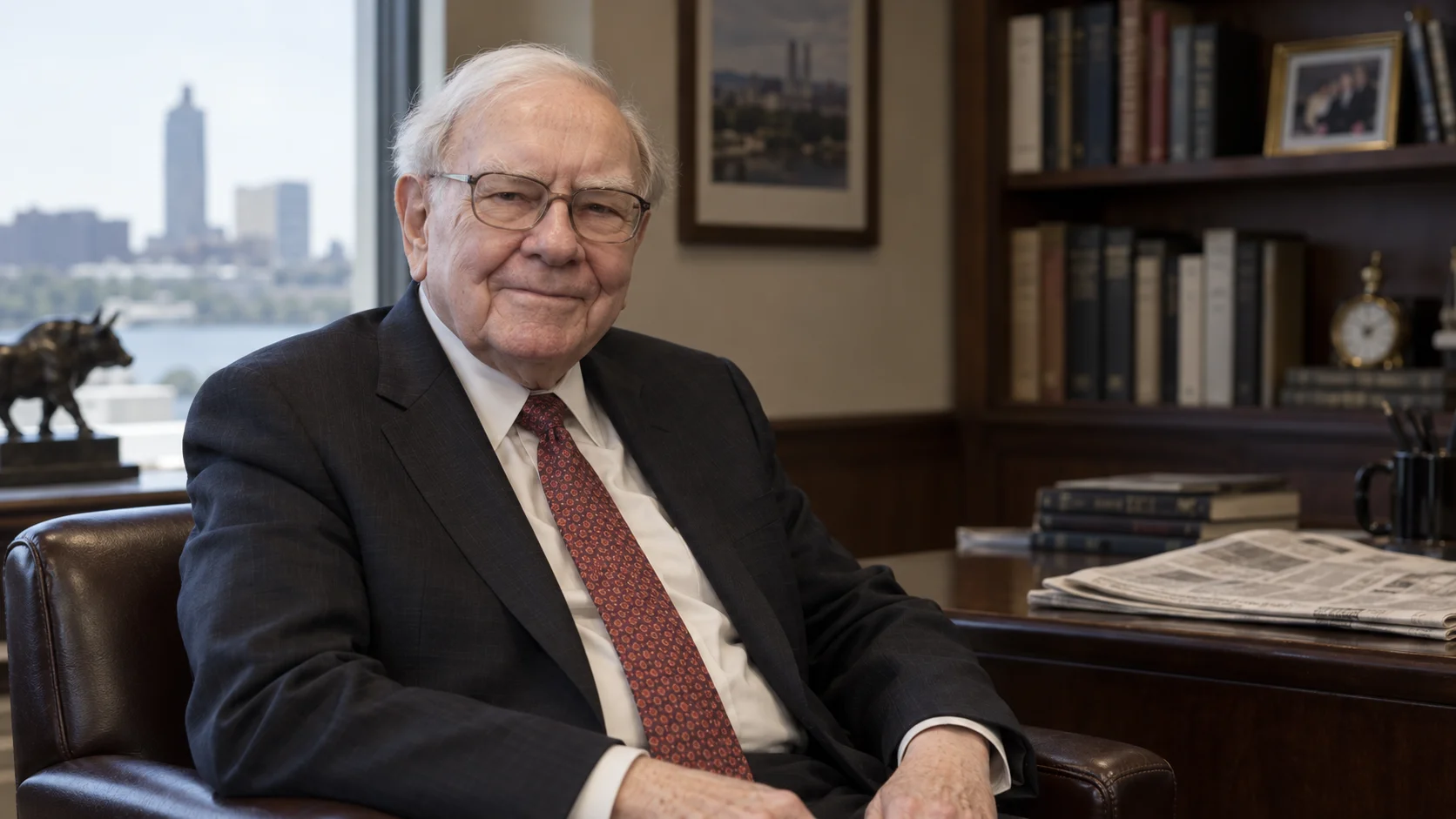
Warren Buffett, 96, has stepped down as Berkshire Hathaway's chairman after 56 years in the role. His son Howard takes over. Here's the full story — quick facts or deep read, your choice.
⚡ The 30-Second Version
Buffett Is Now "Chairman Emeritus"
Effective immediately. He remains on the board as a director but hands over the chair role he's held since 1970.
Son Howard Buffett Takes Over
A Berkshire board member since 1993, Howard becomes chairman — tasked specifically with guarding the company's culture, not running operations.
Not the CEO Job — That Changed Already
Greg Abel took over as CEO eight months ago. This is the second, final piece of Buffett's succession plan falling into place.
"Father Time Always Wins"
Buffett's own words, in a letter to shareholders Friday, announcing the move with characteristic plain-spoken honesty.
What Actually Happened
Warren Buffett, 96, has stepped down as chairman of Berkshire Hathaway, the roughly $1 trillion conglomerate he has led since 1965 and chaired since 1970. The change, announced in a letter to shareholders Friday and a separate company statement, is effective immediately. Buffett becomes "chairman emeritus" and remains a director on Berkshire's board, but the chairman title itself now belongs to his son, Howard G. Buffett, who has served on Berkshire's board since 1993.
This is the second, and by most accounts final, piece of a long-signaled succession plan. Buffett had already stepped down as Berkshire's CEO roughly eight months earlier, handing that role to his longtime lieutenant Greg Abel. At the time, the company said Buffett intended to hold onto the chairman title for a while longer. Friday's announcement closes that chapter, completing the transition of both of Berkshire's two most powerful roles to a new generation of leadership within less than a year.
📜 Timeline: The Full Succession, Step by Step
Buffett begins using Berkshire Hathaway as his primary investment vehicle, transforming a struggling textile company into the foundation of his empire.
Buffett formally becomes chairman of Berkshire Hathaway — a role he would hold for the next 56 years.
Buffett steps down as CEO, handing the role to Greg Abel, his long-designated successor and Berkshire's vice chairman for non-insurance operations.
Buffett hands over the chairman role too, becoming chairman emeritus. Howard Buffett, a board member since 1993, becomes the new chairman.
🔍 Go Deeper: The Questions Everyone's Asking
Why Howard? Why did Buffett choose his son for chairman rather than a professional executive?
Buffett was explicit and deliberate about this distinction in his shareholder letter. Howard isn't being handed the job of running Berkshire — that responsibility sits entirely with CEO Greg Abel. Instead, Buffett described the chairman role as something narrower and, in his framing, arguably more important: guarding the company's culture and values.
Buffett's own words capture the reasoning precisely: "Greg runs the company; Howard will guard its culture and values — both worth more than anything on our balance sheet." He went further, describing his son's role almost like an insurance policy: "Think of Howard as a policy the shareholders own and hope never to claim against." The implication is clear — Howard's real job is to step in only if something ever threatens the culture Buffett spent six decades building, not to make day-to-day business decisions.
The Numbers Just how good was Buffett's track record, really?
The scale of Buffett's outperformance is genuinely difficult to overstate. Since he began using Berkshire as his primary investment vehicle in the 1960s, the company's share price rose more than 5,500,000% by the time he stepped down as CEO. Over that same stretch, the S&P 500 — a benchmark most professional investors fail to beat — returned roughly 39,000%. Under his leadership specifically, Berkshire posted a 19.7% compounded annual return, nearly double the S&P 500's return over the same period.
Those numbers turned Berkshire into a genuine conglomerate spanning insurance, railroads, and consumer brands — the company currently owns BNSF railroad, insurer Geico, and household names including Fruit of the Loom, Benjamin Moore, Duracell, and Dairy Queen.
Timing Why step down now, specifically?
Buffett's own explanation was refreshingly direct — he said the timing was right in part because CEO Greg Abel has exceeded his expectations since taking over eight months ago. "My expectations for him were sky high from the start, and he has exceeded them," Buffett wrote. "The company is in excellent hands."
There's also a simpler, more human explanation sitting right in his own words: "Father Time always wins." At 96, with the CEO transition already successfully completed and stable, this appears to be Buffett choosing to complete his own succession plan on his own terms, rather than waiting for circumstances to force the decision.
Market Reaction How is Berkshire stock actually performing right now?
Berkshire shares were little changed on the announcement itself — but the stock's performance this year adds real context to why this transition carries some pressure. Berkshire shares are up just 1% in 2026, while the S&P 500 has rallied more than 11% over the same period, a genuinely wide gap. Analysts point to rising oil prices and investor preference for faster-growing parts of the market as partial explanations, but the underperformance also means shareholders are watching closely to see whether Abel can deploy Berkshire's capital as skillfully as Buffett did.
That capital is substantial: Berkshire is sitting on a $365.5 billion cash hoard. Abel has already begun putting some of it to work, stepping up share buybacks to $4.5 billion in the second quarter alone — a sign, at least, that the new leadership isn't simply letting the cash pile sit idle.
📊 Buffett's Chairman Tenure, By the Numbers
The Bigger Picture: Why This Matters Beyond Berkshire
Warren Buffett isn't just another corporate executive stepping back — he's arguably the most influential value investor in modern financial history, someone whose annual shareholder letters and public commentary have shaped how millions of retail and institutional investors think about markets. He's also been a prominent voice on tax policy, famously arguing it was wrong that he paid a lower effective tax rate than his own secretary — an argument that became known as the "Buffett Rule" and briefly featured in US presidential politics.
His philanthropic footprint is equally significant: over the course of a decade, Buffett donated almost $50 billion to the Bill & Melinda Gates Foundation and other charitable causes, making him one of the most generous philanthropists in modern history alongside his investing legacy. This transition, then, isn't simply a corporate succession story — it's the formal closing of a chapter that shaped how an entire generation of investors, policymakers, and philanthropists think about capital.
What Happens Next
For now, the practical structure is clear: Greg Abel runs Berkshire's operations and capital allocation decisions, while Howard Buffett's role is explicitly a safeguard — present, watching, and empowered to act only if the company's culture and values are ever seriously threatened. Warren Buffett remains on the board as chairman emeritus and, by his own account, plans to stay actively engaged as a shareholder and occasional public voice, having reportedly initiated a new Berkshire investment in Alphabet as recently as July. The real test now shifts to Abel — whether he can narrow the performance gap with the S&P 500 and prove, over the coming years, that Berkshire's remarkable track record can continue into its next era.
Keep Reading: More Insights You Might Like

Comments
No comments yet. Be the first to comment!