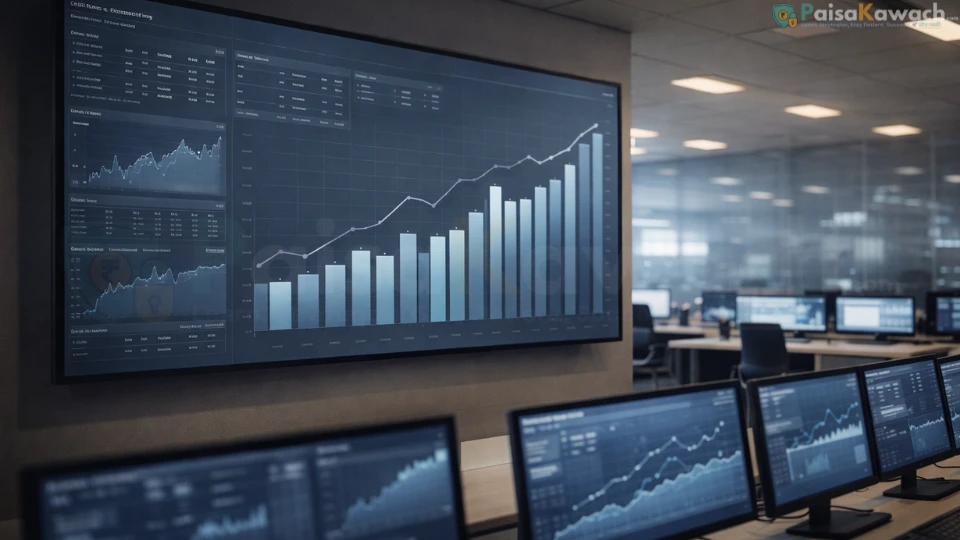
Revenue Up 45%, Valuation Down $500 Billion, Nine Losing Sessions, and a Rate Swing of 30 Points in 48 Hours: The Week AI’s Report Card Arrived
The Week Markets Started Grading AI on Profitability, Not Promise
Anthropic's valuation got cut by $500 billion even as revenue surged. Chip stocks logged nine straight losses. And rate hike odds moved 30 points in 48 hours. Three signals from one week that changed how AI gets priced.
Every major investment cycle eventually produces a week where the market stops asking "how fast is it growing?" and starts asking "how much does it actually earn?" This week appears to be that week for artificial intelligence. Three separate, connected stories arrived in the same seven-day window, each one applying a different version of the same new test to the AI investment universe — and none of them produced a comfortable answer. A company with genuinely extraordinary revenue growth got a $500 billion valuation cut. An index tracking the physical hardware behind the AI buildout logged losses for nine straight sessions. And the Federal Reserve's own rate path became so uncertain that markets repriced it by 30 percentage points in 48 hours — twice. Reading all three together is a more honest account of where the AI trade actually stands heading into November than any single headline in the week could offer on its own.
⚡ 30-Second Version
Anthropic: $2T → $1.5T
Revenue jumped 45% sequentially to nearly $17 billion. IPO valuation still cut by $500 billion. Revenue growth no longer automatically equals higher valuation.
Chip ETF: 9 Straight Losses
iShares Semiconductor ETF heading for its longest losing streak in years. CoreWeave down 15.5% midweek. AI debt worries driving a genuine sector-wide reassessment.
Rate Hike Odds: 45% → 17% in 48 Hours
Hot CPI pushed hike odds to 45% Wednesday. By Friday they were back at 17%. The most unstable rate-expectations environment of 2026.
Story One: How a Company Growing 45% Got a $500 Billion Valuation Cut
Anthropic's quarterly revenue jumped 45% sequentially to nearly $17 billion — a growth rate that, in almost any other market context or any other era of technology investing, would be treated as an unambiguously bullish signal worthy of pushing a valuation higher rather than lower. Instead, Anthropic's expected IPO valuation was marked down from $2 trillion to $1.5 trillion this week — a $500 billion reduction in how public markets are expected to price the company when its listing proceeds in November. The gap between those two data points — extraordinary revenue growth paired with a substantial valuation cut — is the most precise, single-company illustration of the shift happening across the entire AI investment landscape right now.
The explanation isn't that investors have lost confidence in Anthropic's ability to grow. A company generating nearly $17 billion in quarterly revenue, growing at 45% sequentially, has already demonstrated something many AI companies are still trying to prove: that their technology can produce revenue at scale. The problem sits elsewhere. Markets pricing an IPO aren't just valuing today's revenue — they're discounting the entire projected future cash flow of the business against a cost of capital that reflects current interest rates, current debt levels, and current uncertainty about whether today's AI revenue eventually converts into durable, profitable business rather than revenue produced at a loss while infrastructure spending continues to outpace any reasonable payback timeline.
Why Revenue Growth Alone Has Stopped Being Enough
Earlier in the AI cycle, markets were willing to apply generous, growth-based multiples to AI companies even with thin or negative margins, on the bet that scale would eventually produce profitability. That tolerance has been steadily eroding throughout this year, and Anthropic's valuation markdown crystallizes where it currently stands. A company growing at 45% that is simultaneously absorbing enormous infrastructure costs, operating in a market with intensifying competition from OpenAI, Google, and others, and preparing to go public at a moment when AI debt concerns are actively hitting the sector — that company gets priced differently than one growing at 45% with clearer margins and a more resolved competitive landscape. The $500 billion markdown isn't a verdict on Anthropic's technology. It's a verdict on what the market currently thinks that technology is worth net of everything it costs to operate and scale it.
Quarterly revenue reached nearly $17 billion — a genuine, dramatic growth number that confirms AI demand at the application layer is real and scaling fast.
Expected IPO valuation cut by $500 billion despite the revenue growth — markets discounting on profitability, debt sustainability, and competitive risk.
The listing proceeds despite the markdown — but pricing and investor demand will now be the real test of where the market lands on this specific tension.
- A $500 billion valuation cut alongside 45% revenue growth is the clearest single illustration yet that markets are now discounting AI companies on profitability trajectory, not just top-line growth rate
- The November IPO proceeding despite the markdown means public investors will shortly get to express their own verdict on this valuation question directly, with real money rather than pre-listing estimates
- Every other AI company currently privately valued against the prior $2 trillion Anthropic benchmark will be reassessing those comparisons this week
Story Two: Nine Consecutive Losses in the Chip Index — When a Streak Becomes a Statement
The iShares Semiconductor ETF — one of the most closely watched proxies for global AI infrastructure investment — is on track for its ninth consecutive losing session this week, a losing streak length not seen in years for an index that tracks the companies building the physical substrate of the AI economy. CoreWeave, one of the most prominent AI data center operators, fell 15.5% in a single midweek session and was still down in premarket trading Friday, despite Nvidia CEO Jensen Huang going out of his way to offer positive public commentary about CoreWeave's financial position and suggest it doesn't require a backstop.
When a company's stock falls double-digit percentages even after the CEO of its primary chip supplier publicly defends its financial health, it tells you that market concern has moved beyond what reassuring commentary can address. The issue driving CoreWeave's decline, and the semiconductor ETF's nine-session streak, isn't a disagreement about whether AI demand is real — it's a question about whether the companies that borrowed enormous sums to build AI infrastructure can service that debt on a timeline that makes their equity valuable, rather than a timeline that primarily serves the debt holders.
Why an Indebted Data Center Is a Different Kind of Risk Than an Unprofitable Software Company
Technology investors have historically been tolerant of unprofitable software companies, because software businesses can scale without proportional cost increases — once the code exists, distributing it costs close to nothing. AI data center infrastructure companies are structurally different: they borrow to build physical capacity at enormous scale, and that physical capacity has ongoing operating costs, power costs, and debt service costs that don't compress as revenue scales the way software margins do. A data center company that borrowed heavily to build capacity is committed to serving that debt regardless of how AI demand evolves — and if demand growth slows, pauses, or shifts to different suppliers, the equity value can evaporate rapidly while the debt remains. That's the risk nine consecutive sessions of semiconductor ETF losses are pricing right now.
- Nine consecutive losing sessions in the semiconductor ETF reflects a sustained, sector-wide reassessment rather than any individual company's specific news — a pattern that tends to outlast single-session volatility
- CoreWeave falling 15.5% despite public support from Nvidia's CEO shows market concern has moved to a level where reassuring commentary alone can't reverse the sentiment
- The debt-service risk in AI infrastructure companies is structurally different from typical unprofitable tech — physical capacity with fixed operating costs creates downside risk that doesn't compress as revenue grows
🔍 Go Deeper
The Rate Swing How did hike odds move 30 points in 48 hours — and why does it matter?
Wednesday's hot Consumer Price Index reading pushed Fed rate hike odds for October from their recent low of around 17% all the way up to approximately 45% — a sharp, immediate repricing of monetary policy expectations triggered by a single inflation data release. By Friday, those same odds had collapsed back down to 17%. A 28-percentage-point swing in Fed rate expectations, in both directions, within 48 hours, is an extraordinarily unstable rate environment even by the volatile standards of 2026.
What makes this particular oscillation important isn't the direction of either individual move — it's what the pattern itself reveals about market confidence in the current inflation picture. When a single data release can move rate expectations by nearly 30 points in one direction, and then a subsequent combination of data and Fed communication can reverse that entire move within two days, it signals that markets don't have a settled, confident view of where inflation is actually heading — they're reacting to individual data points with high sensitivity because there's no underlying consensus view that any single print can either confirm or significantly challenge.
For India specifically, this instability in US rate expectations is itself a source of volatility for rupee and FII positioning, independent of which direction rates actually move. When global capital doesn't know what to expect from the Fed week to week, it defaults to caution in emerging markets — which shows up as FII selling pressure on Indian equities and bonds regardless of India's own domestic economic picture.
India Angle How do all three threads reach Indian markets on Monday?
Each of this week's three stories reaches Indian markets through a different channel, and unusually for a week this dominated by negative AI sentiment, the net signal for India is probably modestly positive rather than clearly negative.
Anthropic's valuation markdown matters for Nifty IT sentiment — Indian IT stocks have been partially trading on global AI enthusiasm, and a high-profile AI valuation cut can dampen that enthusiasm. But Anthropic's actual revenue growth of 45% simultaneously confirms that AI spending at the enterprise and infrastructure level remains strong, which is what Indian IT services companies actually sell into. The valuation question and the demand question are separable, and demand remaining strong is the more directly relevant signal for Indian IT earnings.
The semiconductor ETF's nine-session losing streak matters similarly — Korean and Taiwanese chip stocks have been the primary carriers of this damage, and while Indian markets track global tech sentiment broadly, India doesn't have significant domestic semiconductor manufacturing exposure that would translate chip-sector losses directly into Nifty losses.
The rate hike odds collapsing back to 17% is the most directly positive signal for India of the three — reduced Fed tightening expectations ease pressure on the rupee, support FII inflows, and give the RBI slightly more flexibility on its own rate path. Monday's open will likely reflect this rate-relief positive more than the AI-valuation negative, though the semiconductor streak's tenth session, if it occurs, will be watched carefully.
📊 The Week's Key Numbers
What to Watch When Indian Markets Open Monday
Three specific signals will tell you how markets are actually processing this week's developments when Dalal Street opens. First, whether Nifty IT opens higher or lower — a sector that's been caught between genuine AI demand strength and AI valuation weakness all week, and whose Monday open will reveal which signal the market is currently weighting more heavily. Second, whether the semiconductor ETF's losing streak extends to ten sessions in the first hour of US premarket trading, since a tenth consecutive loss would make this one of the most sustained chip-sector corrections in recent memory and would likely add to any pressure on technology-linked Indian stocks. And third, whether the rupee opens stronger or weaker against the dollar — the 17% rate hike odds should support rupee strength, but any fresh geopolitical surprise over the weekend could override that signal before Indian markets even see Friday's positive rate-expectations news.
The honest summary of this week is that markets applied a new, harder test to AI investment this week — one that grades on profitability and debt sustainability rather than growth rate alone — and the early results are uncomfortable. That test isn't going to become easier before Anthropic's November IPO arrives as the sector's next, most visible report card. How that listing prices and trades will likely settle, at least temporarily, the argument this week made visible but didn't resolve.
Keep Reading: More Insights You Might Like

Comments
No comments yet. Be the first to comment!