Chips Rebound, Banks Wobble, and a Sponsor Says the Quiet Part Out Loud: Three Signals From a Contradictory Monday

Monday delivered one of those news cycles where almost nothing lines up cleanly. Asian chip stocks, battered for four straight sessions, finally bounced. India's most trusted private bank got punished the moment it reported earnings. Britain's brand-new prime minister inherited a problem that has no clean solution. And a major global sponsor said, out loud, what a lot of people were apparently already thinking about the World Cup final. None of these four things are related on the surface. But look closely and they share a common thread: in every one of them, confidence that seemed settled just days earlier turned out to be far more conditional than anyone had priced in.
The Chip Rebound Nobody Should Mistake for a Resolution
Asian equities rose for the first time in four sessions overnight, and the leadership came from exactly the sector that had been getting punished — chipmakers. The MSCI Asia Pacific Index climbed 1.7%, with South Korea and Taiwan both gaining more than 2.5%, driven by Samsung Electronics and Taiwan Semiconductor Manufacturing Company. Japan's Nikkei added 2.2% as trading resumed after a holiday. On the surface, this looks like relief — the "AI valuation doubt" story that dominated last week finally taking a breath.
But a one-day bounce after a four-day slide is not the same thing as a resolved question, and the market itself seems to know this. Investors are explicitly looking to this week's megacap earnings for clues on whether the AI-driven rally can actually be sustained, which is a very different posture than genuine confidence. A rebound driven by "let's wait and see what the earnings say" is a market still asking the same uncomfortable question from last week — it's just asking it a little more patiently today. The fact that oil fell in the same session, easing one pressure point even as the chip question remains open, is a reminder that these stories rarely move in isolation; a calm day in one corner of the market doesn't mean every underlying tension has actually been settled.
- A single-day rebound following four consecutive down sessions reflects a pause in selling pressure, not a resolved verdict on AI valuations
- Markets explicitly waiting on megacap earnings this week to judge the AI rally's sustainability shows the underlying doubt from last week hasn't actually been answered, only deferred
- A simultaneous pullback in oil prices eased one source of market pressure even as the semiconductor valuation question remains genuinely unresolved
HDFC Bank's Earnings Day Becomes a Lesson in How Fast Trust Can Reprice
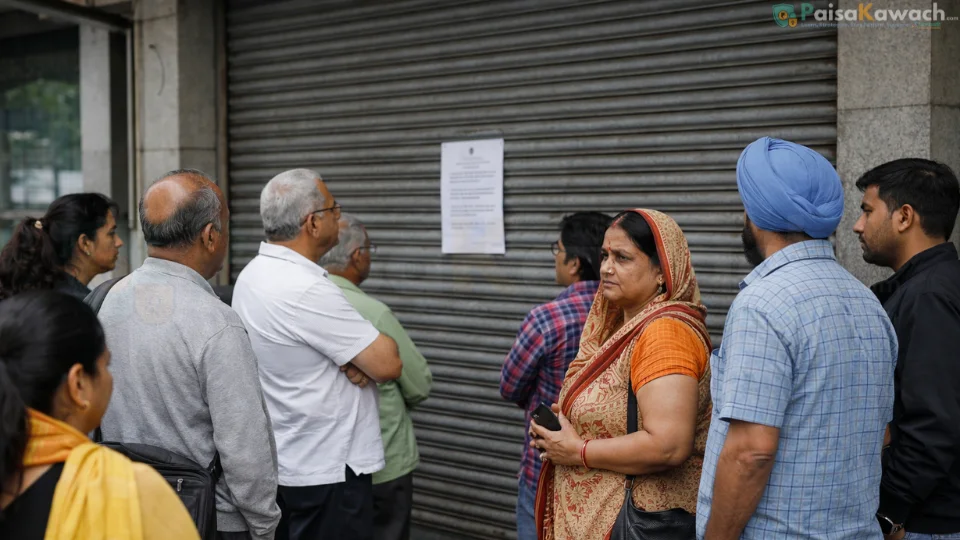
While Asian chipmakers were recovering, India's own market told a strikingly different story. HDFC Bank — one of the most closely watched, widely held stocks in the Indian banking sector — fell more than 5% in a single session immediately following its earnings release, dragging Bank Nifty down nearly 1% and pulling the broader Sensex 442.93 points lower to close at 77,708.52. This wasn't a broad market selloff bleeding into one stock; it was one stock's results reshaping the mood of an entire session.
What makes this genuinely instructive is the contrast with just one trading day earlier. The Sensex had opened Monday precisely at its prior resistance level of 78,151 — a level technical analysts had flagged as the next hurdle in an improving bullish trend — and then sold off through the entire session instead of breaking above it. That's a textbook pattern of sellers stepping in exactly where buyers were hoping for confirmation, and it happened on the very day one of the market's most systemically important stocks disappointed. India VIX, the market's fear gauge, stayed relatively contained at 12.9 even through this — suggesting the reaction, while sharp, was concentrated and specific rather than a signal of broad panic.
Why a Single Bank's Results Can Move an Entire Index
Large private banks carry disproportionate weight in benchmark indices precisely because they represent such a significant share of the financial sector's earnings and market capitalization. When a stock of that size disappoints on the exact day the broader market was testing a key resistance level, the two effects compound rather than simply adding — the disappointment itself hurts sentiment, and it does so at precisely the moment the index needed unambiguous strength to break through a technical ceiling. Options market positioning reflected this split mood clearly: Nifty's put-call ratio suggested a moderately bullish tilt in broader positioning, while Bank Nifty's own ratio showed clear caution specifically around the banking sector — the derivatives market, in other words, already understood this was a banking-specific wound rather than a broad market one.
- A single large-cap bank's earnings disappointment pulled down an entire benchmark index, showing how concentrated index composition can amplify one company's results into market-wide sentiment
- The Sensex opening exactly at resistance and then selling off through the session is a classic signal of seller conviction at a technically important level
- Divergent options positioning between the broader Nifty and the banking-focused Bank Nifty shows the market correctly isolated this as a sector-specific event rather than treating it as systemic
Britain's New Prime Minister Inherits a Problem With No Comfortable Answer
Away from equity markets entirely, Britain's newly installed Prime Minister Burnham is already facing one of the more genuinely difficult governance problems in the developed world: how to manage rising energy prices at the same time the country experiences intensifying heat linked to climate change. This is not a policy debate that can be resolved through clever messaging. Lowering energy costs for households in the near term often means leaning on the same energy sources that worsen the climate pressures driving the heat in the first place, while committing more aggressively to greener alternatives typically carries near-term cost burdens that voters feel immediately, long before any climate benefit becomes tangible.
This tension is not unique to the UK, but it is a useful live case study in a challenge every developed economy is quietly wrestling with simultaneously — including the broader European conversation around delaying methane regulation penalties by three years, a sign that even climate-committed institutions are recalibrating timelines under real-world cost pressure. A new government inheriting this exact dilemma on day one, rather than easing into it, is a genuine test of how much political capital can be spent balancing two goals that are, in the near term, often genuinely at odds with each other.
- Energy affordability and climate policy are colliding in real time for the UK's new leadership, with no solution that satisfies both goals simultaneously in the near term
- A parallel move by EU regulators to delay methane penalty enforcement by three years shows this tension playing out at an institutional level well beyond the UK alone
- How this balance gets managed in Britain will likely serve as a reference case for other economies facing the same energy-versus-climate pressure in the months ahead
The World Cup Backlash: When a Sponsor Says What Fans Were Already Whispering
The fourth story is the lightest in tone but genuinely revealing in its own way. A day after Spain's extra-time victory over Argentina capped the largest World Cup in history, Nike's global soccer executive publicly remarked that the final "wasn't what we dreamed" — an unusually candid comment from a major sponsor whose commercial interest generally favors celebrating a tournament's climax rather than critiquing it.
Comments like this rarely happen by accident. Major sponsors typically choose their public language carefully, especially immediately following a marquee event they've invested heavily in promoting. A senior executive breaking from that pattern to voice disappointment suggests the sentiment was already widespread enough among fans and commentators that staying silent would have looked more out of touch than saying something honest. It's a small moment, but it says something real about how quickly public sentiment around even a historic, record-setting event can diverge from the official celebratory narrative once real fans start comparing what they hoped for against what they actually got.
- A major sponsor publicly voicing disappointment right after a historic final signals that critical sentiment was already too widespread to ignore through silence
- Even genuinely record-setting sporting events — largest World Cup ever, historic individual milestones — aren't immune to a gap between hype and lived experience once the moment itself unfolds
- Sponsor commentary like this is likely to keep the tournament's conclusion in public conversation and brand-marketing analysis well beyond the trophy presentation itself
Four Rooms, One Repeated Lesson
Semiconductor markets, Indian banking stocks, British energy policy, and a football sponsor's candid remark have nothing structurally in common. But each one, on this particular Monday, delivered the same underlying lesson: confidence that looked settled a few days or even a few hours earlier turned out to be considerably more conditional than it appeared. Chip stocks bounced, but only provisionally, pending real earnings proof. A trusted bank's stock got repriced sharply the moment its numbers landed. A new government inherited a problem no amount of good intentions alone can resolve. And even a historic sporting triumph wasn't immune to the gap between expectation and reality once the actual event played out. Reading all four together is a more honest snapshot of where global confidence — financial, political, and cultural — genuinely stands right now than any single story would offer alone.
Keep Reading: More Insights You Might Like
 Kuwait Gets Hit, Kyiv Under Fire, and the World Still Watched a Football Final: What This Week Reveals About a Fractured Global Economy
Next →
Kuwait Gets Hit, Kyiv Under Fire, and the World Still Watched a Football Final: What This Week Reveals About a Fractured Global Economy
Next →
 Ninety-Dollar Oil, Continent-Hopping Disasters, and a Cricket Legend Defending Messi: The Week Three Different Crises Converged
Comments
No comments yet. Be the first to comment!